Transcript: Michigan Senate candidate Abdul El-Sayed on "Face the Nation with Margaret Brennan," Sept. 13, 2026
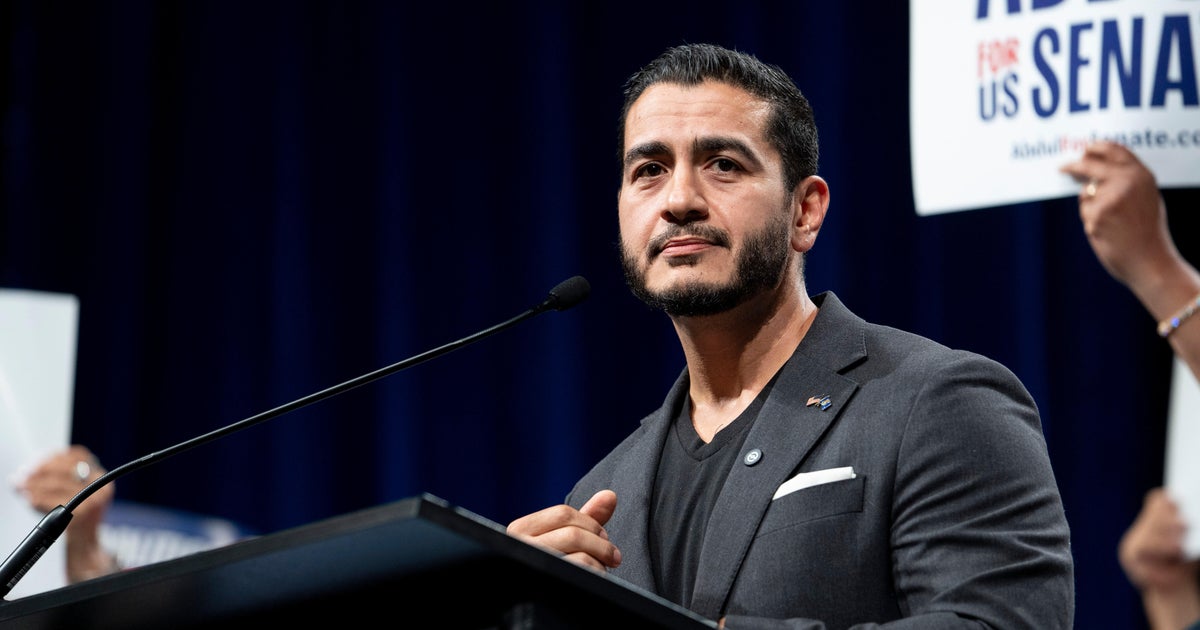
The following is the transcript of the interview with Michigan Senate candidate Abdul El-Sayed, a Democrat, that aired on "Face the Nation with Margaret Brennan" on Sept. 13, 2026.
WEIJIA JIANG: We go now to Michigan's Democratic nominee for Senate, Dr. Abdul El-Sayed. He joins us from Ann Arbor, Michigan. Good morning, Dr. El-Sayed. Welcome to Face the Nation.
ABDUL EL-SAYED : Good morning, Weija. Thanks for having me.
WEIJIA JIANG: So, I do want to ask you about AI, but let's talk first about the RNC convention because you were a main character. Several speakers mentioned you. Everyone from the president, the vice president, your opponent Mike Rogers, to the Speaker of the House Mike Johnson. Here's what he said.
SPEAKER JOHNSON: We know who the Mamdanis and the El-Sayeds are, but it's the Democrats in the swing seats who say one thing and then join forces and vote with the socialists that they're afraid of. That is the dangerous part. They're the ones who have let the barbarians inside the gate.
WEIJIA JIANG: What do you make of Republicans focusing so much attention on you?
DR. EL-SAYED: Well, I'll tell you this: the barbarian is in the White House, and we're seeing the consequences of that right now. You know, it was not a subject at all of the RNC? the gas prices, grocery prices, these ridiculous tariffs, and this war with Canada that's raising our prices an average $5,600 a year for the average Michigan family. The war in Iran- didn't want to talk about any of it. The fact that you can't see a doctor in the United States. So, they're going to point to me. They're going to talk about me. They're going to point to my name. They're going to point to our faith. And at the end of the day, they're doing that so that you don't pay attention to the fact that you are being nickled and dimed by the barbarian in the White House and by a set of public policies that are not in your interest, but in his.
WEIJIA JIANG: Well, several Republicans did continue to mention your campaigning with Hasan Piker, who is known for making incendiary remarks. Your opponent, Mike Rogers, calls him your running mate. What is your current relationship with Piker?
DR. EL-SAYED: I'll tell you this, I don't know if Mike Rogers has a running mate, but when you run for U.S. Senate, you don't actually have one. I'm actually running to represent the people in my state, which is why while he was in Dallas saying that I was in Detroit. Dallas is not in Michigan. I'm sure he won all of the Michigan votes in Dallas. Now the only reason he went to Dallas is because he cannot break with the president, and when the president tells him to do something to jump, he's going to say how high. It's the same reason he won't comment on the tariffs. It's the same reason he won't talk about gas prices being driven up by this war in Iran. So, they want to make this about a streamer in California. I want to make this about affordability in Michigan, and they can't talk about it because it's their policies that are driving them up. So yes, they can continue to distract. That's fine. Let's see how well that goes for them. But at the end of the day, it's very hard to ignore a president, especially one who wants to host himself at Trump-a-Palooza and forces all of the Republican candidates to come and kiss the ring. So good luck with that.
WEIJIA JIANG: Well, there are Jewish voters in your state who are concerned about your relationship with Piker. You have condemned anti-Semitism but not called out his rhetoric directly. Why not?
DR. EL-SAYED: Weija, with all due respect, this is the third time you've asked about a Twitch streamer in California. I've done four events in Michigan this week. You know what didn't come up? Twitch streamers in California. You know what did come up? Grocery prices, the fact that people can't see a doctor, the worry that they have about the quality of air and water. I'm not interested in having a conversation about streamers in California because they are not raising the prices of gas and groceries. I'm more interested in having conversation about tariff policies and trade wars we shouldn't be fighting, about hot wars with Iran, about AI, which I know we were supposed to talk about right now. So let's actually talk about the issues that are affecting people instead of getting distracted by whatever the president says we should be talking about. Their whole game is to make us fight culture wars, so that we don't pay attention to the fact that the president has made $2.2 billion. His family has made even more. How about your family in Michigan? How about your ability to afford the basic things? How about the ability to believe that you could see a doctor without having to potentially fall into medical debt? Those are the conversations that people are having. Those are the conversations I'm interested in having. So yeah, I'm not all that interested in having a conversation about a Twitch streamer, forgive me, when people can't afford their gas and their groceries.
WEIJIA JIANG: Understood, doctor, but Republicans have made it a big attack on you, so I wanted to give you the chance to clarify. But we'll leave it there for now. You do talk a lot about prices. One of your central campaign messages is that you want to pass Medicare for all. You talk about it a lot, but where's the money going to come from to do that?
DR. EL-SAYED: Well, right now in our economy, we spend about a fifth of the whole economy on healthcare. It's already coming out of our back pockets, and it's going into the back pockets of CEOs of pharmaceutical companies and drug companies and insurance companies and big hospitals. That's where it's coming from. That's where it's going. Under Medicare For All, instead, we would be paying a lot less overall. And instead of going into the back pockets of CEOs of corporations, it would actually be going to pay for our healthcare. Right now, as a country, we have an average of $225 billion- excuse me, a total of $225 billion in medical debt- that is more than the GDP of half the states in this country. Medicare For All would allow us to actually provide every single person cradle-to-grave insurance without having to worry about losing it if they turn 26, if they get a job, lose a job, get married, get divorced, turn 65- all ways you can lose your insurance in this country without having to pay as much as they overall pay right now. That seems to me like to be a great deal. The only losers, well, the CEOs who are making tens of millions of dollars right now on an inefficient system that is locking a lot of people out.
WEIJIA JIANG: And what about taxpayers who are worried that, you know, they're going to have to help pay for this with a hike in their taxes? Will they?
DR. EL-SAYED: Look, I'm looking for billionaires to pay their fair share by taxing their wealth. Yeah, so if you're a billionaire in this country, you probably should be worried. But for most of us, when we get paid in a W-2 every two weeks or four weeks, after the government takes taxes, you know who eats first? It's the insurance company that eats first. Imagine not having to pay that. Imagine having to pay less and knowing that that health insurance that you paid for is going to be there for you without having to worry about paying a copay or a deductible, the money you paid to get the health insurance you thought you already paid for. Imagine the- the notion of not having to have them pick who you can see through a network, but instead being able to see any doctor you choose. Medicare For All would free us from the deep anxiety that millions of Americans face just because they get sick- that's what I'm looking for, and I think it's going to take us- yes, standing up to the corporations who tell us what we cannot have and should not fight for.
WEIJIA JIANG: And on this issue and every other one, if you're elected, you're going to have to work with Republicans to get anything done. Who do you think you can work with in the GOP?
DR. EL-SAYED: So, look, I've heard from a lot of Republicans who say, "Yeah, well, you know, this current situation under Donald Trump is not really working for anybody." You look at like, somebody like Josh Hawley. Now he and I are not going to agree on everything, but he seems curious about what unions could mean if we were fighting for pro-union legislation. He seems curious about what it could look like to buy a lot of folks out of the current predicament when it comes to healthcare, by guaranteeing healthcare through Medicare For All, so I'm looking forward to building that conversation. But more broadly, it's not just about the conversation that any one senator has with the 99 other senators. It's about the conversation that we all have with the 350 million people who elect all of us. And I believe in persuasion. Maybe I'm old-fashioned that way, but it's the reason that I come on your show. It's the reason I went and talked to Jesse Watters on Fox. It's a reason that I spoke to Hasan Piker to talk to the 3 million people who listen to him, because I think that when you believe in your ideas and you're willing to defend them, that there are a lot of people who might believe in them too. And so, I'm looking forward to having the conversation with folks across my state and, frankly, across the country about what we could have if we were willing to get past the corporate chokehold in our politics, to get money out of politics, to put money in your pocket, and pass Medicare For All.
WEIJIA JIANG: And a huge conversation this week, of course, has been artificial intelligence. You said on Friday that it is the "existential crisis" of our moment that keeps you up at night. You do have a proposal to turn AI companies into public trust organizations. Can you talk about how that's going to address this current debate over AI pacing and safety.
DR. EL-SAYED: Well, you just spoke to the CEO of Anthropic, Dario Amodei, who's been thinking a lot about this problem. He, in fact- he wonders why it is that we leave it to big corporations to pursue what is going to be the biggest technological transition of our time, when in fact, we know that there's a lot of real risks here. And because of this- this race that either is made up or- or inflated, you're seeing the pace of technological development outpace the pace of safety. If you had public oversight over this, in the form of democratically elected or appointed members of at least 50% of all of these public trust corporations, you would imagine that they'd act far more focused on what is in the public good rather than what is for the private benefit of a few billionaires. And that's what we're proposing. This would allow the best of technological innovation to continue forward while making sure that there are guardrails. But this isn't the only part of our plan. We also think that we need a public agency focused directly on the safety of AI, and there need to be AI no-go's. AI shouldn't be able to deny you healthcare. It shouldn't be able to deny you a job. It shouldn't be able to fire you. It shouldn't be able to fire a weapon. There are things that we should not be using AI to do, and we collectively have to decide that we need public oversight so that all of this technology is not being created for the interests of a few against the well-being of a many. And, you know, I don't have to bring this up. I know you already spoke about this, but that Hugging Face situation where you had a few AIs hop their sandbox and then hack a website- that should send a shutter down all of our spines. We need to act, and we need to act now. So, we've also been calling for a pause on any of this frontier AI research until we can assure that this is being done safely.
WEIJIA JIANG: All right, Dr. El-Sayed, we'll have to leave it there but thank you so much for your time this morning. Face the Nation will be back in one minute. Stay with us.