Trump and Xi’s Summit Is a Tale of Two Straits
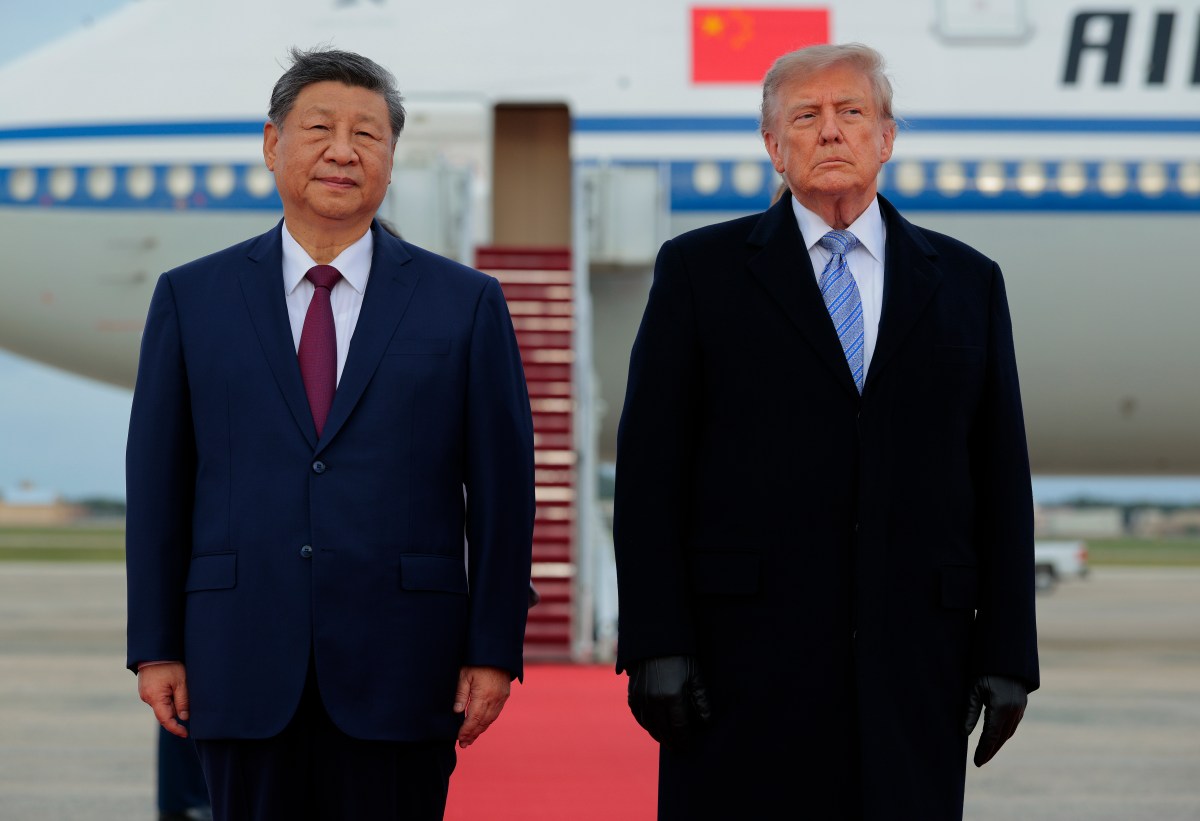
This Friday, Donald Trump and Xi Jinping are due to visit the National Archives, the building where the U.S. keeps the paperwork of its many promises.
Xi may use the moment to read an old one made to China back to his host, just as a little reminder.
The day before, Trump and Xi will hold a formal bilateral meeting beginning at midday Eastern Time. There is much on the agenda. Trade is perhaps the biggest item, the urgency of making a deal eased by a newly announced two-month extension to the current truce.
But there are two other pressing matters to address that are, on paper at least, separate. That may change because of the needs and desires of both the U.S. and China at this present geopolitical juncture. Right now, each side has something to offer the other.
This is a tale of two straits, thousands of miles apart, but perhaps now intertwined: Hormuz and Taiwan.
Xi is expected to press Trump to halt American arms sales to Taiwan under a 1982 joint communiqué in which Washington said it intended to reduce such sales gradually, according to Reuters reporting, citing anonymous sources that have been briefed.
In return, China is offering Trump something he is in acute need of right now: pressure on Iran.
Of course, this is a proposal, not an agreement, and there is no sign Trump has accepted it yet. But it directly ties the Taiwan Strait to the Strait of Hormuz, where nearly seven months of war have left commercial shipping traffic roughly 90 percent below prewar levels.
Asian allies fear Trump might soften support for Taiwan to lock in economic and strategic wins, gifting China a win in the Asia-Pacific. But Gulf states, also partners of the U.S., are keen to restore shipping through Hormuz.
The question is not whether a grand bargain gets struck this week, but what each side would exchange.
Beijing’s proposal goes beyond the roughly $14 billion arms package for Taiwan, which has been on hold for months, and that Trump himself in May had candidly called "a very good negotiating chip."
But China has reportedly also asked Washington to halt deliveries of weapons Taiwan has already ordered, and will press on Washington its own reading of the 1982 text.
The wrinkle for China is that then President Ronald Reagan’s memorandum on the communiqué said the quantity and quality of arms for Taiwan must be "conditioned entirely on the threat posed by the PRC."
So a trade along China’s terms would condition them on Beijing’s conduct in a different strait altogether, and would sit awkwardly with the Six Assurances, under which Washington has not agreed to consult the Chinese government on such sales.
Moreover, the threat posed by China to Taiwan has plainly increased in recent years, shown by its regular incursions into Taipei’s territorial waters and airspace, and military drills simulating an invasion of the island.
But Trump has struggled for months to bring to a conclusion a war against Iran he had initially claimed would be over in weeks.
Military and economic coercion have not been sufficient to force the Iranian regime to agree to U.S. terms on the nuclear issue or free commercial access to the Strait of Hormuz. Tehran has not won the war, but it has survived enough to maintain its threat to the strait.
This is where Beijing’s leverage is particularly strong, and could therefore be deployed to Trump’s ends, ideally for him before what is shaping up to be a punishing set of midterm elections for his Republicans, largely due to the inflationary impact of his war.
Chinese buyers took more than 80 percent of Iran’s seaborne oil exports last year. It provides the regime in Tehran with an essential economic lifeline.
Beijing draws roughly half its oil imports from the Middle East and so also wants the strait open, because it too is facing energy blowback from the Iran war. But whether it wants that to happen on Washington’s terms rather than Tehran’s is another matter.
And this exposes the structural flaw in any linkage of the two issues. An offer costs nothing, but an agreement costs credibility. Implementation is where the bill for that finally arrives, perhaps with hidden charges.
Moreover, the two halves of any such bargain would not be equally visible to all. An arms sale is either notified to Congress or it isn’t, and Taiwan would surely make loud noises about the cancellation of any shipments.
Chinese pressure on Iran, however, would be private, deniable, and ultimately dependent on decisions in Tehran.
There is a material connection between the straits, too. Asked Wednesday about the stalled sales, Secretary of State Marco Rubio said every sale is weighed against industrial capacity and what U.S. commanders say they need worldwide: "when we sell something, that means we don’t have it anymore."
He made clear this applies to all buyers, not Taiwan specifically, and that U.S. forces have ample munitions for their Iran objectives.
Nothing he said shows weapons meant for Taiwan have gone to the Middle East. But by Rubio’s logic, the more a war around one strait consumes, the less there is to spare for the other. And he was responding to a question about Taiwan when he said that.
Of course, Rubio was describing a routine process, and the administration approved an $11 billion Taiwan package in December, the largest ever. And an offer to lean on Iran proves neither Beijing’s willingness nor its ability to actually deliver what the U.S. wants.
We may not know for certain if Xi and Trump make such a deal, but there will be signs. So watch for if the $14 billion package goes to Congress soon after the summit and deliveries to Taiwan continue. That’ll tell us enough.
Chinese pressure on Iran might show up sooner, in reduced oil purchases, or a sudden shift in the Iranian negotiating position with the U.S., perhaps even a decision to lift its threat to the Strait of Hormuz as some kind of gesture of goodwill.
The National Archives can show Xi what Washington promised in 1982. But what either leader delivers in 2026 will be recorded somewhere less ceremonial, in congressional notifications and in the tanker counts at Hormuz.