Trump arrives in China ahead of trilateral summit with Xi, Putin - CNA
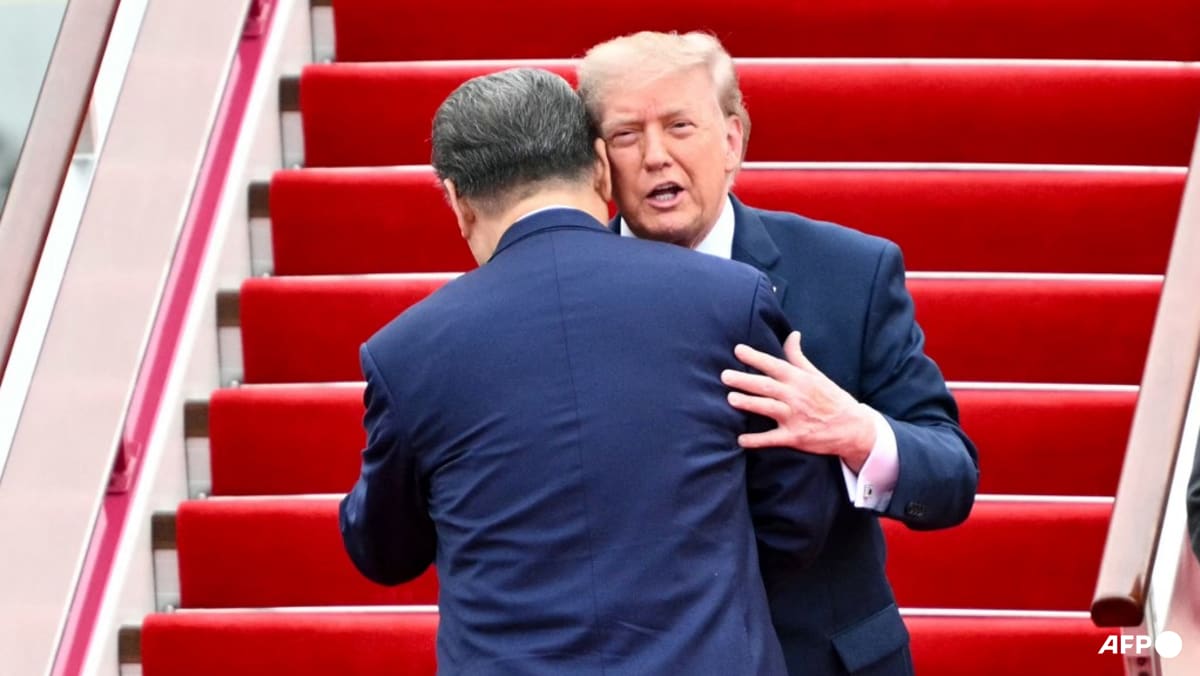
Xi Jinping’s welcome for Donald Trump on the tarmac marks the first time he has personally greeted a visiting foreign leader at the airport since becoming Chinese president in 2013.
Chinese President Xi Jinping hugs US President Donald Trump on the tarmac at the Shenzhen Baoan International Airport. (Photo: AFP/Mandel Ngan/Pool)
SHENZHEN: Chinese President Xi Jinping personally greeted Donald Trump at the airport as the US leader arrived Wednesday (Nov 18) ahead of a trilateral meeting that will also include Russia's Vladimir Putin on the sidelines of the Asia-Pacific Economic Cooperation (APEC) summit in Shenzhen.
After descending from Air Force One, Trump saluted as he stood alongside Xi on a red carpet lined with people waving colourful pom-poms and brandishing Chinese and American national flags, before the two leaders shook hands.
They had a brief hug and a short exchange before walking along the red carpet to their motorcades.
Xi’s welcome for Trump on the tarmac marks the first time he has personally greeted a visiting foreign leader at the airport since becoming Chinese president in 2013.
CNA Games Guess Word Crack the word, one row at a time Buzzword Create words using the given letters Mini Sudoku Tiny puzzle, mighty brain teaser Mini Crossword Small grid, big challenge Word Search Spot as many words as you can Show More Show Less It reciprocates the US president's gesture at Joint Base Andrews in September when they last met.
“China is a country that values etiquette and has a tradition of reciprocity,” Xi told Trump, according to Xinhua.
Trump thanked Xi for coming to the airport in person and for China’s “special arrangements”, according to the Chinese readout. He said he was pleased to be back in “great China”.
He also called Xi a great leader and said he had enjoyed every one of their meetings, the readout added. He expected the visit to advance ties between the two countries.
Xi’s chief of staff Cai Qi, top diplomat Wang Yi and Guangdong party chief Huang Kunming were also at the airport.
In November 2009, Xi, then China’s vice president, received Barack Obama at Beijing Capital International Airport.
Xinhua reported that Xi told Trump he wanted a "constructive, strategically stable relationship" between China and the United States.
"I look forward to an in-depth exchange of views with you on major issues concerning China-US relations, Asia-Pacific cooperation, and the global landscape, with the aim of advancing a constructive, strategically stable relationship between our two nations - one built upon the foundations of mutual respect, fairness, and reciprocity," Xi was reported as saying.
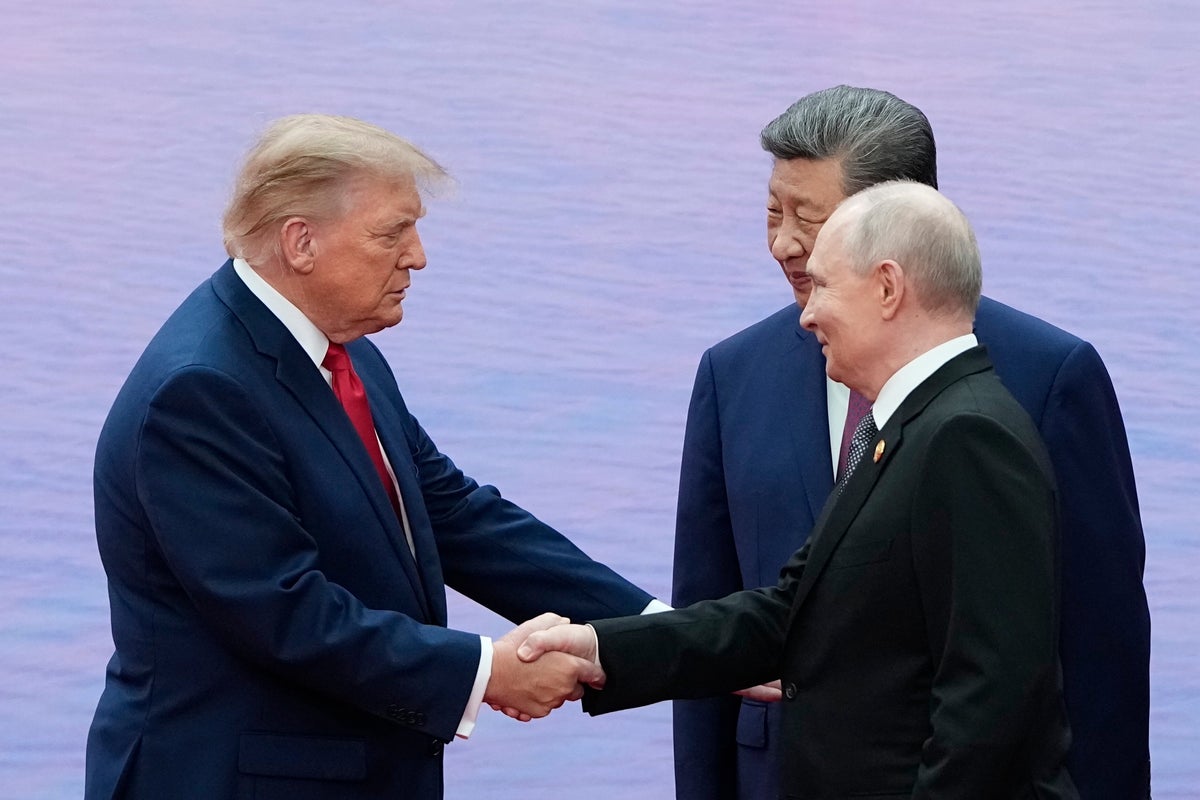
Xi, Trump, Putin and other leaders attending the APEC summit then gathered for a welcome dinner, and the three briefly exchanged greetings before a group photo.
The trio are due to meet on the sidelines on Thursday and potentially discuss Russia's war with Ukraine and the US war in Iran, as well as other flashpoints such as trade, AI and nuclear weapons.
Their meeting has drawn comparisons with the 1945 Yalta Conference between the US, Britain and the Soviet Union that formalised spheres of influence, set the stage for the post-World War Two order and became shorthand for great-power deals imposed on smaller countries.
It has also unnerved leaders of smaller economies, particularly in Europe and Asia, who fear the world's greatest military powers will disregard their interests.
In his opening address, Xi urged support for what he called “free and open trade”, trying to portray his country as a stable partner on the global stage, in contrast with the US, which has raised tariffs and adopted a more muscular foreign policy under Trump.
Xi’s remarks came after Washington announced further restrictions on China’s access to advanced AI chips from companies such as Nvidia, which could further complicate a fragile trade truce with Beijing. China has pledged to retaliate.
“We must firmly uphold the rules-based multilateral trading system with the World Trade Organization at its core, support free and open trade and investment,” Xi told an audience of business executives.
Western trade partners have criticised China for running annual trade surpluses exceeding US$1 trillion through policies that support its manufacturing sector.
Beijing says its growth model is appropriate for an economy still catching up with the world’s richest, but Washington, Brussels and others are concerned about China’s supply chain dominance providing the country with geopolitical leverage and say its policies threaten their industries and jobs.
Xi said China will continue to invest in its industrial complex and new technologies. The world’s second-largest economy will lower tariffs and further open up its markets, while standing up against protectionism and unilateralism, he added.
His “message is likely to resonate with many Global South countries and reinforces Beijing’s effort to contrast its technology strategy with that of Washington,” said George Chen, partner and chair of digital practice at The Asia Group.
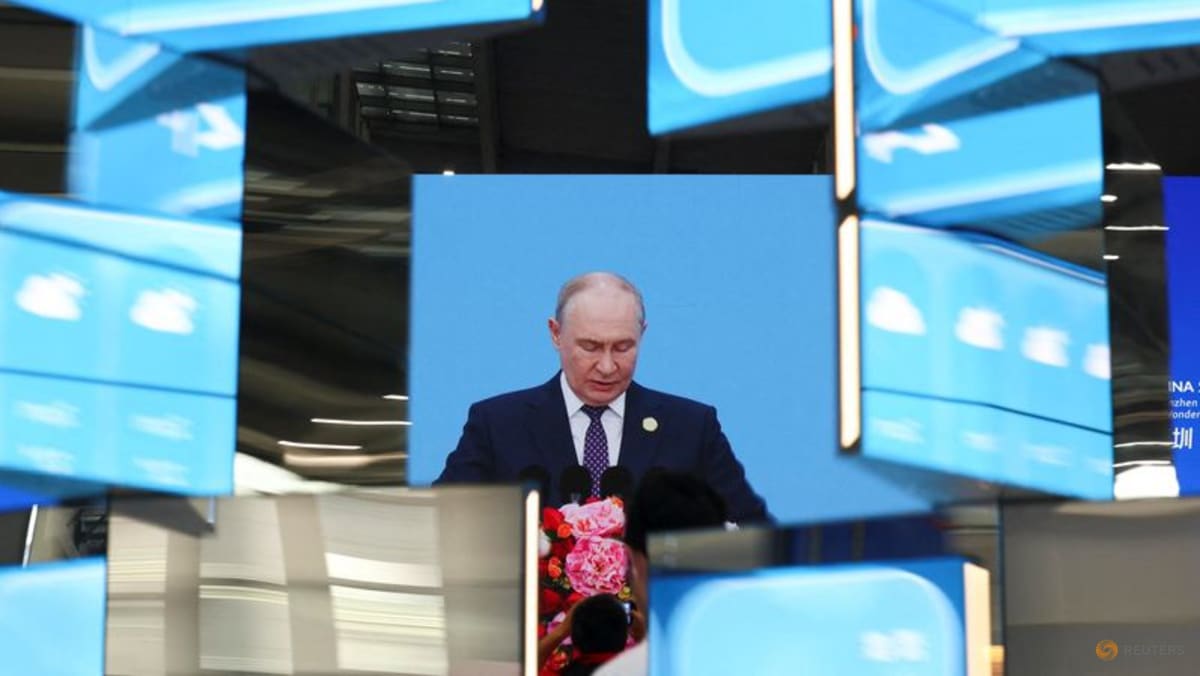
Leaders from Australia, Canada, South Korea and others were met by dancers and soldiers hoisting rifles.Japanese Prime Minister Sanae Takaichi was instead shown to a car after landing without any welcoming ceremony. Her visit to China comes amid a rift between Beijing and Tokyo that began a year ago after she said Japan could deploy its military if a Chinese move on Taiwan also threatened its territory.On Tuesday, Taiwan and Japan flagged incursions by Russian aircraft into their airspace.Putin, who was speaking after Ukraine crippled the vital Kerch road bridge linking Crimea to Russia in a major blow to his four-year-old war, followed Xi on stage with a speech that described Western powers as “former hegemons”.He said Europe was in a “humiliating decline” and that anti-Russian sanctions imposed after his invasion of Ukraine had backfired.“Experience has shown that the traditional tools of economic dominance and de facto coercion have largely run their course, having lost much of their intimidating power,” Putin said.“While sanctions, tariffs, and export restrictions may still exert a certain deterrent effect, they are incapable of halting growth - let alone crushing the economies of competitors.”The Kremlin this week dismissed comparisons with the Yalta Conference as “games of political scientists” but said the meeting will have a major impact on global affairs.
Beijing said the trilateral will promote world peace.Putin described the world as “turbulent” but said disagreements can be addressed by “sitting at the table”.“I therefore expect big potential benefit from the upcoming trilateral meeting,” he said.
An automated curation of our top stories to start your day.
Our chief editor shares analysis and picks of the week's biggest news every Saturday.