Trump backs India-Middle East-Europe corridor to bypass Iran's checkpoints
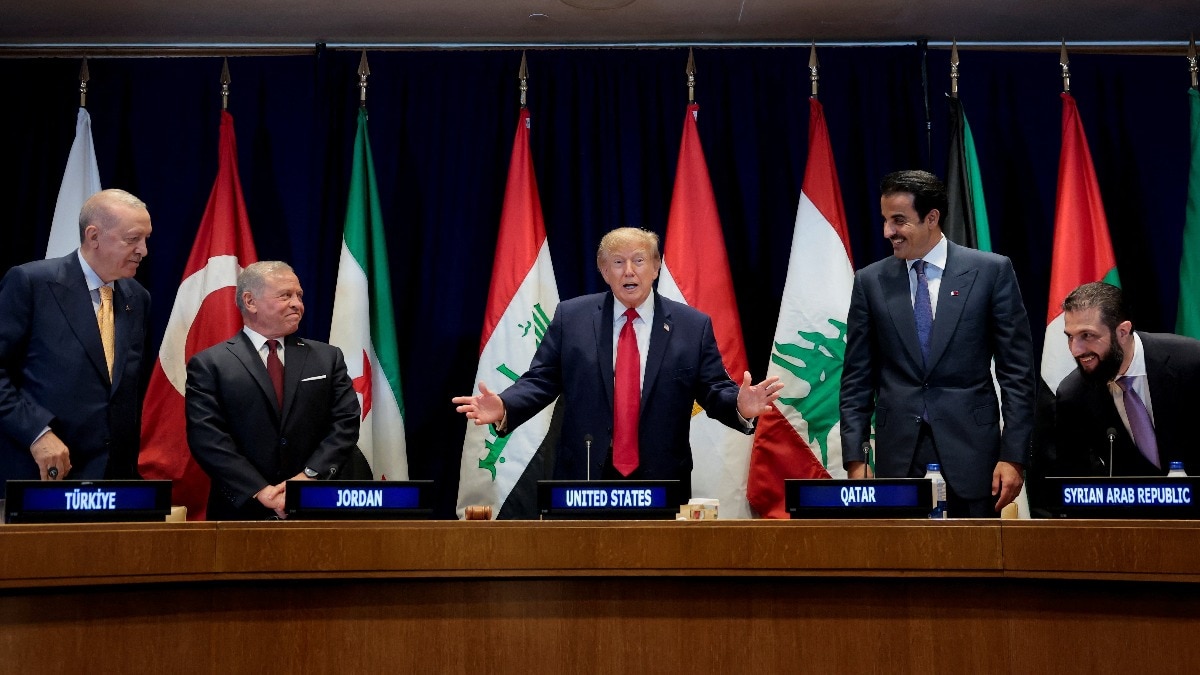
US President Donald Trump has thrown his weight behind the India-Middle East-Europe Economic Corridor (IMEC). He said the project could help reduce the region's dependence on vulnerable energy routes amid the conflict with Iran. The US President made the remarks during a multilateral meeting with Gulf Cooperation Council and Arab leaders on the sidelines of the United Nations General Assembly in New York on Tuesday.
His comments have brought fresh attention to a project that was announced with considerable ambition in 2023 but has since faced major geopolitical hurdles, including the Israel-Hamas war and the wider regional conflict involving Iran. Pointing to attacks on commercial shipping, Trump said there was a need to move critical Middle East energy infrastructure away from Iranian "checkpoints".
"Iran's terrorist attacks on commercial shipping in neighbouring countries have shown the need to shift Middle East energy infrastructure away from the Iranian checkpoints," Trump said.
"That is why my administration strongly supports the India-Middle East Economic Corridor and other places to get oil out, whether it is pipeline or anything else. Together we are on the verge of overcoming challenges that have plagued this region for a decade," he added.
The India-Middle East-Europe Economic Corridor is a planned trade and infrastructure network intended to connect India with the Gulf and, ultimately, European markets through a combination of sea and land routes. The project was formally unveiled at the G20 Summit in New Delhi in September 2023. India, the US, Saudi Arabia, the United Arab Emirates, France, Germany, Italy and the European Union signed a memorandum outlining the broad framework for the corridor.
The idea is built around two main sections.
The eastern corridor is intended to connect India with the Arabian Gulf. From there, a northern corridor would link the Gulf with Europe.
Under the proposed arrangement, goods could travel by sea from India to the UAE before moving through a network of rail and other transport infrastructure across the region. The route was envisaged to pass through Saudi Arabia and Jordan towards Israel and the Mediterranean, from where goods could again be shipped to European markets.
The plan is not limited to moving cargo.
The original framework also envisaged electricity and digital connectivity cables running along the route, as well as infrastructure to facilitate exports of clean hydrogen.WHY THE STRAIT OF HORMUZ MATTERS
Trump's renewed backing comes at a particularly sensitive time for regional trade and energy supplies. The Strait of Hormuz is one of the world's most important maritime chokepoints for energy shipments. Any prolonged disruption there can affect the movement of oil and other energy supplies between the Gulf and global markets, a risk the Iran war has proved all too clearly.
The conflict with Iran and disruption to shipping in the region have therefore revived questions about whether countries need alternative routes for moving energy and goods.
That is where IMEC has gained renewed relevance.
The corridor is not intended to replace the Strait of Hormuz entirely. However, its proposed combination of ports, railways, pipelines and other infrastructure could provide additional routes for trade and energy connectivity, potentially reducing reliance on individual maritime chokepoints.WHY IMEC MATTERS TO INDIA
For India, the corridor has both an economic and strategic dimension.
India already has major trade relationships with Gulf countries and Europe. A dedicated multimodal route could provide another way of moving Indian goods towards European markets. The project is also intended to make transportation more efficient by combining maritime and rail links rather than relying entirely on longer sea routes.
Such a route could reduce transit time and costs between India and Europe while strengthening commercial links between South Asia, the Gulf and Europe.
The proposed electricity and digital cables, along with clean hydrogen infrastructure, mean that IMEC is broader than a conventional freight corridor. It is intended to create a wider network covering transport, energy and digital connectivity.
The project also provides a way for New Delhi to deepen economic ties with major Gulf economies and European markets.
The corridor has frequently been discussed alongside China's Belt and Road Initiative because both involve large-scale infrastructure and connectivity across multiple countries. But IMEC is a separate project, backed by a different group of countries and built around a different geographic route.WHERE DOES IMEC STAND NOW?
IMEC's announcement in 2023 was followed by a major shift in the geopolitical environment within weeks.
The October 7, 2023, Hamas attack on Israel and the subsequent Gaza war altered regional calculations.
The wider diplomatic environment surrounding Saudi Arabia and Israel was also affected. Saudi-Israeli normalisation had been an important part of the broader regional context in which IMEC was being developed, and the Gaza war disrupted that process. The proposed corridor itself runs through a politically sensitive part of West Asia. Its planned route involves countries including the UAE, Saudi Arabia, Jordan and Israel.
That means the project's progress depends not only on money and engineering but also on political stability and cooperation among countries that have been affected by successive regional conflicts.
The later escalation involving Iran added another layer of uncertainty.
An August 2026 assessment by Asia House said IMEC had stalled and faced significant challenges, although India continued to support the project. The assessment also pointed to the impact of the Iran conflict and uncertainty surrounding Saudi Arabia's participation.
Despite the political and security challenges, IMEC has not formally disappeared.
The project's official website said in April 2025 that the initiative was progressing according to scheduled timelines, with developments underway in transportation and logistics infrastructure.
"As of April 2025, the IMEC project is progressing according to the scheduled timelines, with major developments underway in the construction of transportation and logistics infrastructure. Further updates will be shared on this website as the project progresses," the official IMEC website said.advertisementTRUMP'S IRAN WARNINGTrump's comments on IMEC came alongside another stark warning to Iran.
Echoing remarks he made earlier at the UN General Assembly, the US President said Iran had been isolated financially and warned that Tehran could eventually face an existential threat.
"We've isolated Iran financially, and hopefully they'll do the right thing fast...There will be a time when it's too late, and we won't have the chance of letting them survive as a nation. I would like to see that, and I can tell you that people around this table would like to see it," he said.
Trump also referred to the US military operation against Iran's nuclear facilities last year, saying the country's nuclear programme had been "obliterated" and was now under mountains of rubble. His backing for IMEC thus came against the backdrop of a much broader confrontation with Iran.- EndsPublished By: Satyam SinghPublished On: Sep 23, 2026 18:12 IST