Trump bats for a ‘unified’ Ireland: What led to its partition? - The Indian Express
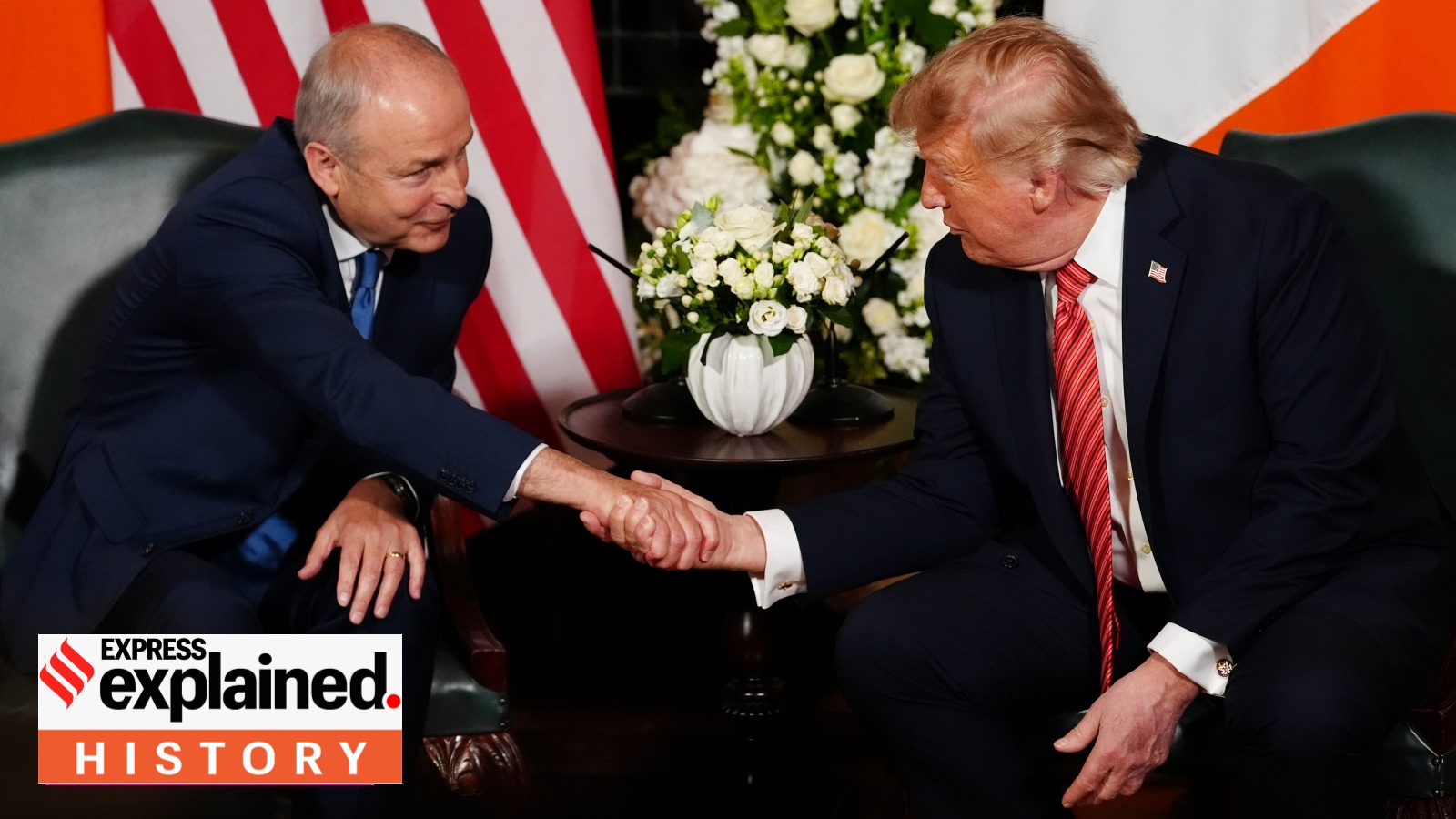
US President Donald Trump said on Saturday (September 12) that he would “love” to see a “unified” Ireland. “I don’t want to cause any problems, but I will tell you, I’d love to see it unified… The way I look at it, it’s going to happen eventually. It may as well happen now,” Trump, who was on a two-day visit to Ireland, told reporters in Dublin.
Trump was referring to the reunification of the Republic of Ireland and Northern Ireland — the latter is part of the United Kingdom.
His comments drew diverse responses from the UK government as well as parties across the political spectrum in both Ireland and Northern Ireland. It came two weeks after UK Prime Minister Andy Burnham said that a referendum on unification was “off the table” during a visit to Northern Ireland.
Here’s how Ireland came to be partitioned after centuries of British rule and whether Irish reunification is still a possibility.
From the 13th century, Ireland had been ruled by Great Britain. But over time, there had been some form of resistance to British rule, which was expressed both in peaceful parliamentary representations as well as violence on the streets. This was partly driven by the fact that most of the Irish population was Catholic, as opposed to the Protestants dominating Britain and parts of present-day Northern Ireland.
Irish nationalists, who mostly belonged to the majority Catholic population and wanted a separate Irish state. On several occasions, they advocated for “Home Rule” — the process of transferring the right to govern from British to Irish hands — but the idea finally gained momentum only in the late 19th century. By the turn of the 20th century, Irish “Home Rule” began to look like a real possibility.
Unionists, the minority, largely Protestant population that believed Ireland should remain part of the UK. Loyal to the British and located largely in the north-eastern province of Ulster, the Unionists actively resisted the idea of Home Rule, since they feared being a Protestant minority being ruled by a Catholic majority in an independent Ireland.
Also in Explained | Can Trump rename Lake Ontario as Lake America?
After three attempts in Parliament, Home Rule finally became law in 1914, granting the Irish the right to govern themselves. But it excluded the six mainly Protestant counties of the Ulster province (which eventually became Northern Ireland). Although tensions almost boiled over into civil war, hostilities were suspended owing to the outbreak of World War I (1914-18).
By the time WWI ended, Sinn Fein (which translates to “We Ourselves”) emerged as the dominant party among the Irish nationalists. In the 1918 UK general election, it became the largest political party in Ireland. In a bid to boost the independence movement, its MPs abstained from the British Parliament in London’s Westminster, choosing to establish a rival parliament in Dublin instead in January 1919.
The same month, the Irish Republican Army began a guerrilla war against the British, also known as the Anglo-Irish War or the Irish War of Independence (1919-21).
As even the Anglo-Irish War dragged on for over two years, the British government attempted to find a political solution. This led to the passage of the Government of Ireland Act, 1920, which stated that while Ireland would remain part of Britain, a “Home Rule Parliament” in Dublin would be given some control over their own affairs. It also partitioned the island into Northern Ireland and Southern Ireland — the latter eventually came to be known as the Irish Free State.
Jane Ohlmeyer, a leading historian of early modern Ireland and empire, earlier told The Indian Express: “The legislation that partitioned Ireland was the same legislation later used to partition India and Pakistan, and also informed partition elsewhere, including Israel and Palestine.”
Of Ireland’s 32 counties, six were allocated to Northern Ireland whereas Southern Ireland comprised the remaining 26. Both regions would have their local parliaments to deal with local issues such as education and health, while Britain would continue to look after major policies, such as foreign policy and the military.
To ensure minorities were adequately represented, proportional representation would be used in elections. A Council of Ireland, comprising representatives from North and South, would be set up to discuss issues of mutual interest and to work towards establishing a single parliament for the whole of Ireland.
Although the Unionists in the north accepted the Act, Sinn Fein (Irish nationalists) rejected the Act completely owing to their objection to the lack of provisions pertaining to complete independence, besides partition.
Meanwhile, the escalating military and economic costs of the Anglo-Irish War forced both the British government and most Irish nationalists to call a truce in July 1921. Negotiations finally culminated in the Anglo-Irish Treaty signed in December 1921, bringing the war to an end.
Under the treaty, Southern Ireland came to be known as the Irish Free State. Although it would be a dominion within the British Commonwealth, the treaty granted the south a greater degree of independence, with its own parliament in Dublin and an army. It also decreed that Northern Ireland had the right to opt out of the Irish Free State, which its representatives eventually did.
By 1937, the Irish Free State adopted a new constitution and renamed the country Éire, or Ireland. In 1949, it became a republic and left the Commonwealth.
In the years since, the island has witnessed a fair amount of violence within its borders, particularly in the form of “The Troubles” from the late 1960s until the 1990s, which saw militant groups belonging to both Unionist and nationalist factions carry out bombings and shootings in pursuit of their political ends. The Troubles finally ended with the signing of the Good Friday Agreement on April 10, 1998.
Newsletter Follow our daily newsletter so you never miss anything important. On Wednesday, we answer readers' questions.
Professor Stewart Weaver, who teaches history at the University of Rochester, said in a Q&A in 2021 that “the strong referendum in favor of the Good Friday Agreement” on both sides of the border suggested that “there was a political will, if not toward unification, at least toward reconciliation”.
He added that although the 2016 Brexit — when the UK voted to leave the European Union (EU) — had complicated the issue of cross-border trade between the north (part of the UK) and the south (still an EU member), changing demographics in Northern Ireland as well as growing liberalisation and secularisation in Ireland meant that reunification remains a possibility.