Trump cuts weekend trip at Camp David after Middle East warning and heads back to DC – with two top golfers at his side
Donald Trump flew home to D.C. late Saturday evening, cutting short his trip to Camp David as the State Department warned Americans abroad that the conflict between Saudi forces and Yemen’s Houthi rebels was rapidly escalating.
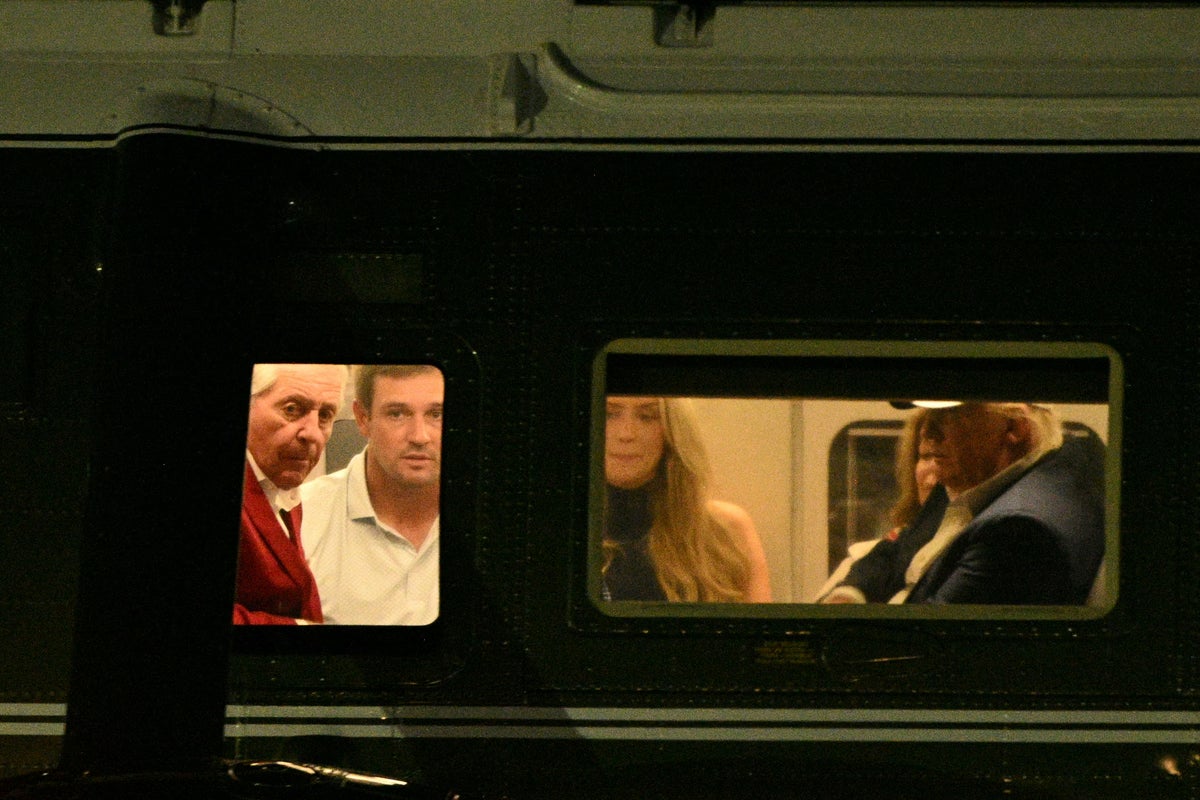
But the president was focused on other issues Sunday as he took an early morning ride to his golf club in Sterling, Virginia, after he was spotted with golfers Gary Player and Bryson DeChambeau – along with DeChambeau’s model girlfriend Mikayla Demaiter – on his helicopter ride back to the White House. Rain and clouds rolled through the D.C. area over the weekend, which typically cause changes to the president’s schedule when he’s flying back from Camp David.
The Independent reached out to the White House for a reason why Trump cut short his trip to the presidential retreat in Maryland, after White House officials declined to give an explanation to pool reporters tailing him. On Sunday morning, Trump left for his Sterling, Virginia club — a short drive from the White House — just before 9 a.m.
Meanwhile, the conflict in the Middle East appears to be deteriorating with no sign of a negotiated settlement to end hostilities on the cards for the near future. Territorial gains by Houthi militants in Yemen and further clashes with Saudi forces have caused fears to rise of even tighter restrictions or greater danger to civilian energy traffic passing through the Strait of Hormuz and the surrounding waterways.
The conflict poses a significant political risk for the president’s party, which is defending twin congressional majorities in the midterm elections. The midterms, on November 3, are set to be held under a cloud of gas prices which are now well north of $4 a gallon nationally and climbing even higher as energy supply shortages on the global market continue.
A State Department notice was issued Saturday evening, warning that the Yemeni conflict had the potential for further unforeseen escalation and that Americans traveling around the region were at risk of being targeted by Iranian-backed groups. The same day, Houthi forces struck Saudi Arabia’s capital, Riyadh, using ballistic missiles and drones. No injuries or deaths were reported by Saudi officials, but major flight disruptions occurred around the region.
“Due to tensions in the Middle East, the security environment remains complex with the potential for unforeseen escalation. Americans currently in the Middle East should exercise heightened vigilance and be aware of potential flight cancellations, airspace closures, and travel disruptions. Iranian-supported Houthis have engaged in hostilities against Saudi Arabia, including civilian airports,” read the State Department notice.
“This military conflict has the potential to escalate rapidly.”
It’s largely understood by D.C. political analysts that the president does not see his party’s success in the midterms as tied to his own political brand, however. Trump has up until recently been hesitant to disburse funds from his massive campaign war chest, which was largely sitting unused as the president cannot run again in 2028. He has also made only sporadic campaign appearances this cycle, compared to strategically-timed rallies he has hosted in key battleground states in past election years.
U.S. officials met with Houthi leaders in Oman one week ago. The meeting, which ended with U.S. officials affirming that America had no plans to get involved in the Yemeni conflict, also resulted in Houthi officials agreeing to hold to the terms of a 2025 ceasefire — sparing civilian merchant ships, with the exception of Saudi vessels, from attacks.
Tracking services indicate that hundreds of vessels are still waiting to pass through the Strait of Hormuz, which remains open only to small amounts of traffic per day. Tankers and other ships passing through the strait continue to face a serios risk of attack, with the latest Iranian attack occurring less than a week ago.