
Trump eases limits on dyed diesel in bid to cut fuel costs
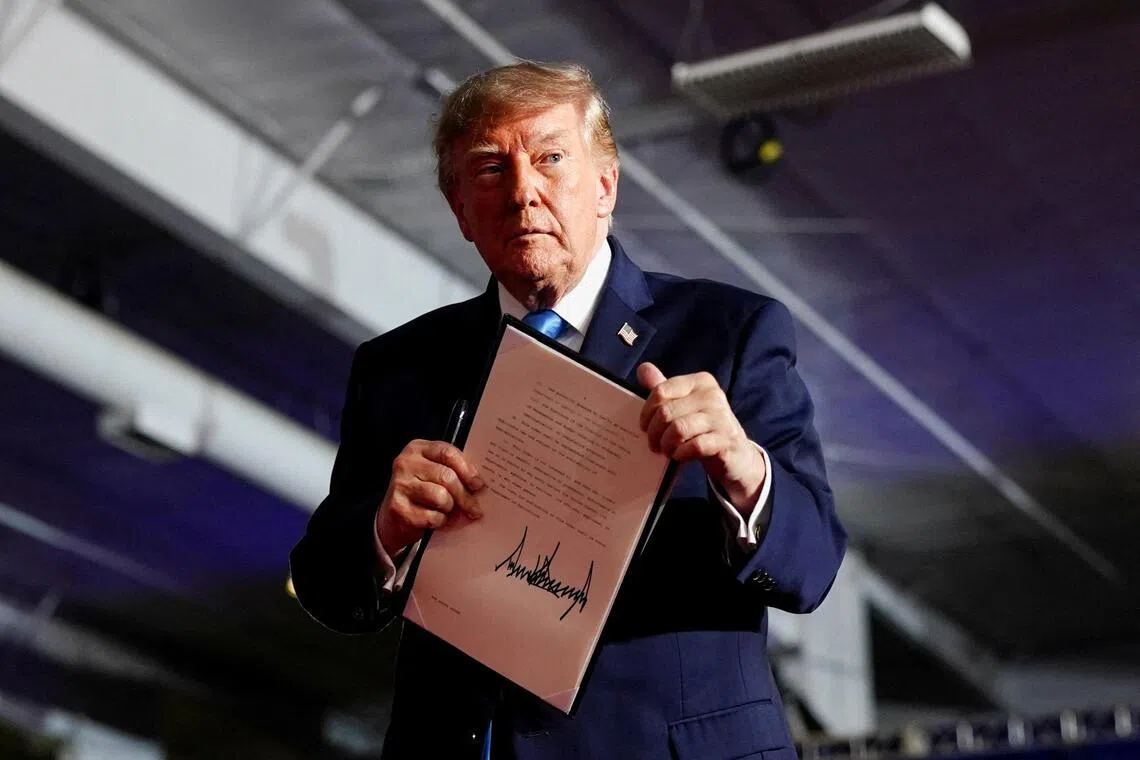
US President Donald Trump holds an Executive Order after signing it onstage during a rally in Grand Island, Nebraska, on Oct 5.
WASHINGTON – United States President Donald Trump on Oct 5 signed an executive order to ease restrictions on the use of a tax-exempt variety of diesel, his latest bid to pare costs for the fuel ahead of November’s midterm elections.
Trump signed the order during an event in Grand Island, Nebraska, part of a month-long blitz to rally Republican voters before an election that threatens to cost the president’s party control of Congress.
The president said the measure would “officially waive the off-road requirement and allow anyone to purchase tax-free, red-dyed diesel for any reason”.
The move marks the latest effort by the White House to address costs for diesel that have surged amid wars in Russia and the Middle East that pared refining capacity and reduced the shipment of petroleum products globally. High prices for the fuel have been a particular flashpoint in heartland states, where it is brings power to rural communities and helps farmers drive equipment.
Trump’s plan would effectively allow more widespread use of red or dyed diesel, which is generally available for off-road purposes, such as in farm and construction equipment. Red diesel is exempt from the federal excise tax of US$0.24 per gallon and enabling its use in on-road vehicles without penalties could translate into an effective tax break in some cases.
While the move would not directly lower operational costs for harvesters, tractors, excavators and other off-road equipment that already runs on tax-exempt red diesel, it is seen as potentially cutting the expense to run pickup trucks and other on-road vehicles.
Trump’s decision to announce the move in a largely rural conservative Nebraska district that he won handily in all three presidential campaigns underscores how Republicans are on the defensive with less than a month to Election Day and the sense of urgency within the party in shoring up support among farmers and ranchers.
Farmers and ranchers, key constituencies for Republicans, have faced economic challenges in the second Trump administration that go well beyond diesel prices.
Rural communities are struggling with higher costs for a range of agricultural inputs and shrunken markets for crops due to Trump’s tariffs. Trump also rankled ranchers by signing an order in August to ease tariffs on some beef imports, a bid to ease grocery prices, that also drew criticism from ranchers.
The president said the order would have far-reaching effects, calling it an “unprecedented step to bring down costs”.
“This order will also drive down the cost of all goods, including grocery prices, very substantially,” Trump said.
The president also cast the order as a temporary salve, saying “we’re not going to need it long. I hope we’re not going to need it long, because your prices are plummeting, and they’re going to really be plummeting in just a little while”.
Yet energy experts and economists have questioned whether Trump’s move would have sweeping impact, warning the infrastructure for delivering red diesel is limited. It also risks blowback in the form of higher prices for farmers, if more on-road customers seek the tax-exempt dyed diesel and strain existing supply of that red variety.
Already at least 10 governors have waived state limits on the sale of red diesel and lifted fuel excise taxes. Under Trump’s order, the administration would encourage more states to adopt corresponding policies.
With less than a month until Election Day, polls show voters unhappy with Trump’s economic agenda, in particular high costs of living for groceries, energy, housing and other items, as well as his handling of the Iran war, which has also spiked energy costs. That crunch for household budgets has made affordability the election’s dominant issue.
Trump at the rally on Oct 5 sought to boost Republican Nebraska Senator Pete Ricketts, who finds himself in a surprisingly competitive race against an independent challenger, Dan Osborn.
While Ricketts is still favoured, the fact that the race is close in a state Trump won by about 20 percentage points just two years ago underscores how the president’s party is being challenged even in states that have long been GOP redoubts.
“This should absolutely assure your election,” Trump told Ricketts on Oct 5. Bloomberg
