
Trump Envoys Witkoff and Kushner Meet With Putin in Moscow for Ukraine Talks - Time Magazine
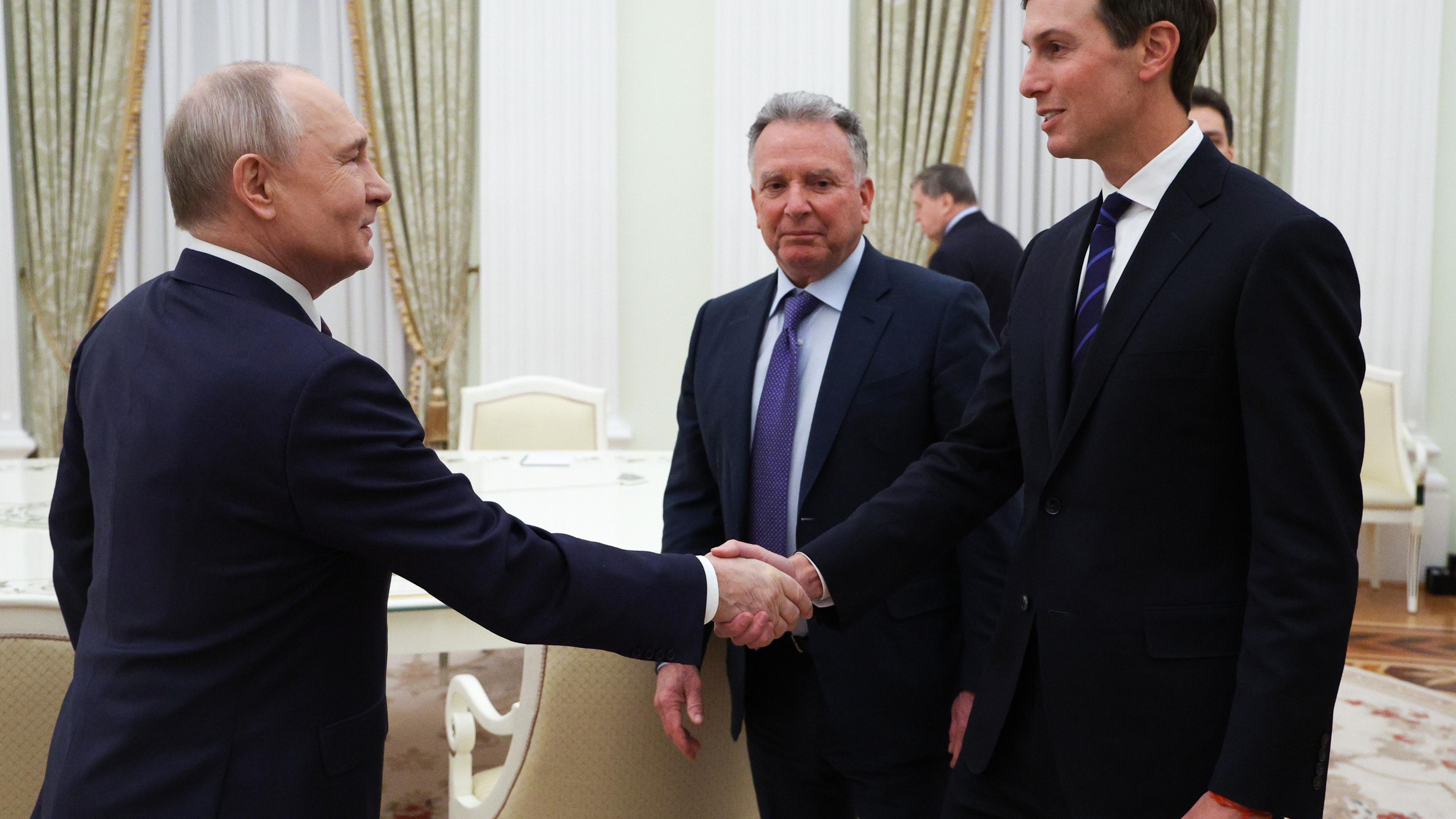
U.S. envoys Steve Witkoff and Jared Kushner met with Russian President Vladimir Putin in Moscow Thursday to discuss Ukraine, after two days of U.S.-led talks between Russian and Ukrainian delegations in Abu Dhabi yielded no major breakthroughs.
“I think progress was made. I think it was made earlier today,” Witkoff told reporters after the meeting at the Senate Palace of the Kremlin. “People didn't think that we were going to restart trilateral. We’ve restarted it. We’ve set a new meeting. This is what President [Donald] Trump wants to see."
He went on to say that a European representative would be present for the next stage of the talks, which are set to look at the continent’s wider security arrangements. “They’re our partners, and it’s important for them to be involved,” he said.
Witkoff and Kushner are now en route to Dublin, where they are set to brief Ukrainian President Volodymyr Zelensky on any developments from the talks. Zelensky is among the dozens of world leaders in the Irish capital for the European Political Community summit.
Zelensky has expressed optimism about the next round of negotiations, saying there is a "window of opportunity” to reach a peace deal with Russia.
“There really is this window of opportunity, when all the participants involved in this negotiating process could get the result by the beginning of 2027,” he said, speaking alongside Irish Taoiseach (Prime Minister) Micheál Martin during a press conference in Dublin.
Although Russian and Ukrainian negotiators reported some progress during this week's Abu Dhabi talks—including a prisoner swap agreement—all sides have acknowledged that significant differences remain, particularly over territory.
Kyiv has strongly rejected Putin's demands to surrender the entirety of the eastern Donbas. With negotiations over territory deadlocked, U.S. mediators instead sought to steer discussions toward post-war security guarantees and reconstruction.
However, Putin doubled down on his opposition to the idea of foreign peace-keeping troops being stationed in Ukraine if an agreement is reached, telling Witkoff and Kushner it would be considered by Russia as a "continuation of war."
Fully integrating European representatives into future negotiations could also prove challenging, despite Witkoff's confidence on the matter. Kremlin aide Vladimir Medinsky, who led Russia's delegation in Abu Dhabi, previously expressed skepticism over any European involvement.
Yuri Ushakov, Putin's foreign policy adviser, told reporters after the Moscow meeting that the Russian President will continue talks on Ukraine with Trump at the Asian-Pacific Economic Cooperation (APEC) summit in China later this month.
Despite the major obstacles that remain, Trump has expressed renewed optimism about ending the war—a goal he had previously claimed would be achieved on his first day back in office in 2025. “We're seeing a very strong inclination to end [the war between] Russia and Ukraine,” the President insisted during a press conference Monday.
The European Union is preparing a new sanctions package against Russia in an effort to increase economic pressure on Moscow and strengthen Ukraine's position in future peace talks.
European Commission president Ursula von der Leyen said the bloc was preparing its 22nd package of sanctions against Russia, alongside a separate proposal to address Ukraine's financial needs, by the year-end.
“We are, as a Commission, preparing a proposal [on] how to cover the financial needs of Ukraine in 2027, we will come with the sanctions package and the proposal for the financial needs before the next European Council,” she told reporters in Dublin. “We will support Ukraine, be it at wartime, or be it at peacetime."
The next European Council meeting is scheduled to take place in Brussels across Nov. 26-27.
Other European leaders also took the opportunity to underscore the importance of bolstering Ukraine.
French President Emmanuel Macron said that “without Europeans, there is no support for Ukraine,” insisting “there is no more U.S. support.”
In an address at the summit, Zelensky appealed to Europe to continue supporting Ukrainian territory and championed sanctions against Russia as an effective measure.
In a separate display of solidarity, the U.K. government announced new levies targeting Russia's 10 largest oil producers. British Prime Minister Andy Burnham described the move as “a sweep of stinging new sanctions to turn the screws on Russia’s oil revenues and drive forward an end to the Kremlin’s needless war.”
Ursula von der Leyen, president of the European Commission, and Antonio Costa, president of the European Council, stand alongside Irish Taoiseach Micheal Martin, Ukrainian President Volodymyr Zelensky, and French President Emmanuel Macron at the European Political Community summit in Dublin, Ireland, on Nov. 12, 2026. Brian Lawless—Getty Images
As Witkoff and Kushner were meeting Russian officials in Moscow, Zelensky raised concerns about new speed restrictions on Starshield, the military-grade sister version of Elon Musk’s Starlink service.
Zelensky said the Ukrainian military was facing "systematic" restrictions to Starshield and, as a result, struggling to intercept Russian drones. "This is helping the Russians kill more Ukrainians and carry out more accurate strikes against Ukraine," he said. "We are trying to clear up all circumstances with the American side."
TIME has reached out to the White House and SpaceX for comment.
Starlink offers Internet connectivity from satellites in low-Earth orbit. Its sister service Starshield, a military version developed for the Pentagon, relies on the Starlink network and has become a vital component for Ukrainian forces, strengthening its far-reaching drone strike missions and air defenses.
Last month, Ukraine complained that speed restrictions had been imposed on Starshield, leading to the “failure” of several military missions. There were conflicting reports as to how the service came to be restricted.
Reuters, citing three U.S. officials, had reported that the decision to limit the service came from inside the White House.
When approached for comment, a senior U.S. official told TIME: “No such request was ever made by the President.”
When initially addressing the matter, SpaceX founder and CEO Musk emphasized how Starlink and Starshield are different. He cited the U.S. authorities as being in control of the latter’s usage determinations.
“Starshield systems are owned and controlled by the U.S. government. Any limits on speed or usage are decided by the U.S. military and ultimately POTUS,” he said on X. “Starlink is a commercial service owned and controlled by SpaceX. Usage of Starlink is limited to civilian or defensive activities and cannot be used for offensive military action, as doing so would be inappropriate for a commercial company.”
Musk later said his company SpaceX had imposed limits on the use of its Starlink satellite system, accusing Ukraine of violating its terms of service by using it for military activity. He denied being behind the simultaneous issue with Starshield.
Kyiv denied breaching Starlink’s terms of service. “It’s very strange that Elon Musk doesn’t know about the restrictions on Starlink in Ukraine,” said Ukrainian presidential adviser Serhiy Beskrestnov via Telegram. “Starlink does not work over Russian territory. So we physically cannot use commercial Starlink for deep strikes and mid-range strikes.”


