Trump Faces Biggest TACO Test Yet—but Xi Faces Dangers Too - Newsweek
As President Donald Trump prepares for his second meeting this year with Chinese counterpart Xi Jinping, the summit on U.S. soil in some ways bears even higher stakes than their last encounter in Beijing.
The heightened significance can at least partially be attributed to the shift witnessed in the two leaders' dynamic during their previous meeting in May. Trump's repeated expressions of praise for Xi surprised some observers amid expectations of a tougher turn given the U.S. president's record of raising pressure on China and his warnings to Beijing over its stance on the U.S.-Israeli war against Iran.
Ensuing developments threaten to further undermine Trump's hand. The conflict with Iran drags on with rising fuel costs, declining domestic support and no clear sign of victory as midterm elections approach, while questions over U.S. security commitments gain traction among both Middle Eastern partners and European allies of Washington.
Whether or not the meeting fuels accusations of another "TACO" ("Trump Always Chickens Out") instance, Xi will likely have a say.
"For one thing, the U.S. does not have all the cards," Xu Qinduo, senior fellow at the Beijing-based Pangoal Institution, told Newsweek. "The fact is the Chinese side also has their own cards."
One area in which China has already demonstrated the capacity to counter the U.S. effectively is on rare earth elements.
China accounts for roughly 70 percent of global rare earth mining and around 90 percent of worldwide refining. So, when Beijing retaliated against Washington's tariffs by restricting rare earth exports last year, the White House was forced to the table.
Xu also pointed out that China's comparatively larger manufacturing capacity and economic weight in terms of purchasing power parity raised doubts as to whether "the U.S. is in a position to confront China head on."
Meanwhile, there were opportunities abound for Xi to capitalize on concerns over the direction of U.S. foreign policy in the wake of the U.S. killing of Iranian Supreme Leader Ayatollah Ali Khamenei in late February and abduction of Venezuelan President Nicolás Maduro in early January.
"By not launching a war or kidnapping or assassinating leaders of other nations, or imposing tariffs on the rest of the world, China is demonstrating what a responsible big power should look like," Xu said.
It's a concept perhaps most easily conveyed by the viral "Do nothing, win" meme that portrays Xi as repeatedly benefiting from the apparent missteps of others, much of the time those of Trump and his predecessor, former President Joe Biden, in social media discourse.
But Miles Yu, director of the Hudson Institute's China Center who previously served as chief China strategist to former U.S. Secretary of State Mike Pompeo, saw a real U.S. effort to compel China to take action behind the pomp and circumstance surrounding their meeting.
"The ceremonial hoopla surrounding the summit reflects the lack of substantive breakthroughs since May, with both Washington and Beijing determined not to appear weak," Yu told Newsweek.
"President Trump wants to use the reciprocal ceremonial extravaganza to show real American power with superior bombers and fighter jets," Yu said. "Xi wants to preserve and extend the trade truce, while Trump is pressing for implementation of Chinese commitments on rare earths, agricultural purchases, and meaningful market access for American companies."
And he cautioned that "Trump’s personal praise of Xi should be distinguished from his administration’s tough policies and actions, which continue to use tariffs, sanctions, export controls, and law enforcement against Chinese entities," effectively putting the ball in Beijing's court.
"The real test of the summit is therefore not the pageantry or rhetoric, but whether Beijing delivers measurable results on the commitments already made," Yu said.
Yet appearances go a long way in Trump's playbook.
Lyle Morris, senior fellow at the Asia Society Policy Institute’s Center for China Analysis and former China director for the Office of the Secretary of Defense, described a "supreme confidence" underlining Trump's bid to "sway or persuade Xi to strike a deal with the U.S. using flattery and charm."
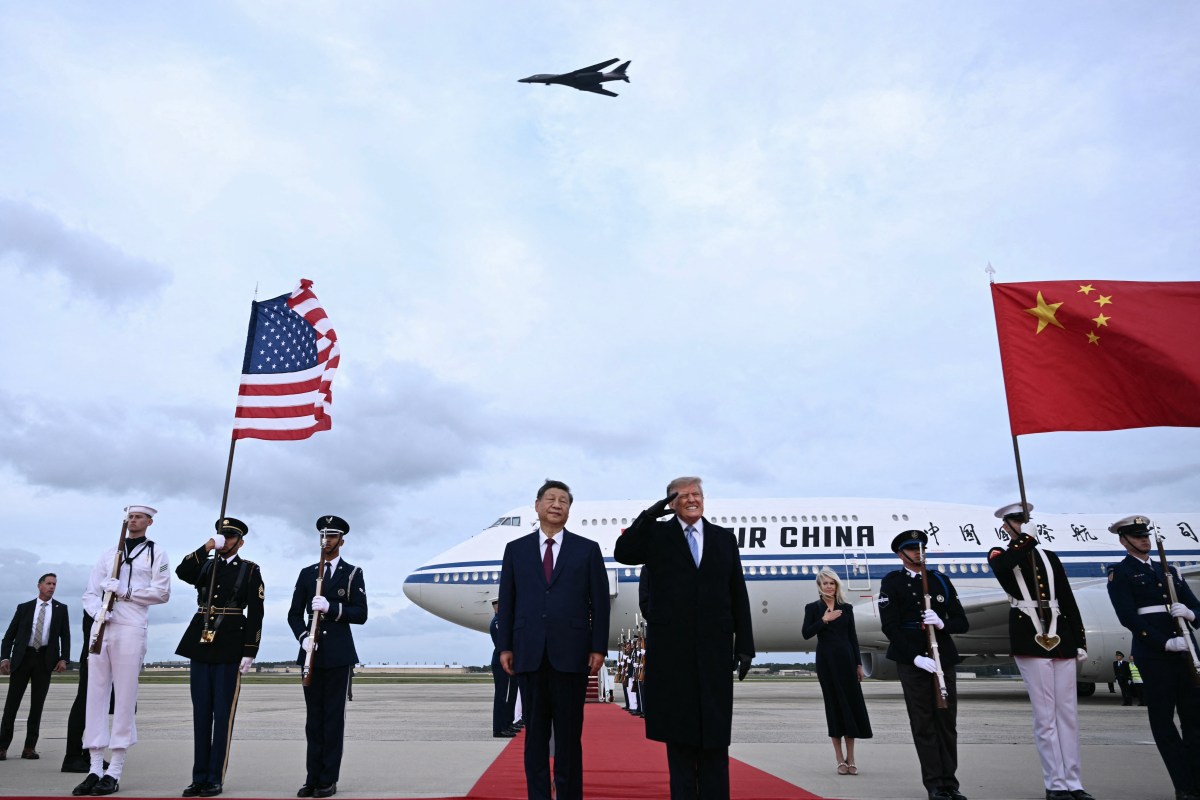
This would explain, Morris argued, why Trump chose to take the historic step of greeting Xi directly at the tarmac of Andrews Air Force Base, complete with a B-1 nuclear bomber flyover and followed by a lavish state dinner.
"Trump’s thinking is, if you shower an authoritative leader with praise and ostentatious displays of U.S. endearment, you will receive benefit in the form of greater willingness to accommodate U.S. interests," Morris said.
Xi's reaction, meanwhile, was deliberately difficult to read. China's longest serving leader since the foundation of the People's Republic in 1949 has held power for 13 years not through the kind of personalized and often unpredictable diplomacy that marks Trump's signature style, but a more restrained and consistent approach rooted in long-term planning and the quiet sidelining of rivals.
The strategy often excels in masking vulnerabilities, including recent economic underperformance and a looming demographic crisis. And it's particularly potent as Trump attempts to woo a Chinese leader bearing real leverage to bring to the table.
"The China that confronts Trump is much different than just a few years ago," Morris said. "Xi has succeeded in positioning Beijing as the new 'center of gravity' in diplomacy, which likely changes the calculus of Trump in co-opting China in pressuring actors like Iran to strike a deal with the U.S. and international partners."
But Beijing's weak spots and the opportunities they may afford the White House cannot be entirely cast aside.
Matthew Turpin, former U.S. National Security Council China director now serving as visiting fellow at the Hoover Institution, argued that "one of the things contributing to the perception that Trump is more constrained than Xi is a poor understanding about how bad the Chinese economy is really performing."
"It is not growing at 4-5% as the Chinese government asserts in their Potemkin economic reports, it is likely in recession and it is largely due to the decisions by Xi Jinping to elevate security and surveillance above economic prosperity during the pandemic," Turpin told Newsweek.
Thus, as predictions of Trump's imminent midterm backlash mount, Turpin asserted that "Xi will face a reckoning" someday, potentially during next year's 21st Chinese Communist Party Congress, which "could turn into a referendum on Xi’s rule" should the leader fail to sufficiently seal the gaps.
"This potentially puts Trump in the position of being a spoiler for Xi Jinping, as Trump is not facing re-election," Turpin said.
Meanwhile, Trump has undergone a transformation of his own since his first term. Now, according to Ali Wyne, a former U.S. State Department official serving as senior research and advocacy adviser at the International Crisis Group, Trump "has far greater political freedom" in channeling "his core views: a narrow conception of strategic competition and a strong affinity for President Xi."
This may not meld well with some of the more skeptical views toward China that emerged not only among Republicans but on a bipartisan level, a consensus consolidated somewhat ironically under Trump's first presidency.
But the shift may not all be by choice. Wyne pointed out how the U.S. leader has also "been chastened into a more realistic appreciation of China's power because his tariff fusillade last year boomeranged so spectacularly, underscoring Beijing's capacity to hold key swaths of the U.S. economy at risk with little exertion."
That China's dramatic reduction in oil imports in recent months is counted as a factor in keeping fuel prices already inflated as a result of the Persian Gulf crisis from spiraling upward also must be taken account, even if Trump publicly seeks to cut off Iran's number one source of energy exports.
There's another factor to take into consideration as Trump weighs his options on China. While the U.S. leader may have once succeeded in promoting greater global skepticism toward Beijing's rise, but a world in turmoil—some of it attributed to Trump's actions—yearns for stability.
"President Trump appears to believe that he can restore U.S. dominance by combining a foreign policy of shock therapy—with steep tariffs, territorial threats, and public humiliations as its centerpieces—with a mercurial disposition that paralyzes his intended targets," Wyne said.
"But that judgment misinterprets short-term accommodations of U.S. power as enduring acquiescence to U.S. preferences," he added. "It also assumes that allies and partners have little to no agency to blunt U.S. influence over time by strengthening their own connectivity and seeking stabler relations with China."
Contact Newsweek editors on this story: Edward T. Cummins