Trump flexes 'American power' on UN's biggest stage

U.S. President Donald Trump speaks during the 81st session of the United Nations General Assembly at UN headquarters in New York on Tuesday. (Seth Wenig/The Associated Press)Social SharingU.S. President Donald Trump is telling the world that he will keep using military power to advance his country's interests, including stopping what he calls "hostile foreign adversaries" from gaining influence in the Western Hemisphere.
During his speech to the United Nations General Assembly on Tuesday, Trump threatened Iran with annihilation, laid claim to Venezuela's oil as the spoils of victory, and justified U.S. strikes on alleged drug traffickers in the Caribbean.
He also warned countries that more such interventions could follow.
"We have acted with decisiveness and speed to reshape the world stage and solve problems that have plagued us for far too long," said Trump.
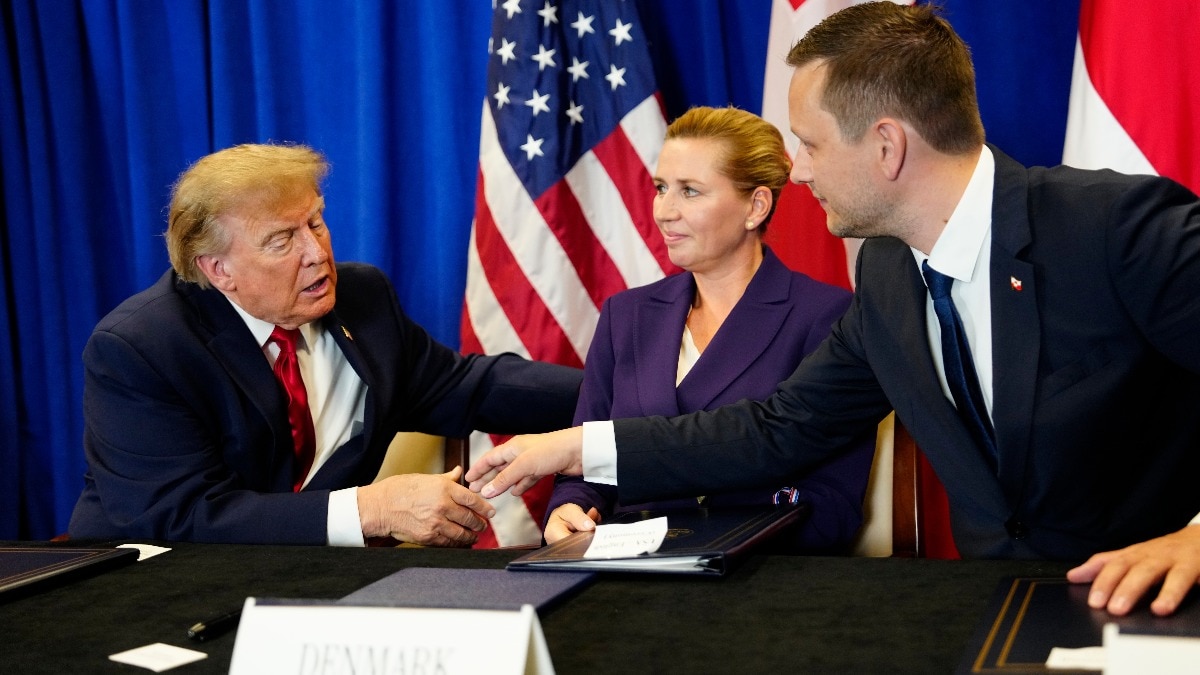
Trump says deal struck to boost U.S. military presence in Greenland
"We're reasserting American power, including American military power, where necessary in our region and around the world, to create a safer future for all of us."
Trump's 37-minute speech to the annual gathering of world leaders only briefly touched on Russia's long-running war against Ukraine. He pleaded for an end to the conflict but offered no new initiatives toward peace.
He devoted a notable portion of his speech to the Western Hemisphere. That echoes his new national security strategy, published last December before Trump ordered the mission to capture Venezuelan President Nicolás Maduro and joined Israel in launching the war against Iran.
The official strategy document, which drew praise from the Kremlin, argues for reviving the Monroe Doctrine, the 19th-century declaration of U.S. supremacy over the Western Hemisphere.
Previous U.S. administrations have allowed much of the region to be "dominated by vicious gangs and bloodthirsty drug cartels, destabilized by uncontrolled migration and infiltrated by hostile foreign adversaries — foreign, sick, demented adversaries," said Trump.
"Our actions in Venezuela are proof that the United States will no longer permit threats to America to gain a foothold anywhere in the Western Hemisphere, and if necessary, we will use our unmatched military might to secure the vital national interests of the United States."
He boasted about the deal that gives the U.S. control over much of Venezuela's oil productions. "To the victor belong the spoils," he declared.
Trump's speech to the General Assembly lasted 37 minutes, and it included scathing criticisms of the UN. (Heather Khalifa/The Associated Press)The speech made clear not only the importance of the Western Hemisphere to Trump's worldview, but also his perception of the region as a potential threat, says Shannon O'Neil, a senior vice-president at the Council on Foreign Relations, a think-tank based in Washington, D.C.
The message sets the U.S. up "to assert control, if not dominance, in this hemisphere," O'Neil told reporters in an online panel discussion Tuesday.
She sees the Trump administration's approach to the governments of Latin America as "really trying to put their finger on the scale to encourage and support those that were ideologically aligned."
The speech did not mention Canada, evidence that the U.S. president has bigger preoccupations than the trade war with his country's northern neighbour.
Trump did, however, take on its southern neighbour, calling Mexico the epicenter of drug cartel violence.
Trade 'war' or not, are Canada and the United States now dug in?
U.S. may seek win with Mexico in wake of collapsed trade talks with Canada, says ex-negotiator
"It's unacceptable for the United States to share a 2,000-mile border with a territory controlled by enemy cartels. So Mexico must reclaim control of its soil from the enemies of humanity," he said.
Trump also said his administration is seeking "fundamental change" in Cuba.
"The communist regime is under great pressure," he said. "We'll not allow a haven for foreign adversaries to threaten America on our own doorstep."
Members of the Cuban delegation walked out of the General Assembly hall as Trump spoke.
Trump also said he faces a "big decision" on Iran.
He said one option is making a deal that allows Iran to become a "far greater country" than ever before.
"Or do I annihilate the Islamic Republic and do it quickly, never giving them a chance to kill and destroy people and countries again? Do I drive them into hell with no chance of survival and no hope of future greatness or generations?"
UN mission finds 'grounds to believe' U.S. committed war crimes in strikes on Iranian school, sports centre
That was Trump's way of laying out both a path for a negotiated solution and the consequences of not following that path, says Mara Rudman, a former U.S. deputy special envoy for the Middle East.
"Fairly clumsy is maybe the kindest word I can use," Rudman told CBC News Network shortly after the speech.
Trump and some of his top officials met Tuesday with Ukraine's President Volodymyr Zelenskyy, left, on the sidelines of the UN General Assembly. (Julia Demaree Nikhinson/The Associated Press)Trump was due to meet the leaders of Gulf countries on the sidelines of the General Assembly on Tuesday.
"My anticipation is that they are urging him, however quietly, to go down the path of negotiation," said Rudman, who served as a national security advisor in both the Clinton and Obama administrations.
Trump predicted that a deal with Iran will happen immediately after the U.S. midterm elections on Nov. 3.
Rudman sees that as evidence that the midterms — which polling suggests put the Republican Party at risk of losing both the U.S. House and Senate — are weighing on the president.
"I think his audience was the American people and not the Iranians or anyone else in the world, despite the fact that he was speaking at the UN," she said.
Your guide to the U.S. midterms, and why they're crucial for Donald Trump
Will the U.S. midterm results affect Trump's tariffs on Canada? Democrats think yes
Trump also used the General Assembly podium to call fears over the risks posed by artificial intelligence a hoax and to repeat some of his long-running sharp criticisms of the United Nations, the main theme of his speech last year.
He also called the International Criminal Court a rogue organization. The court was created jointly by 125 countries in the early 2000s to prosecute war crimes and crimes against humanity. The U.S. has never ratified the court's treaty.
Mike Crawley is a correspondent for CBC News, based in Washington. He began his career as a newspaper reporter in B.C., spent six years as a freelance journalist in various parts of Africa, then joined the CBC in 2005. Mike reported on Ontario politics for 15 years. He was born and raised in Saint John, N.B.