Trump gives his verdict on Flock cameras - Newsweek
President Donald Trump has publicly backed Flock Safety's controversial network of license plate-reading cameras, potentially putting him at odds with some of the most-vocal critics of the technology in Congress: fellow Republicans.
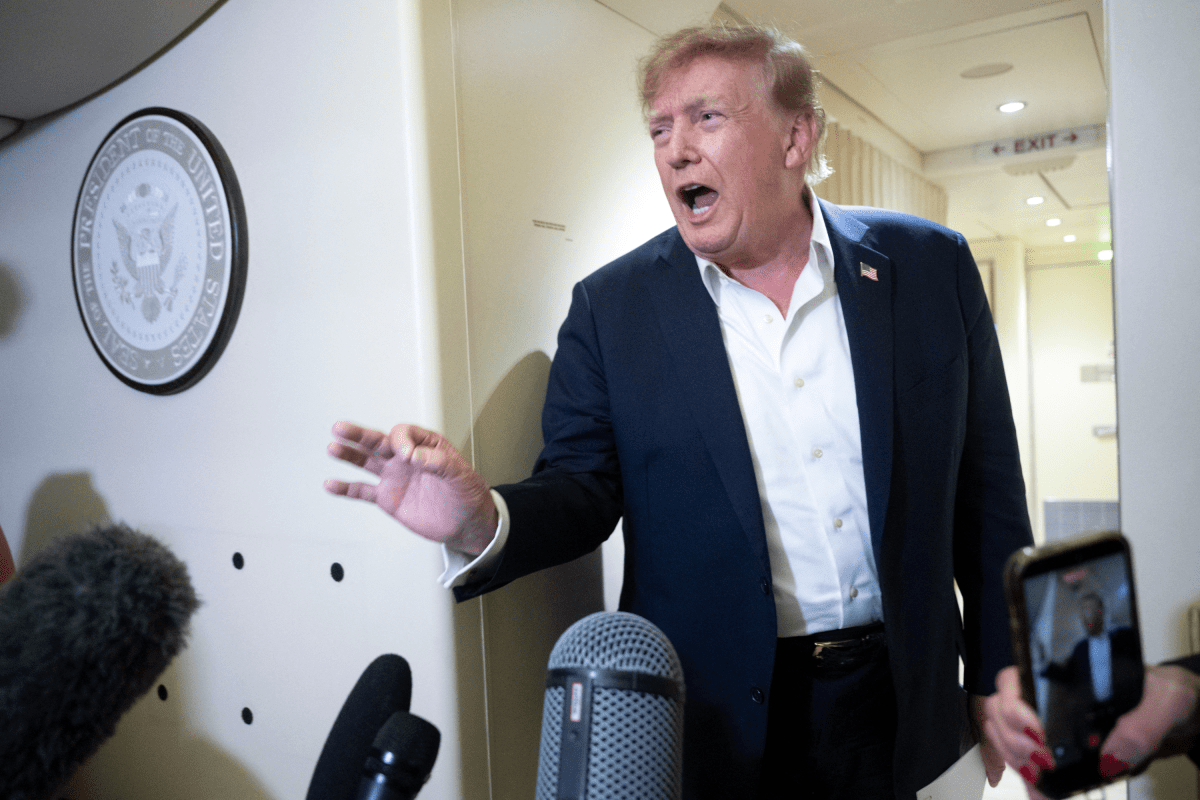
Speaking to reporters aboard Air Force One on Sunday, Trump said the cameras help law enforcement, while acknowledging concerns about privacy and government surveillance.
"I sort of like them because of that, because of law enforcement," Trump said. "But some people don't. They think it's an infringement."
When a reporter responded that the cameras "help catch a lot of criminals," Trump replied: "But I like them."
The remarks represent Trump's clearest endorsement yet of Flock's rapidly expanding Automated License Plate Reader (ALPR) network, which has been embraced by thousands of law enforcement agencies nationwide but has also sparked growing concerns among civil liberties advocates and lawmakers over privacy, data collection and surveillance.
While criticism of Flock cameras has come from across the political spectrum, some of the most prominent legislative efforts to restrict the technology have been spearheaded by Republican lawmakers.
Earlier this month, Thomas Massie, a Kentucky Republican, introduced H.R. 10221, known as the "Flock-Off Act." According to Massie's office, the bill would prevent the use of federal funds to purchase, install, maintain, operate or upgrade automated license plate readers and biometric surveillance cameras.
Announcing the legislation, Massie argued that taxpayers should not be funding what he described as an expanding surveillance state.
"The federal government shouldn't provide 'security' grants to cities and police departments that have gone beyond the pale and turned their communities into a version of 1984," Massie said in a statement, adding that "The Flock-Off Act withholds federal money from municipalities and police departments that deploy Flock cameras to surveil law-abiding citizens."
Massie's proposal would go beyond simply prohibiting future purchases.
According to the bill summary released by his office, it would also require the removal of federally funded systems and prohibit federal money from being used for contracts, subscriptions, cloud services, and data-sharing arrangements connected to covered camera systems.
Newsweek has reached out to Massie for comment and is awaiting a response.
Another Republican critic, Tim Burchett of Tennessee, introduced H.R. 9800, the "Protection Against Mass Surveillance Act," in July.
The legislation would prohibit federal agencies from purchasing, deploying, operating, accessing, or contracting for automated surveillance systems that identify, track, or record individuals through technologies including ALPRs, facial recognition, and biometric identification systems.
The bill would also prevent state and local governments from using federal funds to acquire those technologies. Burchett has argued that widespread automated surveillance raises constitutional concerns and risks infringing on Fourth Amendment protections.
Together, the Massie and Burchett bills illustrate how some of the strongest opposition to Flock-style camera systems on Capitol Hill has emerged from Republicans focused on privacy rights, government overreach, and constitutional limits on surveillance.
Trump's endorsement could complicate that effort.
The president remains the dominant figure within the Republican Party, and his public support for Flock cameras as a law enforcement tool may make it harder for surveillance-focused critics to build momentum for restrictions.
If he continues to frame Flock cameras primarily as a crime-fighting tool rather than a privacy concern, some Republicans who might otherwise be sympathetic to restrictions could become less willing to back measures targeting the technology.
That could make it more difficult for legislation such as Massie's "Flock-Off Act" or Burchett's "Protection Against Mass Surveillance Act" to assemble a broad coalition of Republican support, even as concerns about privacy and government monitoring continue to grow.
For now, Trump's comments have uncovered a growing divide within conservative circles, pitting traditional Republican concerns about government surveillance against arguments that the technology helps law enforcement solve crimes and protect public safety.
Newsweek has also contacted the White House Press Office, asking for comment, and is awaiting a response.