Trump Has No Choice but To Give China’s Xi the 3 Things He Wants
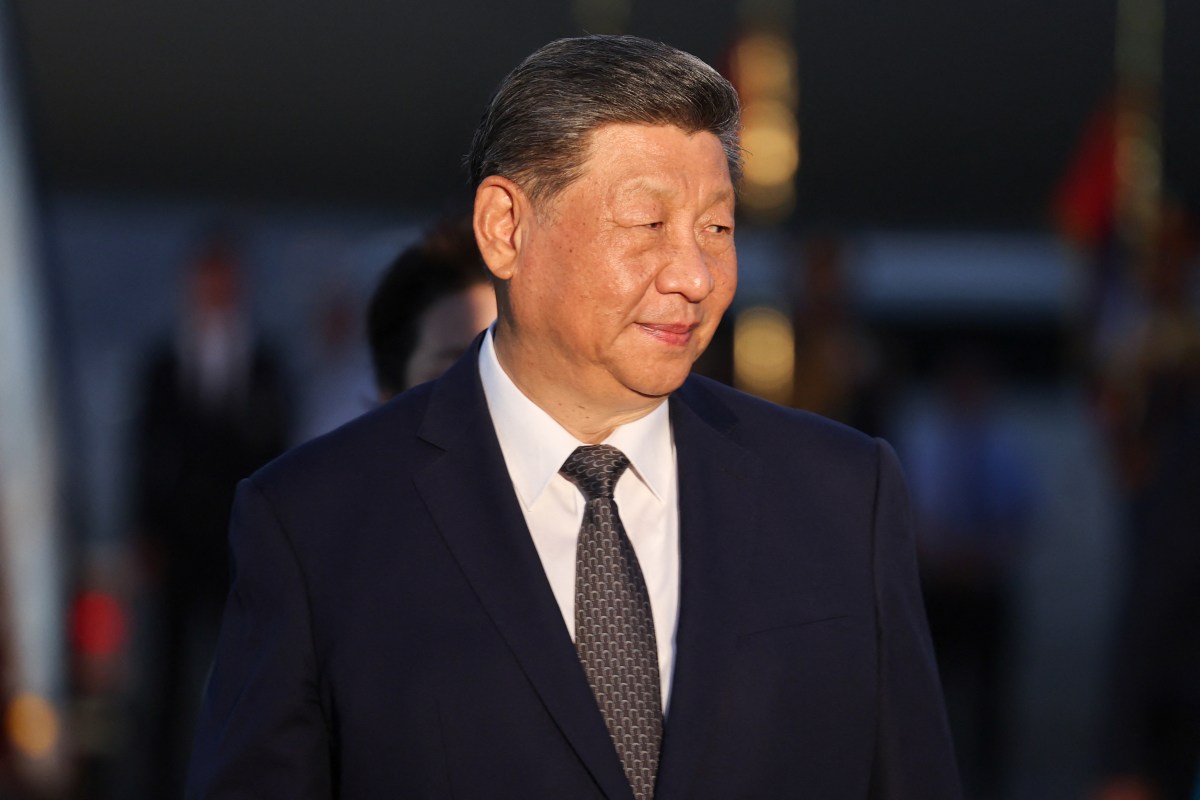
Things are looking up for China and its long-time leader, Xi Jinping, who heads to the United States on Wednesday very much on the front foot, safe in the knowledge that President Donald Trump will give him everything he needs to secure yet another term as his country’s most-powerful political figure in a generation in about 12 months’ time.
This is Xi’s first official state visit to Washington, D.C., since 2015 and his first meeting with Trump on U.S. soil since an invitation to the Mar-a-Lago resort in Florida in 2017. It’s a big deal for the general secretary of Chinese Communist Party to be pampered by the leader of the free world at a time when the U.S. is under pressure from its allies to check China’s rise.
Pageantry isn’t the only thing Xi wants from his U.S. trip. He has told China’s ruling elites that the West is in decline and that time is on their side. Beijing plans to manage what it sees as a steady U.S. decline and can catch up to America without triggering a war. And it intends to seize a rare window of opportunity to wrest control of Taiwan from Washington’s influence.
Trump needs Xi’s help resolving separate wars involving China’s allies Russia and Iran, and he’s looking for more sweet trade deals with Beijing to soften the blow of the Democratic offensive in the upcoming midterm elections in November.
China is already a major power, but Xi wants his country to be viewed as a coequal with the U.S. and he’s brought the receipts to justify it.
Trump helped Xi raise his diplomacy portfolio this year with May’s state visit to China. In the weeks that followed, Xi showed off his easy access to Russian President Vladimir Putin, North Korean leader Kim Jong Un and Iranian President Masoud Pezeshkian—twice.
Xi will arrive at Joint Base Andrews on Wednesday a confident man. The pomp and ceremony of his U.S. state visit will begin with a personal greeting by Trump on the Tarmac, "an unprecedented gesture," said Rush Doshi, a former White House National Security Council official now teaching at Georgetown University's School of Foreign Service.
Trump on Thursday will further honor Xi and Peng Liyuan, the Chinese first lady, with an Air Force flyover by a B-2 bomber and four F-22 fighter jets, according to the official schedule. "Nothing like this occurred when President Trump visited Beijing in May of this year," Doshi wrote on Monday.
The Chinese leader will receive an honor guard and a military band will play the U.S. and Chinese national anthems as part of a welcome ceremony at the White House before their summit begins. A state dinner for Xi in the evening will be attended by a delegation of leading U.S. tech companies, in another sign of America’s deference to the Chinese market.
Xi’s entourage will have secured guarantees from the U.S. of no lapses in diplomatic protocol and no hiccups that could embarrass China’s president during the state visit, which will boost his political stature at home and around the world.
It will further legitimize the Communist Party’s widely expected to decision to give Xi a fourth term at the upcoming party congress in fall 2027.
Beijing believes the postwar international order is shifting in its favor, and that its patience—and careful attempts to avoid outright escalation—will be rewarded. A strategic stalemate with the U.S. is all it needs to close the gap in all areas.
China’s military is modernizing at pace, its hold on disputed territory is expanding, and its dominance of strategic economic sectors is insurmountable—from industrial machinery to electric cars and the critical minerals found in them.
Its chokehold on the global supply chain of rare earth elements was so complete that it stopped Trump’s tariff war last year and now could be used to extract further concessions from the U.S., including a reduction in tariffs and an exemption from sanctions over the purchase of Russia and Iranian oil.
The U.S. doesn’t have many tools to compel Beijing to stop supporting Moscow and Tehran. Xi is doing plenty behind the scenes, from trading dual civil-military use equipment with Russia to supporting the Iranian ballistic missile program with materials and components.
"Beijing believes it has tamed the Trump administration with rare earth export controls, and the Trump administration at times seems to believe it too," Doshi said.
Treasury Secretary Scott Bessent said on Sunday that the U.S. and China, who he called "the No. 1 and No. 2. AI powers in the world"—had agreed to discuss AI safety and the creation of a notification mechanism to alert one another of incidents of national security concern.
But neither party seems to be considering the slowdown in AI development sought by industry leaders. An AI crisis hotline also could be ineffective because Beijing has tended to use similar mechanisms in the past as a negotiating tool to extract concessions from the U.S., experts say.
Plus, China is unlikely to settle for the No. 2 spot for long.
Even before Trump went to Beijing in May, there were questions about how he would handle a $14 billion arms package designated for sale to Taiwan. It had been sitting on the U.S. president’s desk since December as he navigated a detente with China, which has long opposed the U.S. policy to bolster Taiwan's armed forces.
When Trump suggested he was willing to negotiate the issue with Xi, long-time observers knew there would be little movement, especially after Trump announced the dates of the Chinese leader’s state visit to America. Pausing the sale of U.S. weapons to Taipei was the only way to get Xi to agree to come.
That was a significant win for Beijing, which seeks to "incrementally weaken key U.S. policy principles toward Taiwan, especially with regard to defense support," according to William Yang, a senior analyst with the International Crisis Group.
"For now, their immediate goal is to ensure further delay of the U.S. approval of the $14 billion arms package to Taiwan, use the delay to amplify narratives suggesting U.S. defense support for Taiwan may be changing, and seek to influence Taiwanese public's perception about and confidence in U.S. credibility," Yang said.
Control of Taiwan would be a legacy-defining issue for any Chinese leader, not least for Xi, whose preference is to achieve the goal without having to fire a single shot. That’s just as well, since Xi is overseeing "the largest-scale purges in China's history," said Oriana Skylar Mastro, a political scientist and researcher at Stanford University who studies the Chinese military.
Xi will feel vindicated by his decision to stand his ground against Trump, and he couldn’t be traveling to America at a better time for his country’s image, according to a new poll released on Monday by the Chicago Council on Global Affairs.
"Americans today feel more warmly about China, with the public less likely to view China as a threat, and more likely to favor cooperation over containment, though at levels lower than in the 2010s," Craig Kafura, the think tank’s director of public opinion and foreign policy, said in a report.
"This shift toward cooperation and engagement matches the general direction that Trump has taken since his May 2026 meeting with Xi in Beijing. But it is not one embraced by his base: Most MAGA Republicans continue to favor limiting the growth of China’s power rather than cooperation," Kafura said.
The upcoming summit may not produce many concrete deliverables for either side, but that will suit Xi just fine. Trump and Xi’s declaration in May of a "relationship of strategic stability" between their two countries was recognition enough of China’s rise to great power status.