Trump Interrupts AI Summit to Say Robots Won’t Take Over the World
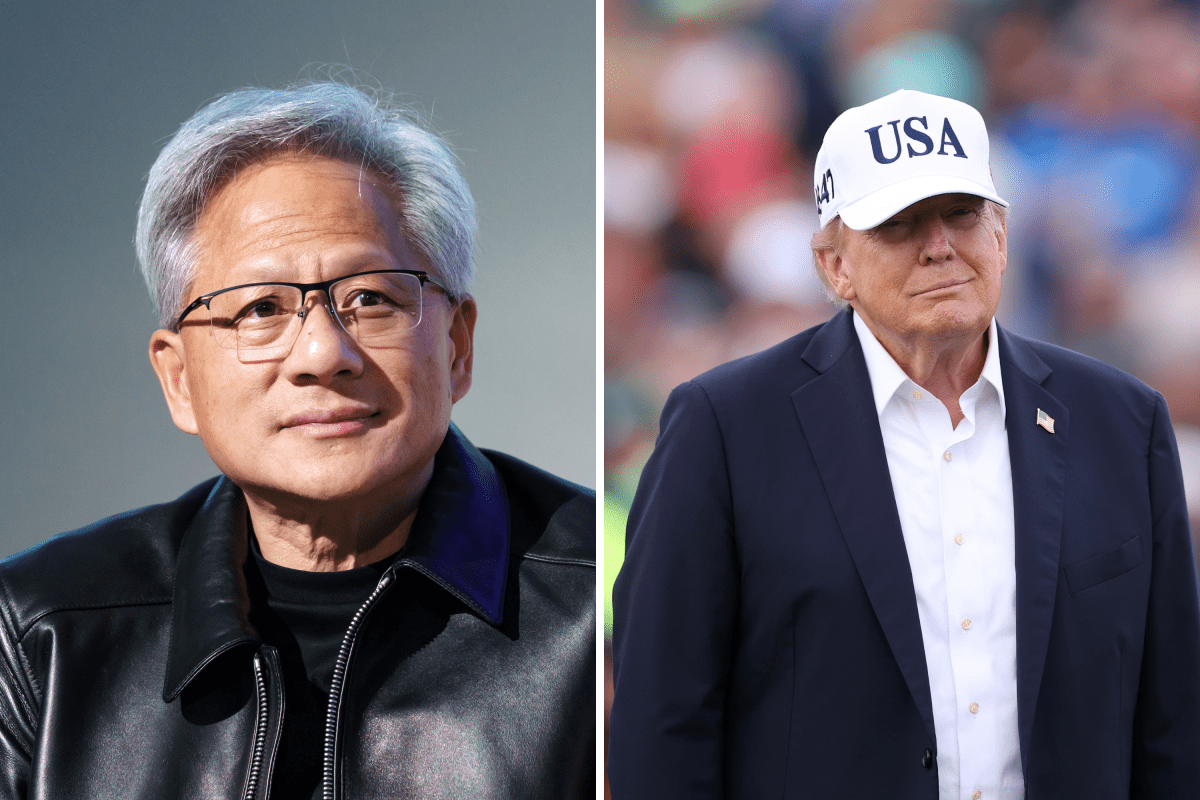
President Donald Trump used a surprise phone call with NVIDIA CEO Jensen Huang at the All-In Summit (an annual technology and policy conference organized by the hosts of the ‘All-In’ podcast) in Los Angeles on Monday to dismiss concerns about artificial intelligence (AI) and to defend the rapid expansion of AI infrastructure.
Huang, who was speaking on stage in front of thousands of attendees, answered the call and attempted to put Trump on speakerphone. The president joked that Huang could design the world's most-advanced AI chips but couldn’t put him on loudspeaker.
Trump then turned to the debate over AI safety, describing warnings that AI could pose an existential threat as a "hoax" and a "scam."
He argued that opposition to data center construction was helping geopolitical rivals such as China and claimed that AI infrastructure would be "the oil of the next 20, 25 years," generating wealth for states and local communities.
"The robots are not going to be taking over the world. The AI will not be taking over the rest of the world. The whole thing is a hoax," Trump said during the call.
Huang appeared to be supportive, responding that America would not allow its lead in AI to slip, which prompted loud cheering and clapping from the hosts and crowd.
The remarks come as a growing debate erupts within the AI industry after leading figures, including Anthropic CEO Dario Amodei, called for slowing the development of increasingly powerful AI systems and introducing stronger safety measures.
In recent days, former and current AI researchers have warned that rapid advances in model capabilities are outpacing efforts to ensure those systems remain safe and controllable.
Last week, former Anthropic researcher Jacob Coxon publicly resigned, warning that advanced AI could eventually become powerful enough to threaten humanity if development continues without sufficient safeguards.
Earlier this month, Dario Amodei, CEO of Anthropic, published an essay "We Must Pace the Frontier" calling for the industry to slow the pace of development and focus on safety measures. Amodei warned about increasingly capable AI agents and the risks associated with systems that may one day improve themselves faster than humans can monitor them.
His intervention drew support from several prominent technology leaders. OpenAI CEO Sam Altman agreed that safety and alignment efforts must advance alongside increasingly powerful models. Altman has repeatedly argued that AI could deliver enormous benefits but has also warned of the possibility of severe harms if the technology is developed recklessly. In recent comments, he said society faces a choice between building AI responsibly or risking outcomes that could be highly disruptive, including potentially dystopian scenarios.
Trump has emerged as one of the most outspoken critics of those warnings.
Trump's remarks at the All-In Summit were the latest in a series of statements rejecting calls from AI leaders to slow the development of increasingly powerful systems.
Speaking to reporters in Ireland on Sunday, Trump dismissed suggestions that the industry should pause or face stronger regulation, arguing that the United States must maintain its lead over China in what he views as a critical technological race.
"We're leading China in AI. And frankly, I want to keep it that way because whoever wins AI, wins," Trump said. He added that while some safeguards might be needed, "a lot of negative forces" were promoting fears about AI that were based on scenarios that "won't happen."
The president has repeatedly framed concerns about advanced AI as exaggerated and potentially harmful to America's economic and geopolitical interests. In a series of Truth Social posts on Monday, Trump, again, described warnings that AI could "take over the world" and destroy humanity as a "hoax."
He also pushed back against calls for new AI regulations and guardrails, claiming existing laws already provide the government with sufficient authority to intervene if companies behave irresponsibly. "The only control or 'guardrails' that AI needs is a STRONG AND SMART (High IQ!) PRESIDENT," he wrote, while insisting that the U.S. should continue expanding AI development and data center construction.
The comments put Trump increasingly at odds with some of the industry's most-influential figures, including Amodei and Altman.
Trump's remarks also touched on one of the fastest-growing controversies surrounding the AI boom: the rapid expansion of data centers.
The facilities, which house servers and specialized chips used to train and run advanced AI models, are being built across the United States at an unprecedented pace. Companies including NVIDIA, OpenAI, Anthropic, Microsoft, Google, and Amazon are investing billions of dollars in AI infrastructure to meet soaring demand for computing power.
Supporters argue the projects create construction jobs, generate tax revenue, attract investment and strengthen America's position in the global AI race.
But opposition has been growing in many parts of the country. Critics have raised concerns about the enormous amounts of electricity required to power AI infrastructure, as well as the strain data centers can place on local water supplies used for cooling. Community groups have also objected to noise from large facilities, pressure on power grids, land-use disputes, and the environmental impact associated with rapidly expanding energy demand.
The clash between those competing visions has increasingly become intertwined with the broader debate over AI safety itself, creating a political battle over whether America should accelerate AI development as quickly as possible or proceed more cautiously as the technology becomes more powerful.
Newsweek has already reached out to Amodei and Altman for comment, and is awaiting their response.