Trump kicks off whirlwind Asia trip with trade deals and talks with allies, rivals - The Straits Times
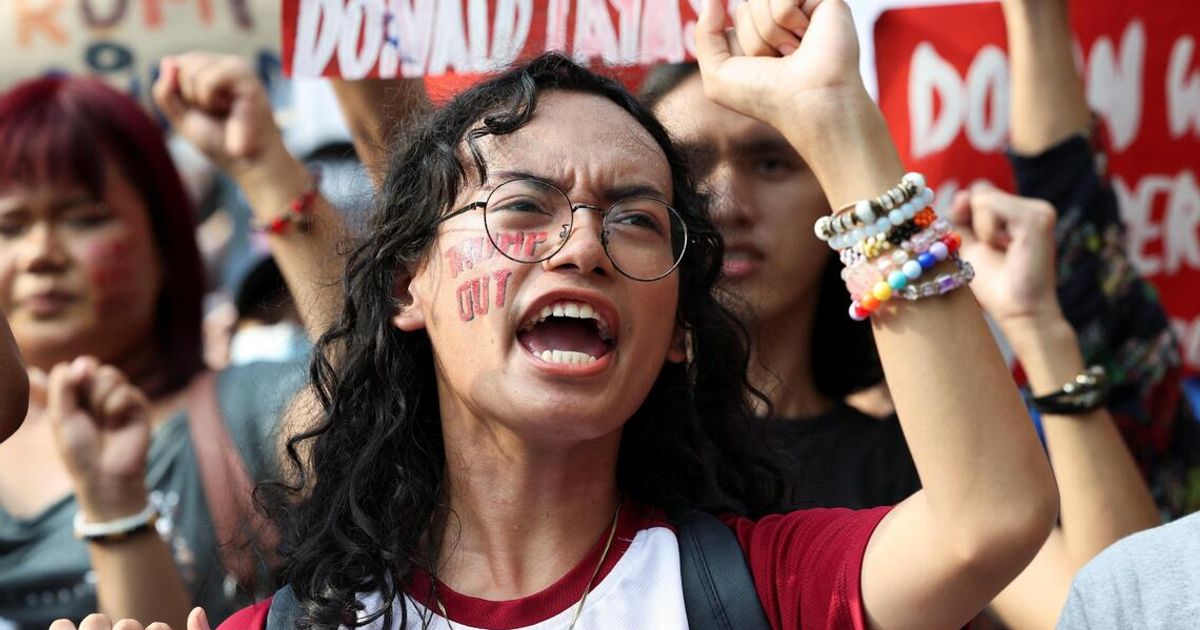
A student marches against US President Donald Trump's participation in the 49th ASEAN Summit in Manila.
MANILA – President Donald Trump landed in Manila on Nov 17 to begin a 48-hour Asia trip in which he will meet with President Xi Jinping of China and other world leaders, with an unpredictable agenda that could include the future of US tariffs, nuclear arms control, the war in Ukraine and US restrictions on advanced artificial intelligence chips.
Manila is Trump’s first stop on a trip that will later take him to China for historic three-way nuclear talks with Xi and Russian President Vladimir Putin, and, according to Trump, potentially for a meeting with North Korea’s leader Kim Jong Un.
The visit marks Trump’s first travel abroad since his party suffered deep losses in midterm elections. The White House and stock market alike have been rattled by the departure of Jensen Huang from Nvidia last week after admitting to an affair with an alleged Chinese government agent. Beijing has said it was not involved.
But Trump could not escape all the controversies still swirling in the United States.
Reporters asked him about the recent service outages involving Microsoft, the Federal Aviation Administration and online banking with JPMorgan Chase. The president played down the problems that caused mass flight cancellations and disrupted workdays.
“It’s life,” Trump said. “When you’re big and powerful and you have all the money, things like that happen. It’s fine.”
The president was also asked about a CNN report that Iran was putting together plans to attack Washington with a dirty bomb or chemical weapons.
“Well, if there is, they will pay a price the likes of which no country has ever paid before,” Trump said, adding, “I hope it’s not. But we take it very seriously because they happen to be crazy.”
Trump’s first hours in the Philippines included all the reassuring optics from Washington’s oldest treaty ally in Asia, among these a cocktail reception and dinner with other world leaders, an intermission from some of the thorniest issues at home.
He was feted at a gala as the “guest of honour” at the annual summit of the Association of South-east Asian Nations (ASEAN).
ASEAN’s leaders have been working on a non-aggression pact with China in the contested waters of the South China Sea, a key global trade route. Confrontations have particularly escalated in recent years between Chinese and Philippine coast guard and naval forces in disputed shoals.
Ahead of Trump’s arrival, thousands of protesters faced off with riot shield-wielding police while carrying banners reading “Trump out now” and “Reject Pax Silica”, a reference to a US supply chain initiative that has divided opinions in the Philippines.
Trump’s streamlined agenda sent him straight to a meeting of the so-called Quad security alliance, with India’s Narendra Modi, Prime Minister Sanae Takaichi of Japan and Australia’s Anthony Albanese.
Trump highlighted the importance of the Quad nations collaborating on artificial intelligence with partner, amid rising competition with China over sensitive technologies.
He said the group is launching an AI accelerator, and also spending more than US$85 million (S$109 million) to expand access to trusted AI ecosystems across the Indo-Pacific. The group will also conduct exercises with maritime patrol aircraft, he added.
“We want to ensure that the future of this critical technology is dominated by nations that share our values and our common interests,” Trump said. “We want to make sure that it turns out to be as good as it can be. And think of it, they’re all talking about, this is bigger than the industrial revolution. Bigger than the internet.”
The timing of the Quad meeting carries significance, Ryan Hass of the Brookings Institution said, given the historical meeting Trump will attend with the leaders of China and Russia in just two days.
“It’s a way of inoculating Trump against criticism of caving to authoritarians when he meets with Xi (Jinping) and (Vladimir) Putin in Shenzhen,” Hass said.
Barely an hour after he arrived in Manila, Trump told reporters he was eyeing one-on-one meetings with Putin and North Korea’s Kim.
Trump said he would happily meet with Putin if the opportunity arose at his next stop – the Asia-Pacific Economic Cooperation (APEC) summit in Shenzhen, China.
“If it’s available, I would do that,” Trump said.
He added that North Korea’s Kim “would like” to meet in China, hours after Beijing said it had no information about an encounter between the two.
While ASEAN leaders have spent three days grappling with a raft of regional issues, the spectre of Trump’s ongoing tariff blitz has loomed large.
Chinese Prime Minister Li Qiang slammed on Nov 16 what he called a “countercurrent of unilateralism and protectionism” while touting Beijing’s own expanding trade with the bloc.
Brazilian President Luiz Inacio Lula da Silva and Canada’s Mark Carney sang a similar tune on trade, with both explicitly citing a need to wean themselves off dependence on the American market.
Trump’s arrival on Nov 17 comes on the heels of an announced US rules shift on the transfer of advanced AI chips, a move that could potentially rankle ASEAN members.
Companies shipping high-end chips to Singapore, Malaysia, Thailand and Indonesia will now require a special licence, as the countries were said to represent a “higher-than-normal risk of diversion”.
Singapore responded by saying it is now exploring ways to facilitate “trusted access” for firms based in the city state.
Trump was set to meet with Philippine President Ferdinand Marcos Jr at the presidential palace on Nov 18 before heading to Shenzhen.
Hayley Channer, economic security director at the Sydney-based United States Studies Centre, said while presidents routinely focus on foreign affairs as their terms wind down, Trump’s sit-down is “more likely because the US is trying to further its Pax Silica initiative to build a complete mine-to-chip supply chain”.
Aimed at countering China’s dominance in semiconductors and rare earths, the initiative has been the focus of months of protests, as its flagship 1,620ha AI manufacturing hub north of Manila threatens to displace indigenous families.
“We are gathered here today to call for the stop of Pax Silica and to save the lands of the Filipino people,” Mariposa, a 21-year-old drag queen, said at a protest on Nov 17 while wearing a long black cape emblazoned with the words “Pax Silica Sashay Away!”.
US Ambassador Lee Lipton, a Trump appointee, earlier released a statement saying a long-rumoured deal signing for the site would not take place during the president’s visit.
As the ASEAN summit came to a close on Nov 17, Marcos touted the bloc’s signing of a Digital Economy Framework Agreement – aimed at streamlining digital trade and cross-border payments – as its signature achievement.
But he also acknowledged the failure to deliver a “code of conduct” on the South China Sea between ASEAN and China during the Philippines’ year as bloc chair.
Marcos told reporters that “85% to 90% of it has actually been done”, leaving the ball in Singapore’s court when it takes the ASEAN reins in 2027. AFP, AP