Trump offers Iran war naysayers an extreme endgame: ‘Let them hit us with a nuclear weapon’
Want to bookmark your favourite articles and stories to read or reference later? Start your Independent Membership today.
Donald Trump presented Americans with an improbable choice on Monday: Higher gas prices or nuclear annihilation.
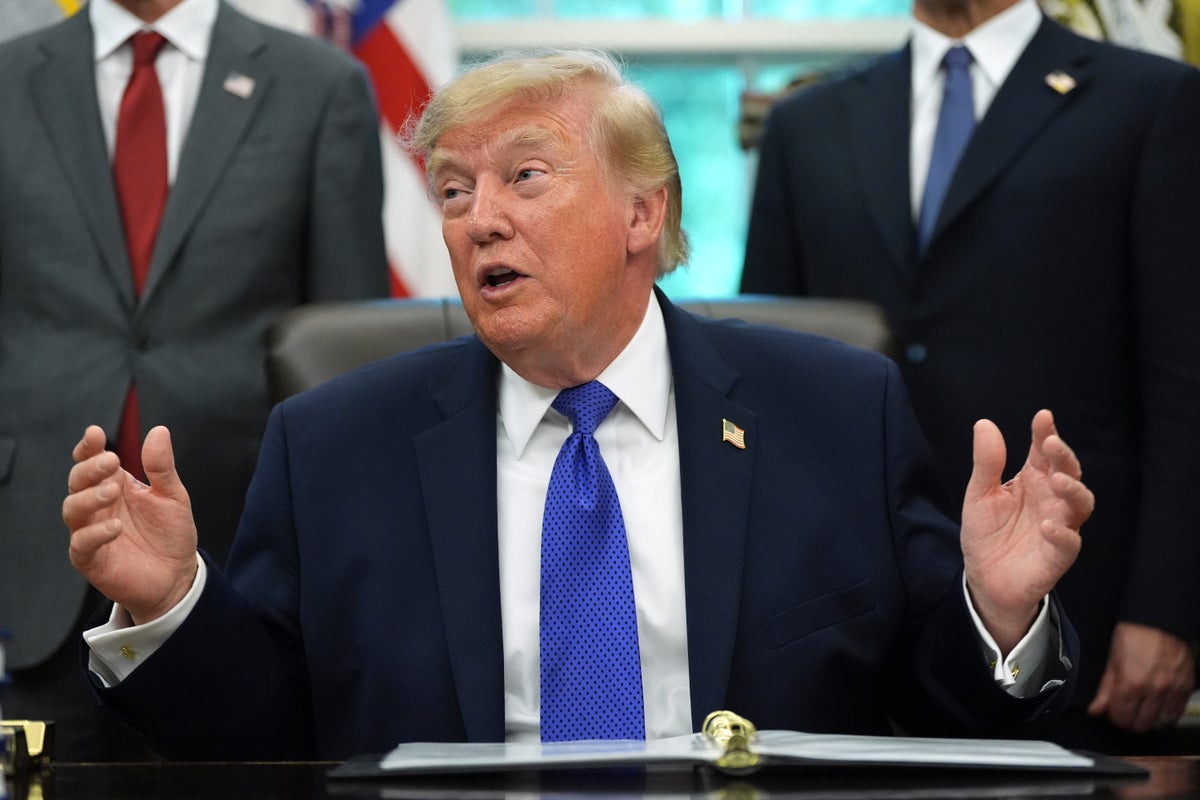
The president spoke to reporters at the White House during an announcement of a new $15bn steel plant set to be built in Iowa, a lifeline for Republicans in that and other Midwestern states. But his most interesting remarks centered, as usual, around the six-plus-month-long war in Iran, which has now sapped the American economy to a painful degree and driven gas prices to new highs right as Trump and his party are due to face voters in the midterms.
He tried to paint a picture of necessary hardship for Americans with those remarks, but polls show his similar warnings have largely fallen on deaf ears. Asked by a reporter whether motorists should expect higher gas prices to persist through October, Trump replied that the real “turmoil” Americans should be worried about is a nuclear attack.
“If you want to see turmoil, and a travesty, let them take out a city with a nuclear weapon,” the president warned. “I'm not only talking about Israel and big parts of the Middle East, but let them hit us with a nuclear weapon.”
In practically the same breath, however, Trump claimed that the threat of Iran’s nuclear program had already been taken out — presumably, by the initial U.S. strikes earlier this year, or by the “obliteration” he previously promised that U.S. forces had unleashed in the summer of 2025.
And therein lies the central issue for the president and his team as they face a deepening skepticism towards the war shared by average Americans. Nearly three in four U.S. adults say they do not believe Trump has a plan for ending the war, and majorities also disbelieve Trump’s stated (and contradictory) position for launching the war in the first place: the imminent threat supposedly posed by Iran’s nuclear program. A Quinnipiac poll as far back as March found that more than half of Americans did not believe the administration then. The White House’s numbers on Iran have only worsened since then.
The president and his team have offered no proof in congressional hearings or other settings that, since the strikes in February, any Iranian nuclear facilities were being reconstituted. Tulsi Gabbard, Trump’s former director of national intelligence, testified under oath to the contrary in March. The administration’s entire premise for the war rests on a wholly unproven assertion that, unlike the controversial explanation for the invasion of Iraq during the Bush era, the Trump machine isn’t even bothering to address.
So why does the president, master of moving on from controversy, keep raising it?
Trump gave a vague answer to another foreign policy question during Monday’s press availability as he insisted that he knew whether the suspects arrested at a British airbase used to support the American war effort against Iran were connected to the Iranian government in any way, but couldn’t tell us. The president instead insisted that he wouldn’t have supported the suspects being released on bail, as the five suspects arrested on terror and explosive offenses at RAF Fairford were on Monday.
"We know everything about them,” the president claimed. At a gaggle with reporters on the tarmac Sunday evening, Trump seemed to nod when asked if the suspects were migrants, though U.K. police have said that all five men are actually British nationals, living in London. Iran’s embassy denied involvement.
The president entered office in 2025 seeking to make foreign policy the forefront of his second-term agenda. Largely delegating domestic policy to the likes of Elon Musk and Stephen Miller, Trump focused on efforts to establish his global leadership credentials, including dispatching deputies in efforts to orchestrate (or simply glom on to) peacemaking efforts around the world. At the same time, he launched an aggressive military campaign against small vessels alleged by the U.S. military to be facilitating drug smuggling in the Caribbean, and launched a wave of U.S. strikes against several key Iranian nuclear installations.
Those efforts culminated in a failed bid to obtain the Nobel Peace Prize, an award he has long coveted since it was given to Barack Obama shortly after Obama became president. The 44th president’s efforts to begin extracting the U.S. from Iraq, a more than decade-long endeavor, as well as his efforts to restart diplomacy with the Muslim world were cited as reasons for Obama’s selection as the 2008 peace prize winner. Trump largely ceased talking about his war-ending efforts after losing the 2025 peace prize, and what was once supposed to be a weeks-long military assault against Iran is now a conflict with no end in sight more than half a year on.
Trump may simply be trying to resuscitate that image now. While Republicans still largely say they approve of his overall job performance, on issue-based polling he has suffered significantly — and on Iran worst of all. Only about half of Republicans in a CNN/SRSS poll last week said that Trump’s actions have helped America’s standing in the world, and only 55 percent of Republicans (Trump’s own voters!) say they currently believe the war was “worth it”. That is not, putting it simply, a group of people who believe they were facing an imminent nuclear attack.
With the midterms approaching, Democrats are likely hoping that the president’s message on Iran remains unfocused and unconvincing, even to Republicans. More and more of his party’s frontline members are breaking rank as a result and are calling for Trump to find a way to resolve the conflict and reopen the Strait of Hormuz, causing gas prices to recover, by November.
For many Republicans, that hope may be their only way to electoral survival in the midterms, which are just 36 days away.