
Trump open to meeting Iran President as Pezeshkian heads to New York for UNGA
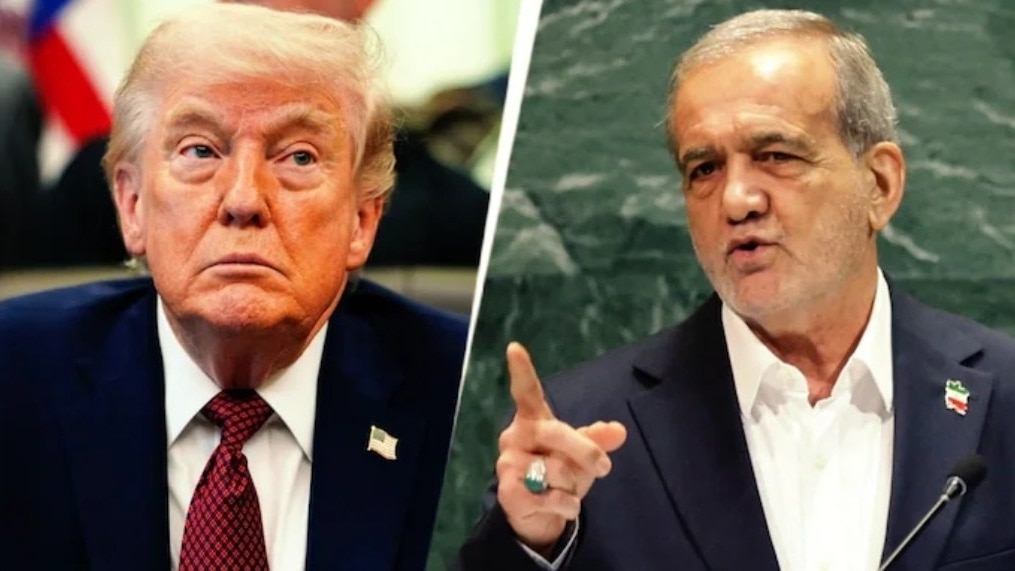
The United Nations General Assembly could provide a rare opening for direct US-Iran contact, with President Donald Trump saying he is "probably open" to meeting Iranian President Masoud Pezeshkian during the gathering in New York.
According to Iranian media, Pezeshkian is due to travel to New York on Tuesday to attend the 81st session of the UN General Assembly, where he is expected to address the UN General Debate, which begins on September 22 and present Iran's position on international developments. He is also scheduled to hold meetings with leaders and officials from several countries on the sidelines of the gathering.
Trump's comments have opened a rare possibility for direct contact between the two presidents in New York. The gathering could provide an opportunity for the two sides to explore diplomatic channels and discuss ways to ease tensions, even as military threats and warnings continue to dominate their relations. Any face-to-face meeting, however, has not been confirmed by either side.
The Iranian delegation's participation follows a decision by Washington to allow Pezeshkian and Foreign Minister Abbas Araqchi to attend the UN gathering. The US government had initially withheld visas from some members of the Iranian delegation, including members of the President's media team, according to Abbasi. Washington later said it would issue visas to some senior Iranian officials.
The United States has also imposed restrictions on the Iranian delegation's movements in New York, according to Reuters.
The possibility of a Trump-Pezeshkian meeting has added a new dimension to a conflict that has continued for nearly seven months.
Trump said he was "probably open" to meeting Pezeshkian when asked whether he would meet the Iranian President on the sidelines of the UN General Assembly. However, he has also maintained a hard line towards Tehran. In a Fox News interview, he said the choices facing Iran were "wiping Iran out," allowing its economy to "rot" or reaching a deal.
"My question is, if and when do I blow the entire nation up," he said.
"They better behave," Trump warned.
Trump's remarks have put diplomacy back into the picture at a time when military escalation remains a real possibility. Washington is weighing its next steps, while Tehran has sought to define the terms under which it would consider returning to the negotiating table.IRAN WARNS OF NEW WEAPONS
While diplomatic possibilities have emerged around the UNGA, Iranian officials have simultaneously warned that any fresh US attack could trigger a wider military response. Hossein Mohebbi, spokesperson for Iran's Islamic Revolutionary Guard Corps, said Monday that Tehran would change the weapons and geography of the conflict if the United States launched another attack.
"If a new aggression takes place, we will definitely change the weapons and geography of the war," Mohebbi said, according to Iran's semi-official Fars news agency. The IRGC has also warned that it has weapons and targets that have not previously been used in the conflict.
Separately, Iran's Khatam al-Anbia Central Headquarters said its intelligence indicated that the US and its allies were preparing a new large-scale attack.
"If the US makes any mistake against the Islamic Republic of Iran, all its positions and interests in the region will be targeted by sustained, effective and painful attacks," it said, according to Tasnim.HOUTHI ATTACKS ADD TO REGIONAL TENSIONS
The uncertainty has unfolded alongside renewed attacks involving Iran-backed Houthi forces in Yemen. The Houthis claimed missile and drone attacks on targets in Riyadh on Saturday, triggering an air-raid alert in the Saudi capital. Saudi authorities said they intercepted and destroyed a ballistic missile and reported no casualties or damage.
Saudi-led coalition spokesperson Major-General Turki al-Maliki said the Houthis had also attempted to target civilians and infrastructure in several parts of Saudi Arabia, but that the attacks were thwarted by the kingdom's air defences.
The developments have added another layer to an already volatile regional situation. Fighting has also intensified in southwestern Yemen, where the Houthis have made gains against Saudi-backed forces.
The New York Times reported that Trump considered joining Saudi Arabia in joint strikes against the Houthis but decided against doing so on Sunday. The report could not immediately be independently confirmed, while the White House did not immediately respond to a request for comment.HORMUZ REMAINS KEY TO DIPLOMATIC CALCULUS
The conflict has also continued to disrupt shipping through the Strait of Hormuz, a vital route for global energy supplies.
Shipping data showed that 17 commodity vessels passed through the strait over the weekend, down from 37 the previous week, Reuters reported. Middle Eastern oil producers have continued sending tankers through the waterway, with some vessels operating with their transponders switched off.
A total of 22 tankers, mainly very large crude carriers, crossed out of Hormuz during the week of September 13, with Saudi Arabia and Iraq accounting for 43 per cent each of the reported volume, according to data from tracking group Kpler cited by Reuters.
The Bab el-Mandeb waterway has also seen reduced traffic. At least 51 vessels made the crossing, while 33 exited the waterway over the weekend, compared with 57 the previous weekend.
Tehran has linked the reopening of the Strait of Hormuz to conditions it says Washington must fulfil, including lifting the naval blockade of Iranian ports, easing sanctions, unfreezing Iranian assets and ending US military threats.
Iranian parliament speaker Mohammad Bagher Ghalibaf said Sunday that Tehran should continue both fighting and negotiating, arguing that diplomacy should be pursued when Iran has the upper hand on the battlefield.- EndsWith inputs from agenicesPublished By: Satyam SinghPublished On: Sep 21, 2026 20:57 IST


