Trump rolls out red carpets for Xi, though he has portrayed China as a global menace
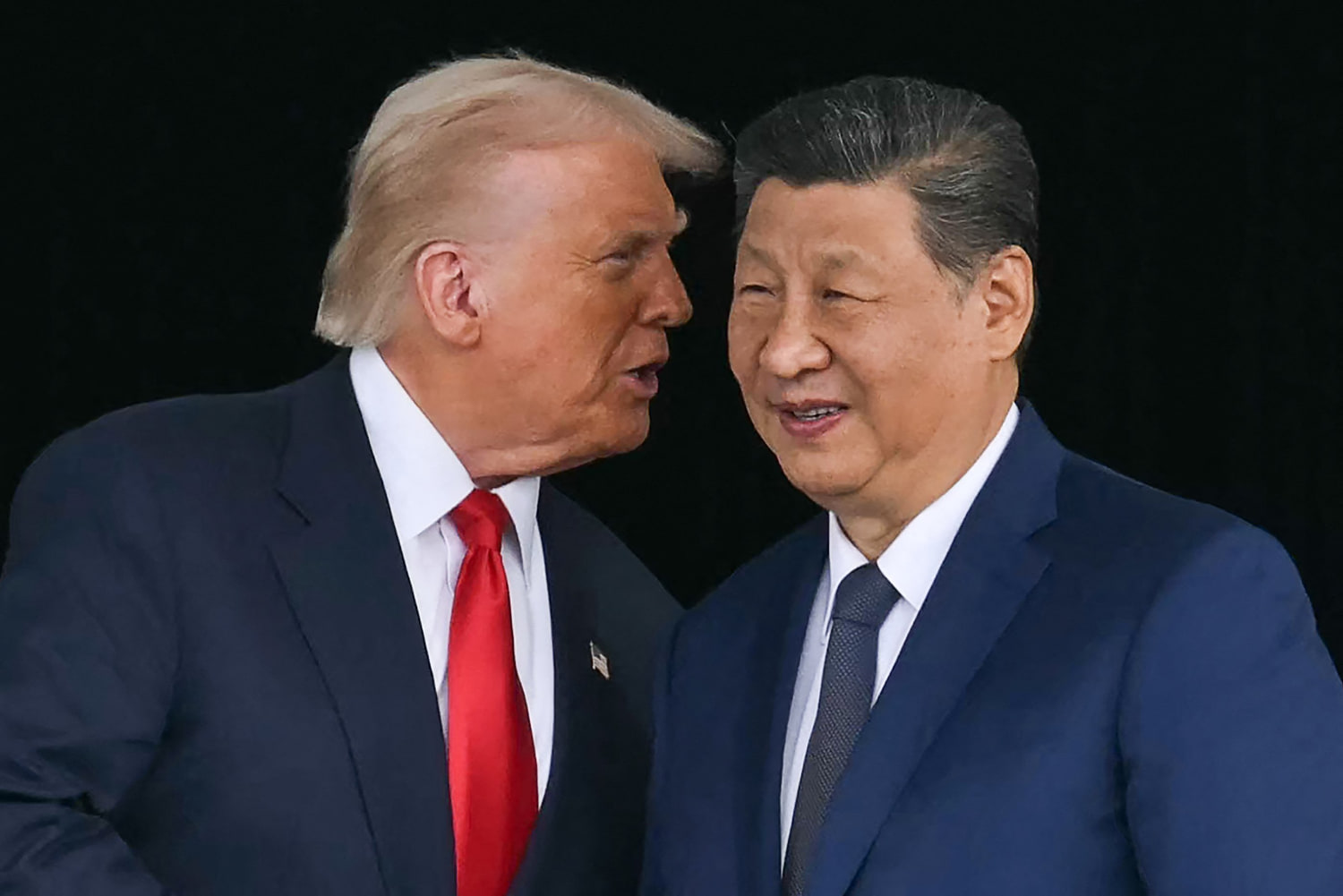
President Donald Trump talks to Chinese President Xi Jinping after their discussion in South Korea last year.Andrew Caballero-Reynolds / AFP - Getty Images fileShareAdd NBC News to GoogleSept. 24, 2026, 9:03 PM EDTBy Peter NicholasWASHINGTON — He has accused China of hacking America’s elections and plundering its wealth, yet President Donald Trump has showered the visiting Chinese leader, Xi Jinping, with tributes and affection during their summit meeting this week at the White House.
Trump met his Chinese counterpart on the tarmac at Joint Base Andrews, Maryland, outside Washington on Wednesday rather than wait back at the White House for an official greeting. It’s the first time he has ever shown a visiting world leader that courtesy.
Trump rolled out a red carpet not once but twice for Xi. The leaders walked side by side down a 100-foot-long red carpet after Xi’s Air China plane landed at Andrews. Another red carpet was laid out Thursday morning when Xi and his wife, Peng Liyuan, arrived at the White House for the summit’s first full day.
In the evening, Trump feted Xi at a state dinner whose menu included sesame-crusted sea bass and braised bok choy, followed by a dessert of vanilla crémeux and honey ice cream.
“As the leaders of our two nations, President Xi and I both understand that we represent different systems, but the ties between our people endure, and we’ve never gotten along better since the first trade ships from New York left the harbor to arrive on the banks of the Pearl River,” Trump said at the dinner.
He gave his guest a statue of a bald eagle as a gift.
All the pomp and ceremony might appear unusual given Trump’s past complaints that China has meddled in elections and exploited the U.S. through trade. Just two months ago, Trump gave a rare primetime speech asserting that China interfered in the 2020 election, which he lost to Joe Biden.
But Trump, who has long believed that personal relationships are key to managing geopolitical tensions, has set out to charm the Chinese leader.
“From the time of my first election in 2016, President Xi and I have forged a friendship — a truly great friendship, actually — built on mutual respect and the vital interests of our people,” Trump said Thursday morning in joint public statements he and Xi made before they held a private meeting in the Oval Office.
Xi struck a cordial tone in his remarks, saying he and Trump have developed a “personal rapport and stayed in touch.”
He also made an announcement certain to delight American children and anyone who has ever logged on to a panda-cam feed for a respite from life’s pressures: China will soon send two giant pandas, Ping Ping and Fu Shang, to the Atlanta zoo, Xi said.
In an unusual rebuke from a member of Trump’s own party, Sen. Roger Wicker, R-Miss., chairman of the Armed Services Committee, said Wednesday in a speech on the Senate floor that, “quite frankly, had the White House asked me for advice, I would have suggested the president not invite Xi Jinping to Washington for such a lavish welcome here in the United States of America, based on all of the troubling issues we have with President Xi and the Chinese Communist Party.”
China may also have aided Iran in the war with the U.S. An F-15 fighter jet that was shot down over Iran in April was most likely hit by a Chinese-made shoulder-launched missile, three people familiar with the matter told NBC News. And in the early days of the seven-month-old conflict, China may have given Iran radar capabilities to help spot stealth aircraft, according to one of the people and a U.S. official with knowledge of the matter.
Honoring the leader of the world’s largest communist country may also undercut an argument Trump has made to discredit Democrats in the midterm elections. He has warned repeatedly that Democratic candidates would steer the U.S. in a communist direction if they are elected.
Sen. Lisa Murkowski, R-Alaska, told NBC News on Thursday, “I personally look at the red-carpet treatment and thought it was a little bit over the top.”
Sen. John Kennedy, R-La., said in an interview that while he didn’t mind seeing Xi thrown a dinner, “I don’t think the president ought to believe his bull----.”
After the U.S. and Israel launched attacks on Iran on Feb. 28, the Iranian regime exerted a chokehold over the Strait of Hormuz, a crucial shipping lane for oil supplies.
Xi “could open up that strait with a phone call, and in a myriad of ways, he is helping Iran with military equipment, intelligence,” Kennedy said. “The guy learned to lie before he learned to talk.”
No substantive breakthroughs are expected at the summit, foreign policy experts said. The two presidents were set to discuss trade, the Iran war and artificial intelligence, among other issues that have divided the U.S. and China. Trump entered the summit in a weakened posture, experts said, vexed by the prolonged Iran war and looming midterm congressional elections in which his party could lose its slim majority. He lacks the leverage needed to wring concessions from China, experts said.
Mark Montgomery, a retired Navy admiral, said at a pre-summit event hosted by the FDD think tank: “We have a president entering this playing a weak hand. I’m not 100% sure President Trump knows he’s playing a weak hand. I am 100% sure that leader Xi knows Trump is playing a weak hand.”
One area of cooperation might be the creation of a hotline that the U.S. and China could use to cope with an emergency arising from rapidly evolving AI technology, Secretary of State Marco Rubio suggested in an interview on “Fox & Friends” this week.
“It’s not a bad idea; it’s one that we’ll explore with the Chinese, among others,” Rubio said.
Along with closed-door meetings, Trump made a point to show off his prized White House projects. He took Xi outside to see the helipad he built on the South Lawn. Both men pointed down at the granite base.
When the leaders passed the press corps at one point, Trump said, “We had a great meeting.” He said Xi was “an expert on stone, aside from many other things, and he loves good granite.”
Walking with Xi along the West Wing Colonnade, Trump pointed to his “Presidential Walk of Fame” — pictures and biographical accounts of former presidents. He paused at the portrait of Biden, showing how he has mocked Biden by referring to him as “Autopen,” the device that presidents have used when they don’t have time to sign their own names to documents. A video snippet released by the White House shows the two presidents chuckling at the picture of Biden, with Trump giving Xi a friendly pat on the arm.
Confronting Xi in the moment may prove difficult for Trump. Xi is president for life; Trump is a president at risk of losing his governing majority in Congress. His approval rating has hit a second-term low.
One source of Xi’s leverage is his hold over rare earth materials, which are used in high-tech manufacturing. Last year, Trump slapped China with steep tariffs, igniting a trade war. Trump has long complained that China’s trade policies have bled the U.S. of wealth.
A statement from the White House in April 2025, tied to Trump’s “Liberation Day” tariffs, said Chinese practices “have given China global dominance in key manufacturing industries, decimating U.S. industry.”
But China’s command of rare earth supplies has proved an effective countermeasure, a resource the Trump administration can’t afford to lose. The two sides agreed to a trade truce last year, and on Wednesday they agreed to extend it two months, from Nov. 10 to Jan. 10.
Add to GoogleCNN, MS Now turned away from state dinner event despite court order to restore access03:33Viewers who wanted to watch the summit live faced unusual difficulties following a media ban that Trump imposed last week. He barred CNN, MS NOW and Politico from entering the White House grounds, prompting them to sue to regain access.
CNN is part of the five-network press “pool” that provides real-time coverage of the president’s public events. In solidarity with CNN and the other outlets that were banned, the other networks opted to suspend video pool coverage of Trump.
Confusion reigned in the hours before Xi arrived. ABC News had been scheduled to provide the pooled video feed. A White House official hurriedly approached a network journalist and asked where the camera was. Absent any clarity over when the banned outlets’ access would be restored, ABC declined to record.
Trump took notice that TV coverage had thinned. He wrote on social media that CNN and MS NOW “refused to cover one of the Biggest and Most Beautiful Events to take place in many years, the arrival at the White House of the Highly Respected President of China, Xi Jinping, and his beautiful wife, Madam Peng.”
Journalists from both CNN and MS NOW were physically unable to cover Xi’s arrival at the White House. Though a federal judge had ruled overnight that their access must be restored, they were still barred from entering the White House until about two hours after Xi showed up.
During a photo spray with Xi later in the day, Trump joked that China had the friendliest press corps, according to a press pool report.
A Reporters Without Borders survey of press freedoms worldwide ranked China 178th out of 180 countries, sandwiched between North Korea and Iran.
Peter NicholasPeter Nicholas is a senior White House reporter for NBC News.