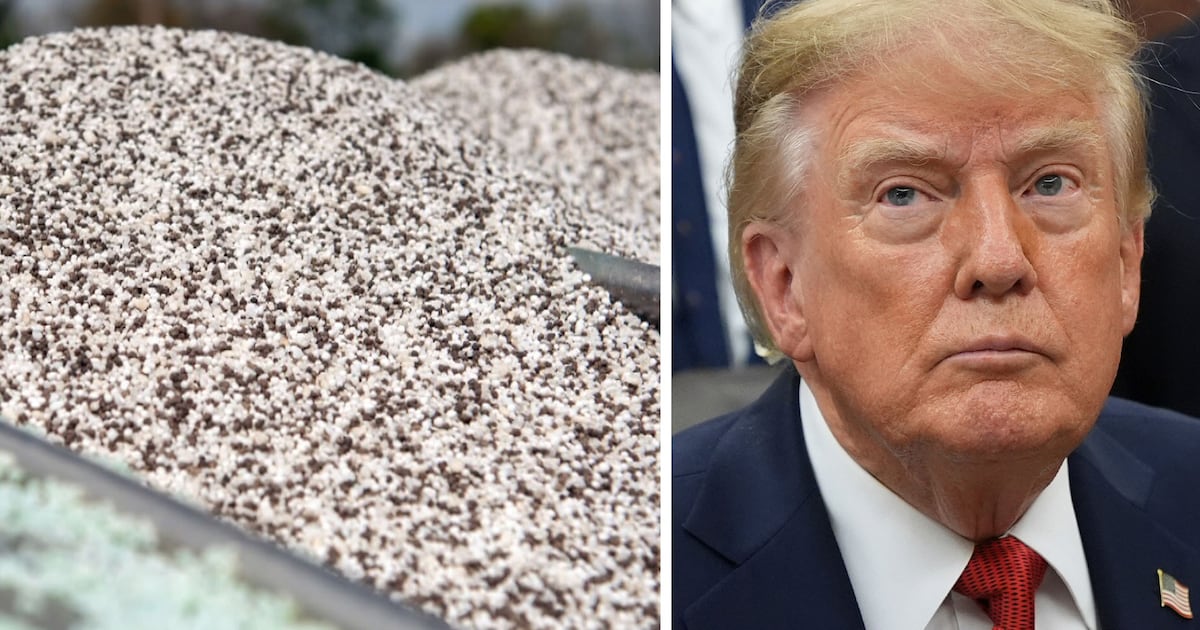
Trump says U.S. working on deal to buy potash from Belarus instead of Canada

The Mosaic Potash plant is seen in Belle Plaine, Sask. U.S. President Donald Trump says he's working on a deal to buy potash from Belarus, a close ally of Russia, rather than Canada. (Chris Young/The Canadian Press)Social SharingU.S. President Donald Trump said on Monday that Washington is working on a deal to purchase potash from Belarus for less than what the U.S. currently pays to Canada.
"The United States is working on a massive Deal with respect to the purchase of Potash from Belarus," Trump said in a post on social media.
"The pricing would be for substantially less than we are currently paying to Canada, very good news for our Farmers and Ranchers."
The mineral helps improve a plant's disease resistance and crop quality and increases yields.
The announcement signals Trump's willingness to use alternative suppliers as leverage in his trade disputes with Canada, which supplies the vast majority of U.S. potash imports. It could also mark a further thaw in Washington's relations with Belarus after the lifting of sanctions.
Why isn't Canada blocking the Welland Canal? Other trade war questions answered
Canada-U.S. Trade Minister Dominic LeBlanc and Saskatchewan-based Nutrien, the world's top potash producer, had no immediate comment.
Belarusian President Alexander Lukashenko, seen here in August, says Belarus resumed sales of potash to the U.S. after Washington lifted sanctions, but he wants about $40 million US previously frozen in the U.S. banking system returned. (Anastasia Barashkova/Pool/Reuters)Lukashenko wants funds returnedBelarusian President Alexander Lukashenko, a close ally of Russia, said on Sept. 11 that his country resumed selling potash to the United States following the lifting of U.S. sanctions. But Lukashenko also said he wants Washington to return more than $40 million US that is "stuck" in the U.S. banking system.
Belarus and Russia are major potash producers, but sanctions and the closing of a key port on Lithuania's Baltic coast have made those supplies expensive to ship to the U.S. through Russia's Arctic. The U.S. is still receiving potash exports from Russia, but the overwhelming majority of supply comes from Canada.
Canada and the EU are getting cosy. These charts show how our economies stack up
Fertilizer analyst Josh Linville of StoneX said he doubts Belarusian potash will play a major role in either supplies for U.S. farmers or in lowering prices that they presently pay.
"I'm afraid the impact would be limited. We have not struggled to find potash," he said. "We have more than enough to go around. It is phosphate and nitrogen that we need help with."
Even if Lithuania opened its port of Klaipeda to Belarusian potash exports, the relatively low current value of potash makes it hard to justify exports through the Baltic and across the Atlantic Ocean, Linville said.
The Iran war has restricted nitrogen and phosphate fertilizer supplies, blocking most Gulf shipments of nitrogen fertilizer, natural gas and sulfur — a key component in phosphate mining.