
Trump wanted Canada but Europe's 'better manners' is winning Carney over
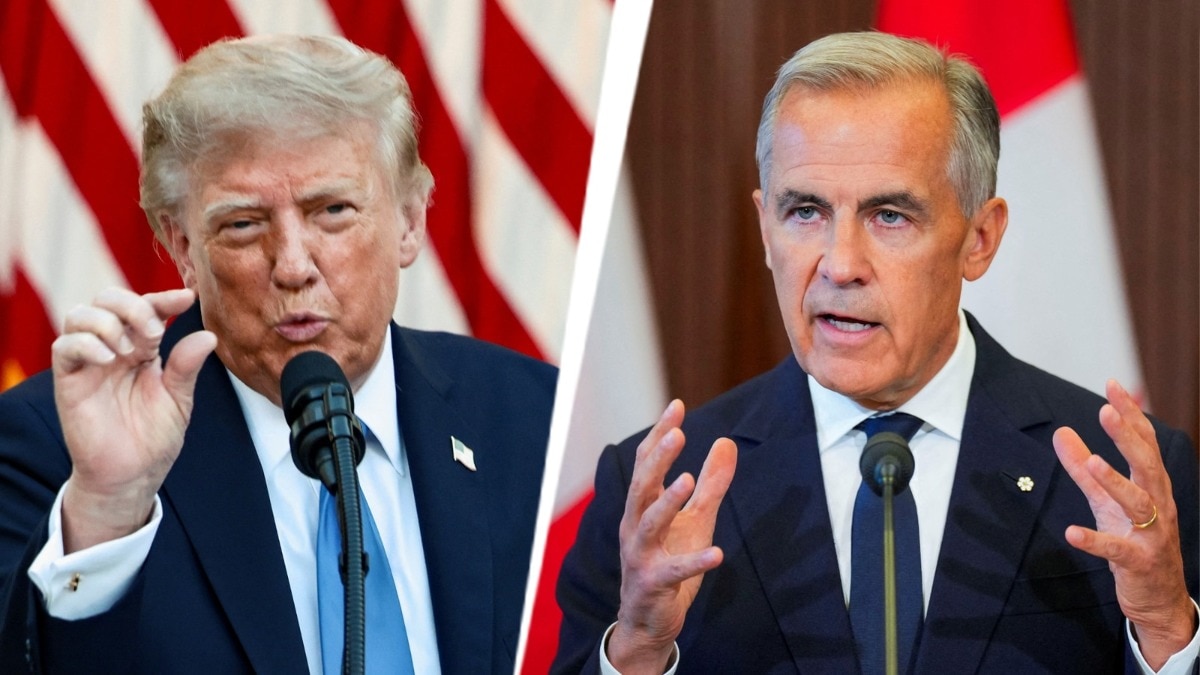
US President Donald Trump wanted Canada as America's 51st state. But after a year of threats, public taunts, personal jibes at Canadian Prime Minister Mark Carney, a tariff war and constant snarks, he may have ended up pushing the US's neighbouring country and long-time ally into Europe's arms.
First came European Commission President Ursula von der Leyen's invitation on Wednesday for Canada to join the EU as its first "associate member" -- a label that does not currently exist.
Then came Carney's response on Thursday: "We welcome this ambition", delivered before a packed European Parliament in France's Strasbourg, with von der Leyen in the audience.
Whether the idea eventually materialises or not, its symbolism cannot be overlooked. Trump, in his bid to bring Canada closer to the US, has instead succeeded in pushing its long-time ally in North America towards Europe.
And Trump did not appear pleased with the newfound bonhomie. He issued a fresh tariff threat, warning that the United States could impose "heavy tariffs" on the European Union if any new agreement with Canada was seen as a "hostile act".Hoewever, Carney went on to say his push to deepen ties with the European Union was not an attempt to build a new geopolitical bloc, as he rejected the idea of creating a rival power centre "with better manners" in an apparent jibe at Trump.
In recent times, Canada and the EU have both faced Trump’s aggressive approach to trade, prompting efforts on both sides to build new partnerships and protect their economies.
Speaking to EU lawmakers in France, Carney said a closer relationship with Europe was meant to create "resilience" rather than "self-sufficiency". "I’m not proposing a third bloc in order to become a great power rival, only with better manners," he said.
"We do not seek power to dominate others. On the contrary, we are pursuing resilience so no one can control our open markets, impair our sovereignty, threaten territorial integrity or undermine our freedoms, our democracies, our rule of law," Carney added.
Carney later told reporters that Canadian lawmakers would debate and eventually vote on the "final structure" of any new alliance with the EU. He also stressed that Canada was neither in a position to become a full member of the European Union nor trying to do so. "This is an opportunity to make Canada stronger, more sovereign, more independent, more prosperous, more sustainable," he said.
Canada is already in a trade war with the United States, its biggest trading partner, which has added urgency to Ottawa’s efforts to move closer to the EU. Trump said on Wednesday that the US could place "heavy tariffs" on the bloc if he judged any new arrangement with Canada to be unfriendly. "If it’s a good intention, that’s fine. If it’s a bad intention, we’ll put very heavy tariffs on Europe, which is a possibility," Trump told reporters.
In a speech that at times shifted into French and drew on the historical links between Canada and Europe, Carney argued for closer cooperation to build resilience against what he called "new storms". He pointed to climate change, the weaponisation of trade and the weakening of democratic norms. "Europe and Canada are stronger together," he said. He added that "a Canada-EU alliance would create a beacon for other democracies" and said other countries could also be allowed to join.
Carney welcomed von der Leyen’s idea of making Canada an EU "associate member" and said polls showed an "overwhelming majority" of Canadians also backed stronger ties. He said Canada and Europe should work together on critical minerals and energy security, and pointed to Canada’s capacity to supply Europe with liquefied natural gas and hydrogen.
He also identified defence production, payments and artificial intelligence as areas for deeper cooperation, saying Canada and Europe could jointly develop AI safety protocols.
Von der Leyen highlighted many of the same areas in her speech on Wednesday, though unlike Carney she did not refer to reciprocal work and study visas for young people.
Carney said Canada should be allowed to take part in the EU’s Erasmus+ and Horizon programmes, which fund education and scientific research respectively. "We should deepen our people-to-people ties, allowing our youth to live, work and study where they want on either side of the Atlantic," he said. Canada already has reciprocal arrangements with many EU member states that allow people aged 18 to 35 to work and travel in Europe.
The proposal has also met some hesitation within Europe. Some EU officials have questioned the idea of giving Canada a status that does not exist at present. German government spokesperson Stefan Kornelius said on Wednesday that Berlin welcomed moves towards an "especially close partnership" with Canada and was open to "discussing new models that reflect the special significance of the relationship", but added that the term "associate member" should be reconsidered.
Carney said the "precise nomenclature" was a "question for Europe" and added, "What matters is the substance."
He said more details could be worked out at an EU-Canada investment summit due to be held in Montreal next month. Spain’s Prime Minister Pedro Sanchez appeared to back closer ties. During Carney’s speech, Sanchez posted an image on X of an EU flag with a red maple leaf beside the usual 12 golden stars.
"Associate membership does not exist," Tinatin Akhvlediani, head of EU enlargement at the Center for European Policy Studies, a Brussels-based think tank, told CNN on Wednesday. She said countries such as Ukraine, Moldova and Georgia have "association agreements" with the EU, but these require alignment with the bloc’s laws, something Canada was unlikely to want.
Canada and the EU already have sizeable trade ties, though the CETA trade agreement reached in 2017 still has not been ratified by 10 EU member states, including France, Italy and Poland. That could become a hurdle to any broader EU-Canada arrangement.
According to the European Commission, bilateral trade in goods and services reached 130.8 billion euros (151 billion dollars) last year, up by more than 80 per cent over the past decade. The EU's major exports to Canada include cars, machinery and pharmaceuticals, while Canada's exports to Europe include crude oil, fertiliser, critical minerals and base metals.
Carney's pitch for a closer Canada-EU partnership has therefore opened up questions over trade, defence, research and youth mobility, while also drawing scrutiny over what form such a relationship could take and how it may affect ties with the United States.- EndsPublished By: Sayan GangulyPublished On: Sep 17, 2026 22:14 IST
