Trump Worried Over Handpicked GOP Nominee in North Carolina—What Polls Show - Newsweek
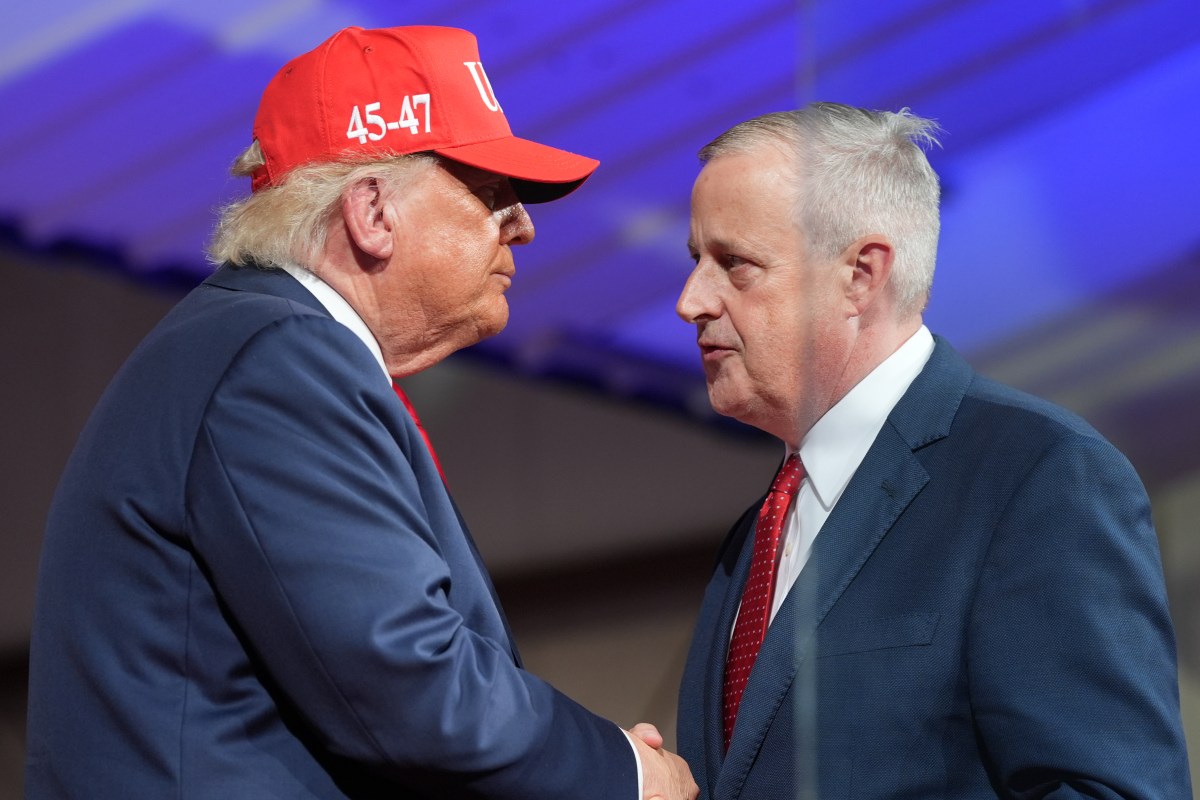
President Donald Trump said Friday that he is concerned about Michael Whatley’s campaign for U.S. Senate in North Carolina, as a major Republican-aligned political action committee paused advertising in the race and recent polls showed Democratic former Governor Roy Cooper pulling ahead.
“I am worried about him,” Trump told reporters Friday as he departed for a campaign rally in Alabama. “I hope he wins.”
Trump also praised Whatley, a former chairman of the Republican National Committee (RNC), calling him “a great man” and saying he “was a great leader for the whole Republican Party” when Trump won. The president added that Whatley “would be a great senator.”
The comments arrive the same day the Senate Leadership Fund, a major Republican-aligned super PAC, announced it would pause its remaining advertising spending in North Carolina and redirect resources to other Senate races. The group had already spent more than $30 million in the state.
Whatley is running against Cooper for the Senate seat being vacated by Republican Senator Thom Tillis.
Newsweek has reached out to Whatley and Cooper for comment.
Recent polling has consistently shown Cooper ahead of Whatley, although the size of the lead has varied among pollsters.
The AARP poll, published last week, found Cooper receiving 53 percent support compared with 42 percent for Whatley. The survey was conducted September 17-20 among 1,115 likely voters, with a margin of error plus or minus 2.9 percentage points. The same poll showed a different picture among older voters. Whatley led Cooper 51 percent to 45 percent among voters age 50 and older. Cooper led among voters younger than 50.
An InsiderAdvantage poll conducted September 16-17 had Cooper at 48.4 percent and Whatley at 42.5 percent, while a High Point University survey conducted September 16 found Cooper leading 50 percent to 42 percent, and a Quantus Insights poll conducted September 21-22 put Cooper at 48.4 percent and Whatley at 43.3 percent.
A Carolina Journal poll released September 17 found Cooper with a larger lead, 49 percent to 34 percent, with 12 percent undecided.
The surveys use different methodologies and samples, so their results are not directly interchangeable. Nevertheless, the recent polling cited above has consistently shown Cooper ahead.
The polling results come amid a significant change in Republican campaign spending. The Senate Leadership Fund had previously pledged as much as $71 million toward the North Carolina race. The group is now pausing its remaining advertising in the state and redirecting money toward other contests, according to reports.
The move does not mean Whatley has ended his campaign or that Republican groups have withdrawn all support.
Whatley has continued to campaign in the state and previously said he expected to receive the resources necessary to compete.
“We are going to continue to get support,” Whatley said at a September 25 event in Pittsboro. “We just had the president down last week. We had Vice President [JD] Vance in-state earlier this week. We will get the support we need to win this race.”
The spending decision instead reflects how Republican groups are allocating finite campaign resources among races across the country.
Whatley, a North Carolina Republican, previously served as chairman of the RNC. He resigned from that position to run for the Senate.
He previously served as chief of staff to former Republican Senator Elizabeth Dole, and chaired the North Carolina Republican Party from 2019 to 2024. He also worked in the U.S. Department of Energy during the George W. Bush administration.
Whatley is now running for office for the first time.
Trump has played a central role in Whatley's political career in recent years. He backed Whatley for chairman of the RNC in 2024, and Whatley is now Trump's endorsed candidate in the North Carolina U.S. Senate race.
Trump also campaigned with Whatley in North Carolina, including at a September rally in Gastonia. At that event, Trump asked voters to view the Senate contest as another opportunity to support his agenda.
“In this election, I’m asking you to pretend I’m on the ballot just one more time,” Trump said.
The president's involvement has made the race an important test of his political influence in a state he carried in each of his three presidential campaigns.
North Carolina is one of the most closely watched Senate contests of the 2026 election.
Democrats have not won a Senate election there since 2008, although the state has remained competitive in presidential and gubernatorial elections. Trump also narrowly carried the state in the 2024 presidential election.
The Tar Heel State's electorate also includes a large number of unaffiliated voters. North Carolina's State Board of Elections says roughly one-third of registered voters are unaffiliated, alongside roughly one-third registered as Democrats and one-third as Republicans.
That makes the performance of independent and unaffiliated voters a crucial part of the race. Recent polling has shown Cooper holding an advantage among independents, although individual surveys differ in their findings and the race remains subject to change as Election Day approaches.
The AARP poll found Cooper leading among independent voters, while Whatley held an advantage among voters age 50 and older.
The contest is also significant because Democrats are seeking to gain the four Senate seats they would need to take control of the chamber, while Republicans are defending their existing majority.
North Carolina voters will choose their next U.S. senator on November 3.
The remaining weeks of the campaign will give Whatley and Cooper an opportunity to respond to the current polling, reach undecided voters and make their respective cases on issues including the economy and other matters affecting North Carolina voters.
For now, the most recent polling generally shows Cooper ahead, while Whatley continues to campaign with Trump's backing.
Newsweek’s reporters and editors used Martyn, our AI assistant, to produce this story. Learn more about Martyn here. Contact Newsweek editors on this story: Edward T. Cummins