Trump, Xi and Putin’s Warless Peace Declaration: Dissected - Newsweek

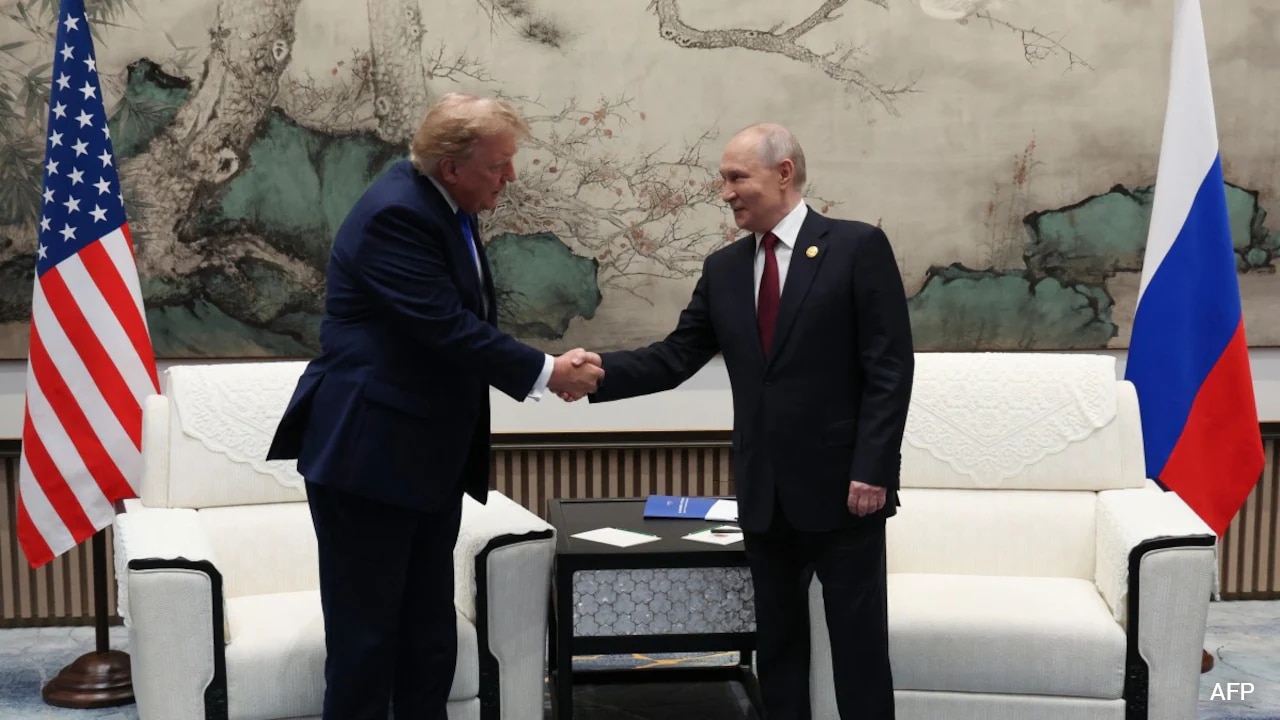
At a lakeside villa in Shenzhen on Thursday, Donald Trump, Xi Jinping, and Vladimir Putin produced a joint "Declaration toward Peace" at a trilateral summit that Russians would like us to think was Yalta 2.0. But the only war these unlikely peaceniks mention—and there are plenty to choose from—is a nuclear one that hasn’t even happened.
Not Ukraine, where Russia’s full-scale invasion nears its fifth anniversary. Not Iran, where Washington and Tehran have settled into a frozen war of rival blockades around the Strait of Hormuz. Gaza and Sudan go unnamed, as does Taiwan, where the threat of one hangs overhead, sometimes literally as Chinese jets practice for an invasion.
What the three not-so-great men did agree on fits on an index card. And, like most index cards, it probably belongs in the trash.
The U.N. should be reformed by the countries that hold its veto. The world needs more refined fuel. International courts should mind their own business. And nuclear war is bad, a view Ronald Reagan and Mikhail Gorbachev inked together 41 years ago this week.
This is not a peace plan. It’s not even a Yalta-style carve-up into spheres of influence, which, grim as it is, would at least be tangible. Instead, it flatters three large egos belonging to men who agree on little except that none of them should answer to anyone: not to courts; not to countries without a U.N. veto; not to treaty limits; not even really to their allies. Nearly every commitment shields the signatories from accountability, tries to vibe more fuel into existence, or recycles an ancient vow.
Call them what you like. The three amigos! The three musketeers! The three little pigs! Here’s their dodgy declaration, as distributed by China and Russia, Dissected.
"China-Russia-U. S. Heads of State Declaration toward Peace"
"Toward" is doing a great deal of work, unless they mean tanks rolling forward. Peace through strength, right? Putin and Trump both raised Ukraine in the room. None of it reached the page. Even the 1987 Reagan-Gorbachev summit statement named Afghanistan, the Iran-Iraq War, and Cambodia. Volodymyr Zelensky feared Shenzhen might produce a Ukraine deal struck behind Kyiv’s back. But it delivered nothing on Ukraine at all.
"The Russian and U.S. heads of state expressed appreciation to China for hosting this historic trilateral Summit."
How sweet. The most concrete commitment in the declaration is a thank-you note, and Putin owes Xi plenty. China is propping up his war in Ukraine, and, really, Russia has no business pretending it’s a great power. He should have been there to serve Xi and Trump tea.
"The three heads of state had an in-depth exchange of views on the current international situation and committed to maintaining strategic stability and international security."
The in-depth exchange lasted about 90 minutes. As for "maintaining" strategic stability, there’s less to maintain than there was. The war in Ukraine thunders on. Russia wages hybrid war against NATO allies. The U.S. and Israel upended what was left of Middle East stability when they took on Iran in February. Meanwhile, the Iranian regime is still the Iranian regime. And New START, the last treaty limiting U.S. and Russian strategic nuclear forces, expired on Feb. 5, leaving the world’s two largest arsenals uncapped for the first time in more than half-a-century. Sorry, what were we maintaining again?
"As permanent members of the United Nations Security Council, China, Russia, and the United States committed to reform the U.N. so that the U.N. can respond more effectively to global challenges and conform to its fundamental mission of international peace and security."
Three of the five veto holders agree that the U.N. needs fixing, without saying what is broken. "Reform" seems to mean a U.N. even less able to constrain permanent members more interested in war and insecurity.
"The three countries plan to increase the production and supply of refined petroleum products for the benefit of all nations."
Look, everyone wants cheap gas. Americans wanted it before the midterms and got Trump’s war in Iran and $6 diesel instead. China, too, lost a key oil supplier when the U.S. blockaded Iran. Russia’s oil industry, which funds its war in Ukraine, is under constant attack. So what does this mean in practice? Will China press Iran into a war-ending deal that lifts the blockade? Will Trump again ease sanctions so Russia can sell more oil? Will he punish Ukraine for defending itself by striking Russian refineries? And how does OPEC feel about all this?
"They reaffirmed the importance of stable energy flows."
Some flows are more stable than others. The U.S. and Iran both maintain blockades around the Strait of Hormuz, once the conduit for a fifth of the world’s oil and natural gas. On October 26, a U.N. commission of inquiry concluded that Russia’s attacks on Ukraine’s energy grid, which have cut power and heat to millions through freezing winters, amounted to war crimes and crimes against humanity. Less than a month later, Russia put its name to this. Go figure.
"Paramount" will come as news to Nicolás Maduro, erstwhile ally of China and Russia. U.S. forces captured him in a raid on Caracas on January 3 and spirited him to New York, where he is asking a federal judge to throw out the charges on grounds of head-of-state immunity. Washington says it stopped recognizing him as Venezuela’s legitimate president in 2019. But a principle that applies only to leaders you recognize is not paramount. It is conditional. Did Trump really agree to this?
"…and concurred that the International Criminal Court and other similar bodies must not abuse their jurisdiction."
None of the three countries belongs to the court, but one of the leaders is wanted by it: the ICC issued a warrant for Putin in March 2023 over the unlawful abduction of Ukrainian children. Before the meeting, Trump said the court "has gotten out of control." All three leaders may fear the ICC and "similar bodies" will "abuse their jurisdiction." But many people fear those three leaders will abuse their power, which is precisely why institutions like the ICC are needed.
"The three heads of state reaffirmed that a nuclear war cannot be won and must never be fought."
"Reaffirmed" is the right word for a sentence with a long, long résumé. Reagan and Gorbachev signed it in Geneva in 1985. The leaders of the five permanent Security Council members repeated it on January 3, 2022. Fifty-two days later, Russia invaded Ukraine and began hinting at nuclear use. In Shenzhen, Xi called for nuclear weapons to be banned and eliminated, as he has before, even as China’s arsenal has grown to more than 600 warheads. Trump last year ordered the Pentagon to resume nuclear testing "on an equal basis" with China and Russia, and a senior State Department official has not ruled out the first full-scale U.S. underground test since 1992. Three leaders who agree nuclear war is futile and verboten all seem to be pushing the world closer to it.
"The three countries will conduct a dialogue on reducing nuclear risks and preventing the proliferation of nuclear weapons."
A dialogue is not a negotiation, or a commitment to anything but jaw-jaw, and this one has no date, venue, or agenda. In 1987, Reagan and Gorbachev welcomed an agreement to set up Nuclear Risk Reduction Centers in both capitals. In 2026, the risk-reduction offer is a conversation. China has little reason to accept limits while its arsenal is a fraction of the more than 5,000 warheads each held by the U.S. and Russia, and Trump conceded in Shenzhen that giving up nukes is "not an easy thing to do." On proliferation, Trump told the room the U.S. would not let Iran acquire a nuclear weapon, and it went to war with Iran in February for that very reason. Yet China and Russia have used trade and more to support Tehran during that war. Sometimes, it takes more than talk to stop nuclear proliferation.