
Trump’s Disapproval Rating on Cost of Living Worse Than Bush on Iraq War - Newsweek
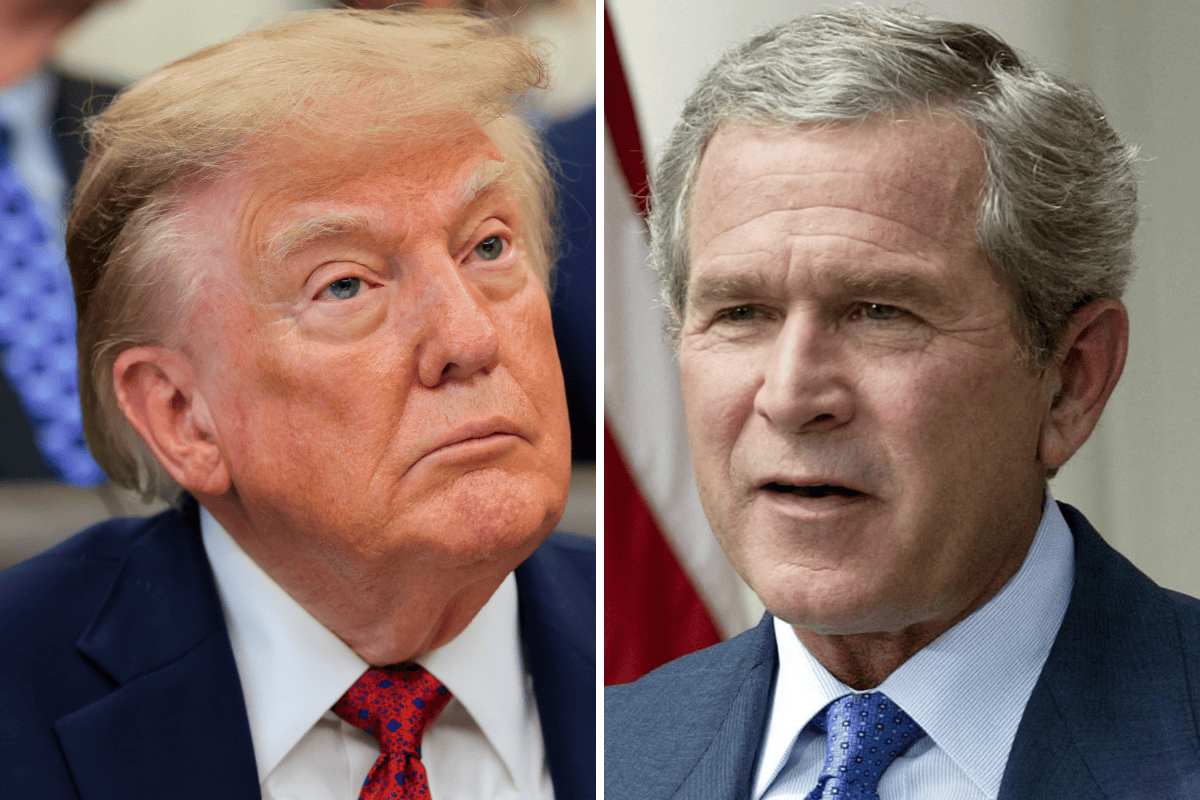
President Donald Trump’s disapproval rating on the cost of living has exceeded the level recorded for former President George W. Bush’s handling of the Iraq War, according to a comparison of national polls.
An AP-NORC poll conducted from September 24 to 28 found that 82 percent of U.S. adults disapproved of Trump’s handling of the cost of living, while 17 percent approved. The survey questioned 2,140 adults and had a margin of sampling error of plus or minus 2.9 percentage points.
That was 11 percentage points higher than the 71 percent who disapproved of Bush’s handling of the Iraq War in a CBS News/New York Times poll conducted from January 11 to 15, 2009, among a random sample of 1,112 adults nationwide, interviewed by telephone, with a plus or minus 3 percentage point margin of error.
The comparison is striking but not definitive. The surveys were conducted by different organizations, used different questions and measured opinion under substantially different political and economic conditions.
Still, the most recent result is not an outlier: several recent polls show Trump’s approval on inflation or the cost of living falling into the teens.
The samples and methodologies (included in full at the end of this article) of the polls mentioned above vary: some surveyed all U.S. adults, while others focused on registered or likely voters.
Their results should therefore be treated as several snapshots pointing in the same direction, rather than as directly interchangeable measurements.
White House spokesman Davis Ingle said "the ultimate poll" was the November 5, 2024, election, when voters elected Trump to pursue what Ingle called his "popular and commonsense agenda."
Ingle pointed to the administration’s efforts to "create jobs, cool inflation, increase housing affordability" as evidence of "historic progress."
Newsweek emailed the White House on Friday morning for further comment.
Living costs affect voters through groceries, gasoline, rent, utilities and other recurring household expenses. Weak ratings on affordability therefore present a direct political risk ahead of the midterm elections.
The scale of public dissatisfaction with Trump’s handling of the cost of living has few obvious modern precedents.
The closest historical comparison in the January 2009 CBS News/New York Times poll may be Bush’s rating on the economy rather than Iraq. That survey found 77 percent disapproved of Bush’s economic performance as the country struggled through the financial crisis.
Trump’s current cost-of-living disapproval was five points higher, although "the economy" and "the cost of living" are not identical measures.
An ABC News/Ipsos poll, conducted October 29-30, 2021, among a random national sample of 514 adults, with a margin of sampling error of 4.7 points, put approval of former President Joe Biden’s withdrawal from Afghanistan at 34 percent, meaning roughly two-thirds did not approve, while historical Gallup data show that approval of President Lyndon B. Johnson’s handling of the Vietnam War fell as low as 27 percent in 1967.
Trump’s ratings on the Iran conflict have also been deeply negative. A CBS News/YouGov poll, conducted from September 8 to 11 among 2,460 U.S. adults, with a plus or minus 2.3 percentage point margin of error, found that 64 percent disapproved of his handling of the situation with Iran, while 36 percent approved.
Crises outside wartime have produced similarly stark judgments.
In an August 2006 CNN poll, 64 percent disapproved of Bush’s handling of the aftermath of Hurricane Katrina. The poll surveyed 1,003 adults and had a sampling error of plus or minus 3 percentage points.
At the height of the Watergate era, 71 percent disapproved of former President Richard Nixon’s handling of domestic policy, according to historical polling cited by the American Enterprise Institute. That finding covered domestic policy broadly, rather than Watergate alone.
Even former President Gerald Ford’s pardon of Nixon generated less opposition than Trump’s current handling of the cost of living.
Gallup found that 53 percent opposed a pardon before Ford issued it, while a June 1976 poll found 55 percent believed he had done the wrong thing.
The comparisons, which are not a definitive historical ranking, illustrate how unusual Trump’s 82 percent disapproval figure is.
In the September 2026 CBS News poll, 87 percent of likely voters said the economy would be "very important" to their congressional vote, while 82 percent said the same of inflation.
Inflation ranked ahead of health care, immigration, taxes, the U.S.-Iran conflict and tariffs in the share calling it very important.
The survey also found that higher prices were creating direct pressure on household finances.
Among registered voters, 33 percent described higher prices for goods and services as a financial hardship and another 39 percent said prices were difficult, though not a hardship. Only 4 percent said their finances had not been affected.
That gives Democrats a straightforward political case: turn the congressional elections into a referendum on affordability and connect Republican candidates to a president whose inflation ratings are deeply negative.
CBS News found that 45 percent of likely voters viewed their congressional ballot as a vote in opposition to Trump, compared with 28 percent who saw it as a vote in support of him.
Forty-eight percent said a Trump endorsement would make them less likely to back a candidate, while 21 percent said it would make them more likely to do so.
The poll’s electoral model produced a central estimate of 228 Democratic House seats and 207 Republican seats, while emphasizing a broad range of possible outcomes.
Marquette interviewed 1,023 U.S. adults from September 2 to 9, with a plus or minus 3.3-point margin of error; CNN/SSRS surveyed 1,206 adults from September 16 to 17, with a plus or minus 3.5-point margin of error; Reuters/Ipsos conducted an online poll of 1,277 adults from September 17 to 20, with a plus or minus 3-point margin of error; and Fox News surveyed 1,211 registered voters from September 11 to 14 by telephone and online, with a plus or minus 3-point margin.
Newsweek’s reporters and editors used Martyn, our AI assistant, to produce this story. Learn more about Martyn here.
Contact Newsweek editors on this story: John Fitzpatrick and Tony Phillips.
