
Trump’s envoy arrives in Australia after lengthy delay, ‘grumbling’ about pet quarantine
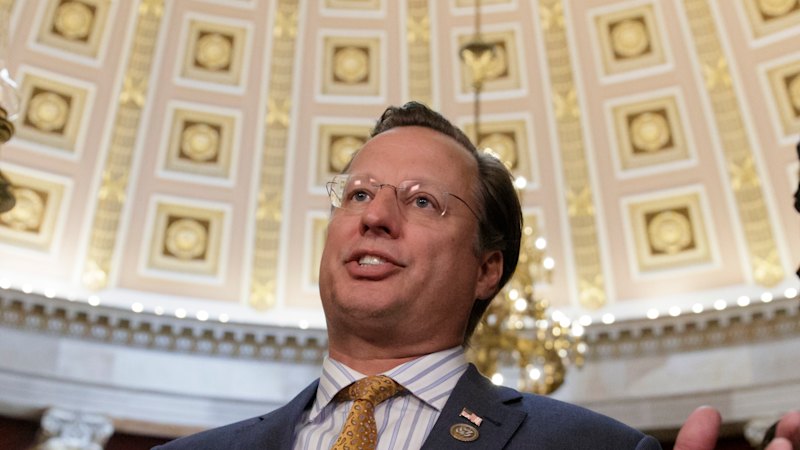
Incoming United States ambassador David Brat has arrived in the country to begin his role as President Donald Trump’s top representative in Australia, ending an almost two-year wait for the post to be filled.
Brat landed in Sydney on Friday morning and will start work next week in Canberra, where he will present his diplomatic credentials to Governor-General Sam Mostyn.
The ambassador’s arrival came as former prime minister Paul Keating branded it “very disturbing” that a prominent Republican congressman said the US nuclear submarines that will rotate through Western Australia under the AUKUS pact could carry nuclear weapons.
Dave Brat during his time as a Republican congressman representing Virginia.APBrat, a Detroit-born former Republican congressman, was confirmed by the US Senate in August after being nominated by Trump in April.
As ambassador, Brat will be tasked with advancing the US-Australia alliance, including driving forward the AUKUS defence pact and co-operation on critical minerals.
But Australia’s efforts to regulate the US-dominated tech industry, including through a crackdown on social media algorithms and the news bargaining code, could cause tension.
The former Virginia congressman, 62, came to prominence in 2014 when he defeated then-Republican leader of the House of Representatives, Eric Cantor, in a preselection contest that was an emblematic battle between the conservative establishment and upstart Tea Party movement.
After losing his seat, he became the senior vice president of business relations at Liberty University, a private, evangelical Christian university.
He has regularly appeared as a guest and fill-in host on former Trump strategist Steve Bannon’s podcast.
The Australian Financial Review reported this week that Brat had been “heard grumbling about how long it will take for his dog to get through Australia’s strict biosecurity border controls” to associates in the US.
Canine arrivals in Australia typically require six months for health checks, tests and paperwork and the dogs are then required to spend up to a month in a Melbourne quarantine facility.
At his confirmation hearing in May, Brat identified three priorities for the relationship: critical minerals and commercial engagement, defence co-operation and broadening the two countries’ partnership in the Indo-Pacific.
“Australia has been with us every step of the way with loyal friendship and with courage,” he told the hearing. “I love the Australian people I have met in life – I appreciate their decency, their wit, their sense of humour above all.”
The Centre for Strategic and International Studies’ Australia chair Charles Edel said: “In his May confirmation hearing before the U.S. Senate, Ambassador Brat sketched a policy agenda with a clear emphasis on commercial diplomacy — anchored by critical minerals — paired with a renewed push on defense cooperation, and set within a broader commitment to collaborative Indo-Pacific diplomacy.”
Brat’s predecessor Caroline Kennedy, part of Democratic Party royalty, departed Australia at the end of 2024 following Trump’s election victory.
Brat, a passionate tennis fan, is expected to play tennis with Prime Minister Anthony Albanese, who enjoys hosting guests for a hit at the Lodge in Canberra.
Foreign Minister Penny Wong said following Brat’s appointment that he would find Australia to be a “warm host and good friend”.
Trump announced diplomatic appointments for scores of other countries before Australia, prompting claims the country was a low diplomatic priority for his administration.
Albanese and Trump are not expected to have a formal meeting during the United Nations General Assembly in New York next week, but could have a more informal pull-aside encounter.
China’s new ambassador Liu Jinsong arrived in the country at the end of last month and will hold a ceremony in Canberra next week.
Keating, a forceful critic of the AUKUS pact, said in a statement on Friday he was not comforted by Republican congressman Michael McCaul’s claim that the presence of nuclear-armed submarines in Australia would make the country more of a target for China.
“With a continent of our own and a border with no one, we would have to be dumbstruck and go out of one’s way, to become a target for anyone,” Keating said.
The former prime minister accused McCaul, who visited Australia on a congressional delegation last week, of adopting an “uppity schoolmaster posture” by saying it was “absolutely critical” that Australia backed any US intervention to protect Taiwan if China invades the self-governing territory.
“I have said repeatedly over the years and will say again – Taiwan is not an Australian interest, certainly not a vital Australian interest, certainly not one we would go to war over,” Keating said.
In a level of candour not always displayed by Australian officials, Australia’s ambassador to the US Greg Moriarty separately said on Friday that AUKUS was intended to balance China’s growing military power in the Indo-Pacific.
China is “building its submarine capability and its nuclear missile capability at such a pace, where these Australian boats are not destabilising the region”, the former head of the Defence Department said at an event organised by the Centre for Strategic and International Studies think tank.
“The growth of PLA (China’s People’s Liberation Army) nuclear submarines is very profound, and it is changing the strategic balance in the Indo-Pacific.”
Cut through the noise of federal politics with news, views and expert analysis. Subscribers can sign up to our weekly Inside Politics newsletter.
You have reached your maximum number of saved items.
Remove items from your saved list to add more.


