Trump’s ICE Policy to Face Supreme Court Justices He Regrets Nominating - Newsweek
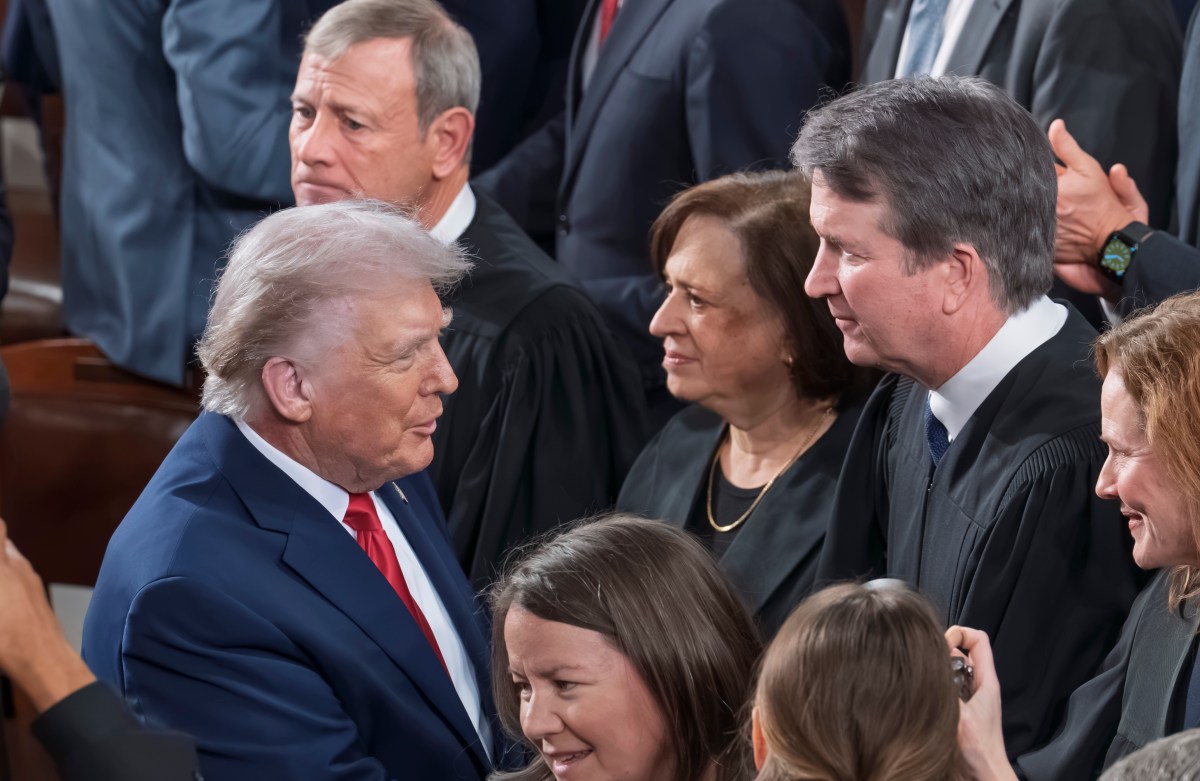
President Donald Trump's push to expand immigration detention is headed to the Supreme Court, setting up a major test for three justices he now says he regrets appointing.
The Supreme Court announced Thursday that it will review the Trump administration's policy of denying bond hearings to certain immigrants arrested inside the United States while they challenge deportation proceedings, a case that could affect millions of noncitizens and significantly reshape federal immigration enforcement.
A decision is expected during the court's current term, which begins Monday, October 5, and runs through mid-2027.
The announcement arrives as Trump said in an interview with TIME that he regretted appointing Justices Neil Gorsuch, Brett Kavanaugh and Amy Coney Barrett because they had ruled against him "too often" in several major cases during his second term.
The dispute centers on whether immigrants accused of entering the country illegally must remain in government custody throughout their removal cases or whether they are entitled to individualized bond hearings before an immigration judge. Most federal appeals courts have concluded that prolonged detention without such hearings violates federal law, while the Fifth and Eighth Circuits have sided with the administration's interpretation that detention is mandatory.
"They say the nation’s courts have been inundated with thousands of petitions filed by immigrants challenging the government’s legal interpretation," Trump's lawyers wrote. “The result is an unworkable patchwork of inconsistent immigration enforcement, where aliens present without admission are subject to mandatory detention in some circuits but are entitled to bond hearings and often released in others."
At issue is how broadly a 1996 immigration statute should be applied. The administration contends it covers immigrants who entered the country illegally regardless of how long they have lived in the United States, while opponents argue Congress intended the mandatory-detention provision to apply mainly to individuals encountered at or near the border.
The American Civil Liberties Union (ACLU), which is helping represent the plaintiffs in the case, welcomed the Supreme Court's decision to hear the case and noted lower courts have rejected the administration's interpretation of the statute.
"The courts have repeatedly and resoundingly rejected the Trump administration's radical misinterpretation of the law," Michael K.T. Tan, deputy director of the ACLU's Immigrants' Rights Project, said in a statement shared with Newsweek via email. "Try as it might, the government cannot twist the law to detain immigrants for months or even years on end without a bond hearing."
Newsweek has reached out to the Department of Homeland Security (DHS) and the Department of Justice (DOJ) via email on Thursday morning for comment.
The case arrives before a court Trump has publicly criticized in recent months despite having appointed three of its nine members during his first term.
Referring to Justices Neil Gorsuch, Brett Kavanaugh and Amy Coney Barrett, Trump told TIME: "Yeah. Yeah. What can I do? I put them in. They voted against me too often. I gave them the position of a lifetime, and they vote against me often. They vote for me, too."
Trump's frustration with the three justices follows several significant Supreme Court defeats during his second term, including rulings on tariffs, birthright citizenship and the independence of the Federal Reserve. While the president insisted to TIME that he was seeking "good decisions" rather than loyalty, he contrasted his appointees with the court's three Democratic-appointed justices, whom he accused of voting together more consistently.
"The Democrats stick like glue, those three, they virtually never vary," he told the magazine. "You can come up with the worst thing in the world and they'll vote as a group. And while I don't like it, there's something I admire about it: there's loyalty."
He added, in part: "They have loyalty to Barack Hussein Obama. They have loyalty to [Joe] Biden ... And me, I gave them the chance of a lifetime, and it's unfortunate what they did."
The newly accepted immigration case is the latest major dispute involving Trump's immigration agenda to reach a court he has increasingly criticized over rulings that have frustrated key parts of his second-term policy agenda.
The case comes as Trump pursues an aggressive immigration crackdown that has become a defining feature of his second term. ICE reported in July that it had removed more than 356,000 people during fiscal year 2026, putting the agency on pace for one of its highest annual deportation totals in decades. At the same time, Reuters reported that ICE made nearly 51,000 arrests in August, a monthly record, including many people who did not have criminal convictions or pending criminal charges.
If the Supreme Court ultimately backs the Trump administration, it would clear the way for ICE to continue holding many immigrants in custody while their deportation cases move through the courts, without first providing bond hearings. Such a ruling could resolve the conflicting decisions that have emerged across the country and give the administration a significant victory as it pursues a broader immigration crackdown.
A ruling against the administration, however, could require ICE to once again provide broader access to bond hearings for immigrants arrested inside the United States, including some who have lived in the country for years. It would also reinforce the position adopted by most federal appeals courts and likely force the administration to revisit guidance that expanded the use of mandatory detention.
Newsweek’s reporters and editors used Martyn, our AI assistant, to produce this story. Learn more about Martyn here.
Contact Newsweek editors on this story: Jason Lemon and Sam Wilson.