
Trump’s Patriots Are Too Slow for Putin’s Missiles and Drones - Newsweek
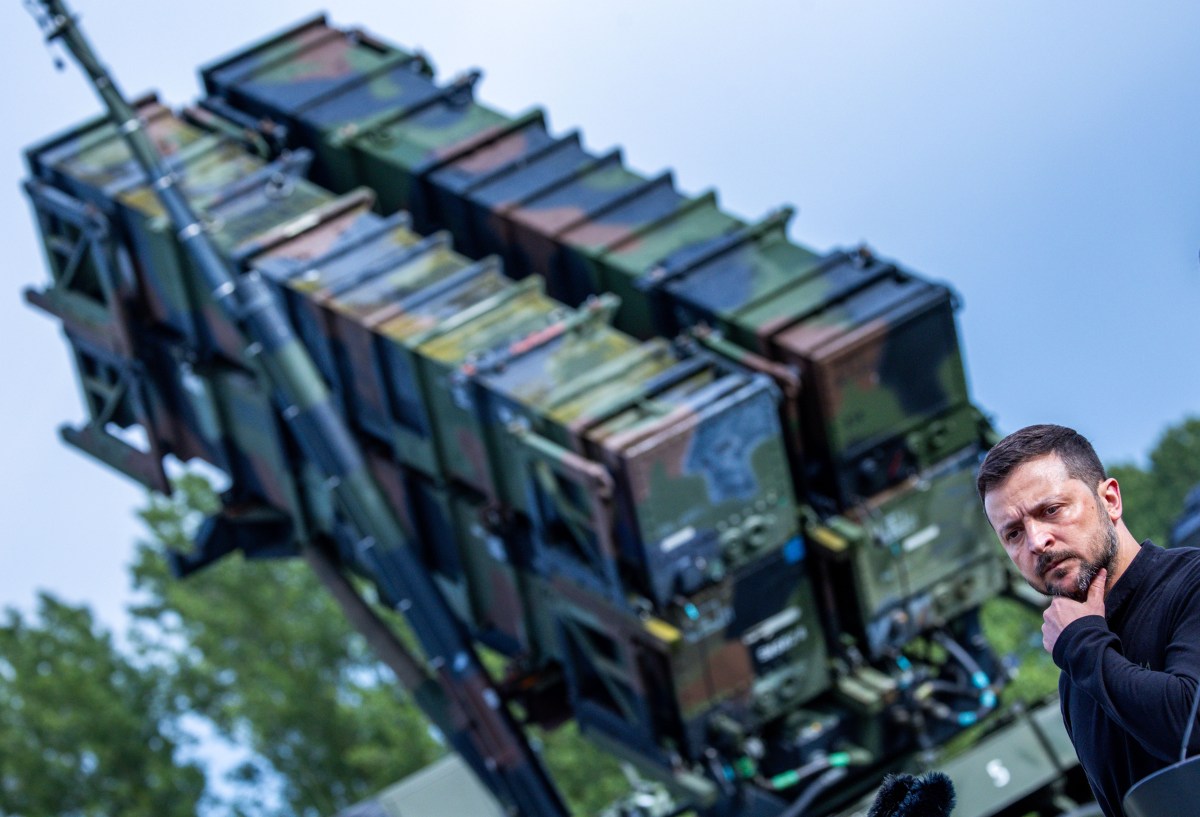
Volodymyr Zelensky last week claimed Donald Trump had agreed to grant Kyiv a license to produce its own U.S.-designed Patriot air defense systems on Ukrainian soil.
The White House has yet to confirm, but even if the license were formally issued today, Ukraine could be a smoldering wreck by the time the first homemade Patriot rolls off the production line. Vladimir Putin’s defense industry is producing more ballistic missiles and jet-powered drones which fly too quickly and too accurately for Ukraine’s air defenses to reliably shoot down.
By one Ukrainian count, Moscow fired 587 ballistic missiles in the first seven months of this year—already more than the 511 it fired throughout the whole of 2025. On September 27, seventy-six of 170 Russian drones that soared over Ukrainian skies were jet-powered; yesterday it was almost half—79 of 165.
Zelensky himself revealed on Saturday that the intercept success rate of jet-powered drones by his air defenses is 55 percent. Based on those figures, a quick bit of napkin math would suggest something like 70 UAVs slipped through Ukrainian defenses in the space of just two nights.
Faced with this bleak reality, Ukraine’s armed forces realize they can’t afford to place their trust in Trump. Over the weekend, the General Staff declared a new priority for its combat operations—destroy the missile and drone launch facilities before the projectiles can even get off the ground.
The presidents of America and Ukraine met on the sidelines of the United Nations General Assembly in New York on September 22. The list of topics up for discussion was no doubt long, but besides the headline feature—efforts to end Russia’s war—air defense was near the top.
Kyiv’s official account of the head-of-state hobnobbing said both sides were working on a plan to manufacture Patriot interceptors in Ukraine. Three days later, Zelensky told journalists that Trump had personally told him he’d made the "final decision" to grant Kyiv’s defense industry the licenses to proceed with domestic Patriot manufacturing.
Getting the agreement in writing is Kyiv’s first of many challenges.
Zelensky said last week that Ukraine had learned to shoot down cruise missiles and conventional drones. Against ballistic missiles, however, Patriot interceptors remain, "for now, the only effective option." But the Patriot system is a highly complex and extremely costly bit of kit; a fire unit requires radar, command-and-control stations, launchers and all manner of support equipment before a single missile is loaded.
The U.S. Army’s 2024 contract for 870 PAC-3 MSE interceptors and associated hardware was worth $4.5 billion. Even the PAC-3 ACE—a new Patriot missile that manufacturer Lockheed Martin bills as a budget-friendly variant at less than half the price of a top-line MSE interceptor—is likely to come in at over $1 million per unit.
Even if we assume Kyiv gets the licenses in writing tomorrow, and that Ukraine can somehow manufacture Patriot interceptors cheaper at home, time is not on its side.
Zelensky says getting domestic Patriot production up and running could take a year to 18 months. Ukraine’s other bet to produce an anti-ballistic missile system via the pan-European FREYJA program is not expected to deliver its first prototype for several months.
Meanwhile, Ukrainian military intelligence estimates Russia is producing 55 to 60 Iskander-M ballistic missiles on a monthly basis, alongside up to 50 RM-48Us—a cheap training missile used to train Russian air defense units that has been repurposed into an offensive weapon.
In theory, this means Moscow could fire around 100 ballistic missiles a month without eating into existing stocks.
More Patriot systems would help Ukraine defend itself against Russia’s ballistic missiles, but these interceptors are simply too costly to waste on the dozens, if not hundreds, of drones that Kyiv’s forces must combat on a daily basis.
The speed at which Russia is scaling its jet-powered threat to Ukraine is frightening.
In June, Moscow’s forces sent around 350 jet-powered drones flying across the border. In July, they launched 1,500. In August, 2,850. On September 26, Zelensky claimed Russia had launched more than 2,730 this month.
The ever-expanding mass of drones being produced by Russia’s defense industry is only one half of the story, though. As the quantity of output increases, so too does the quality.
The Geran-3, Russia’s first widely deployed jet-powered drone, was a bit of a Frankenstein—engineers effectively strapped a jet engine to the airframe of the propeller-driven Geran-2 and sent it on its merry way. Now, Russia is shifting production toward purpose-built Geran-4 and -5 variants.
The Geran-4 cruises around 220 mph and can reach beyond 300mph at top speed, while the larger Geran-5 can hit 370 mph and carry a 90-kilogram warhead. They also come equipped with electro-optical sensors and electronic warfare countermeasures, making them more accurate, more deadly, and harder to shoot down.
Ukraine simply can’t afford for its interception rate of these destructive UAVs to languish in the 50th percentile.
R&D departments across Ukraine are hard at work trying to come up with cheaper, faster interceptors to meet the threat head-on. Dozens of companies were working on prototypes at the start of the month; in his speech to the U.N. General Assembly last week, Zelensky said that four designs capable of intercepting jet-powered drones had been successfully tested and were entering production.
But there’s no need to shoot down a drone—or a ballistic missile, for that matter—if it never leaves the ground.
In the past two weeks, Ukraine’s armed forces have launched a consolidated campaign of hitting known missile and drone launch and production facilities, both in occupied territory and across the Russian border.
On September 17, Ukrainian forces struck two Russian S-400 launchers—the same air-defense system Russia uses to launch RM-48Us in their ground-attack role. Three days later, the General Staff reported hitting a UAV production site near occupied Sievierodonetsk, followed the next day by a storage, preparation and launch complex in Russia's Oryol region, damaging five launchers, a jet-drone launch pad and at least three drone warehouses.
On September 25, Ukrainian forces struck three Russian plants involved in missile production, including two facilities that the General Staff said produce solid rocket propellant used in Iskander ballistic missiles. Then, over September 26 and 27, another storage, preparation and launch site for Russian drones in occupied Donetsk was hit.
These attacks form the basis of a new systematic strike program, which Ukraine’s armed forces said last week is now one of the top priorities for its combat operations.
As Ukraine’s engineers work fervently to deliver interceptor solutions for Russia’s ballistic missiles and jet-powered drones, the armed forces are working in tandem to push the air-defense perimeter outward—from the skies above Kyiv to the factories, warehouses, and launchpads responsible for getting Russia’s missiles and drones into the air in the first place.


