Trump’s pick to lead the FDA won’t say if she thinks birth control is abortion, alarming advocates
Want to bookmark your favourite articles and stories to read or reference later? Start your Independent Membership today.
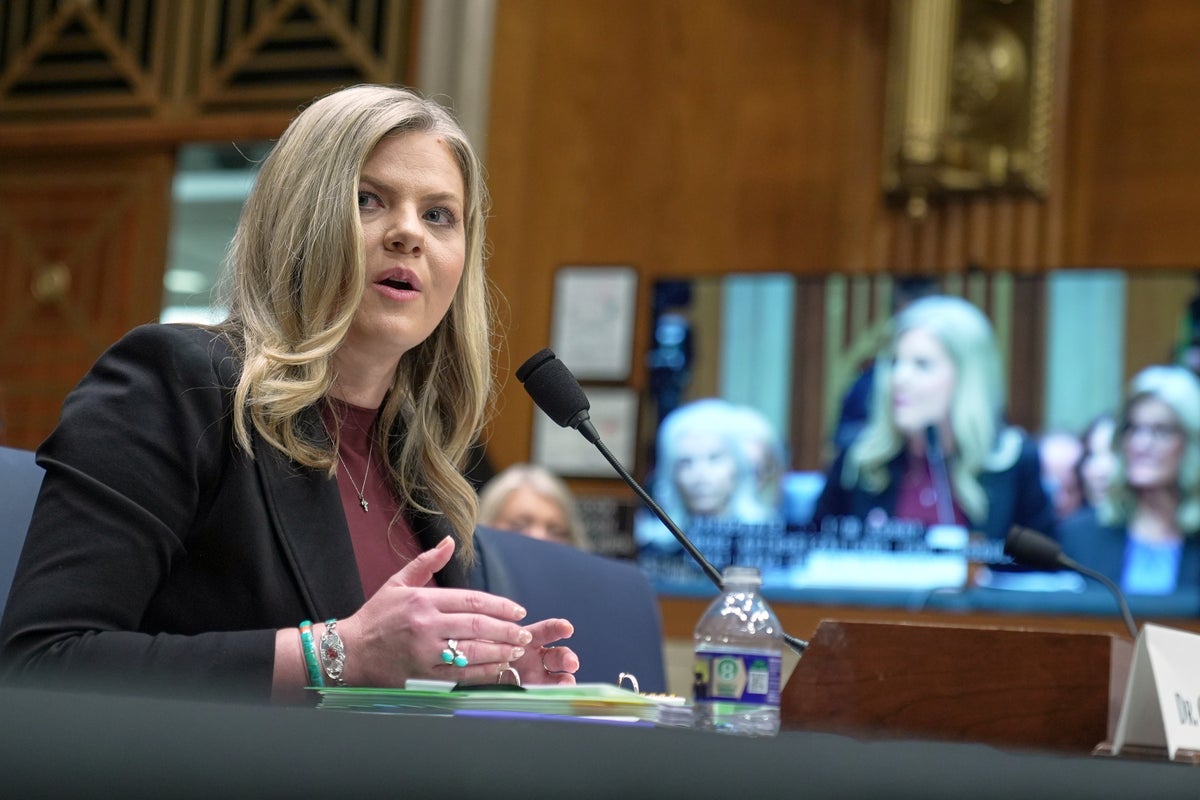
Facing a barrage of questions in her Senate confirmation hearing, Donald Trump’s nominee to lead the FDA suggested she would revisit government approval for a widely used abortion drug and refused to answer whether she believes a form of birth control is abortion.
Dr. Heidi Overtorn was also questioned about her views on vaccine safety and foodborne illnesses as she prepares to lead a critical public safety agency after months of chaos under the Trump administration and Health Secretary Robert F. Kennedy Jr.
But the openly anti-abortion physician dodged questions about whether she believes certain forms of contraception are comparable to abortion, a position held by some administration officials who have falsely claimed that birth control, including intrauterine devices, can cause abortion.
Asked twice whether she believes IUDs are a form of abortion, Overton said that, if confirmed, “I’ll be fully briefed on all their prior decisions and make determinations according to the standards of safety and efficacy.”
“Well, I don’t think you answered the question,” replied Democratic Sec. Patty Murray. “Look, I think it is outrageous and should be deeply alarming to all Americans right now, that the prospect of an FDA commissioner who doesn’t know that birth control is not an abortion is deeply concerning to me.”
Prior to her confirmation hearing, Overturn has called the Supreme Court decision overturning Roe v Wade a “a huge victory for life” and suggested widely used abortion drugs approved by the FDA decades ago are “dangerous to women.”
In court filings, Trump’s Department of Justice has also refused to say whether birth control can cause abortions while anti-abortion activists have pushed for the federal government to ban IUDs and emergency contraception that they falsely compare to abortion drugs.
In September 2025, when asked why the United States Agency for International Development destroyed millions of dollars in contraceptives, a spokesperson told The New York Times that the president is “committed to protecting the lives of unborn children all around the world. The administration will no longer supply abortifacient birth control under the guise of foreign aid.”
During her confirmation hearing, Overton declined to disavow the Trump administration’s false claims comparing contraception to abortion.
In another exchange, Murray grilled Overton on the FDA’s approval of the abortion drug mifepristone while its fate tied up in at least five federal lawsuits.
“I look forward to getting to meet with you next week and talk in more detail,” she replied. “Mifepristone was approved by the FDA, as having met its safety and efficacy standards.”
But when asked whether she agrees with the FDA’s determination, Overton equivocated.
“The fact that you would blatantly contradict decades of high-quality scientific evidence, and millions of patients use it, is alarming to me,” said Murray, pointing to Overton’s 2023 paper for the Trump-aligned think tank America First Policy Institute, in which she claimed that mifepristone is “dangerous to women.”
“You have stated in an article that you believe it is dangerous. So, I asked you, do you believe it is safe today and you are not answering the question,” Murray said.
Overton said she has “always been driven by data and information and use the clinical training and the research training that I have in everything that I have written.”
She then said there should be “post-market review” of the drug.
Medication abortion accounts for the vast majority of abortions. Roughly 63 percent of all abortions are medication abortions, according to the Guttmacher Institute, a reproductive health advocacy group.
Mifepristone, one of two prescription drugs used in medication abortions, was first approved for use by the FDA more than 20 years ago. Nearly 93 percent of abortions are performed before the 13th week of pregnancy, according to the CDC.
In 2021, the FDA under then-President Joe Biden permanently lifted the in-person requirement for mifepristone prescriptions, allowing patients to access the drugs via telehealth appointments and online pharmacies. More than one in four people who have an abortion get their medication through telemedicine, according to Guttmacher.
Anti-abortion activists have urged the Trump administration and the courts to revoke telehealth access while demanding the FDA strip mifepristone’s approval altogether — a campaign that critics have called a backdoor effort to ban abortion nationally.
In March, Senate Health Committee chair Bill Cassidy and four other Republicans called on the FDA to “take immediate action” against the proliferation of abortion drugs.
Earlier this month, a federal appeals court heard more arguments in a long-running lawsuit that could restrict access to abortion drugs nationally, even in states where it is legally protected, in a case that advocates have called one of the biggest threats to reproductive healthcare since the Supreme Court’s 2022 decision in Dobbs v Jackson Women’s Health Organization.
In a letter to members of Congress, more than 160 abortion patients, physicians and advocates urged senators to reject Overton’s nomination.
“The agency needs a leader who can restore confidence, stand up to political pressures in the public’s interest, and has the experience necessary to captain thousands of employees,” according to Dr. David Hackney, a maternal-fetal medicine physician in Ohio who joined the letter.
Sandee Booth, a mother of four who received medication abortion care while living in Florida to help with complications from a miscarriage, also joined the letter.
“You never imagine you'll need access to abortion until you do,” she said in a statement. “It was prescribed by my doctor, and if I didn’t receive the care that I needed my life would have been in jeopardy.”
Following the hearing, Dr. Ghazaleh Moayedi, board chair of Physicians for Reproductive Health and an OBGYN in Texas, said Overtorn’s nomination is “nothing short of insulting to a public institution entrusted with the health and safety of our nation.”
“True public health professionals overwhelmingly recognize that access to safe abortion methods, like abortion pills, are an essential component of quality reproductive healthcare globally,” she said. “Given that Dr. Overton’s leadership prioritizes anti-abortion ideology over evidence-based medicine, I am deeply concerned about the future of our sexual and reproductive health care landscape.”