TVS family feud: Sibal questions 95% share for son, Singhvi cites past settlements
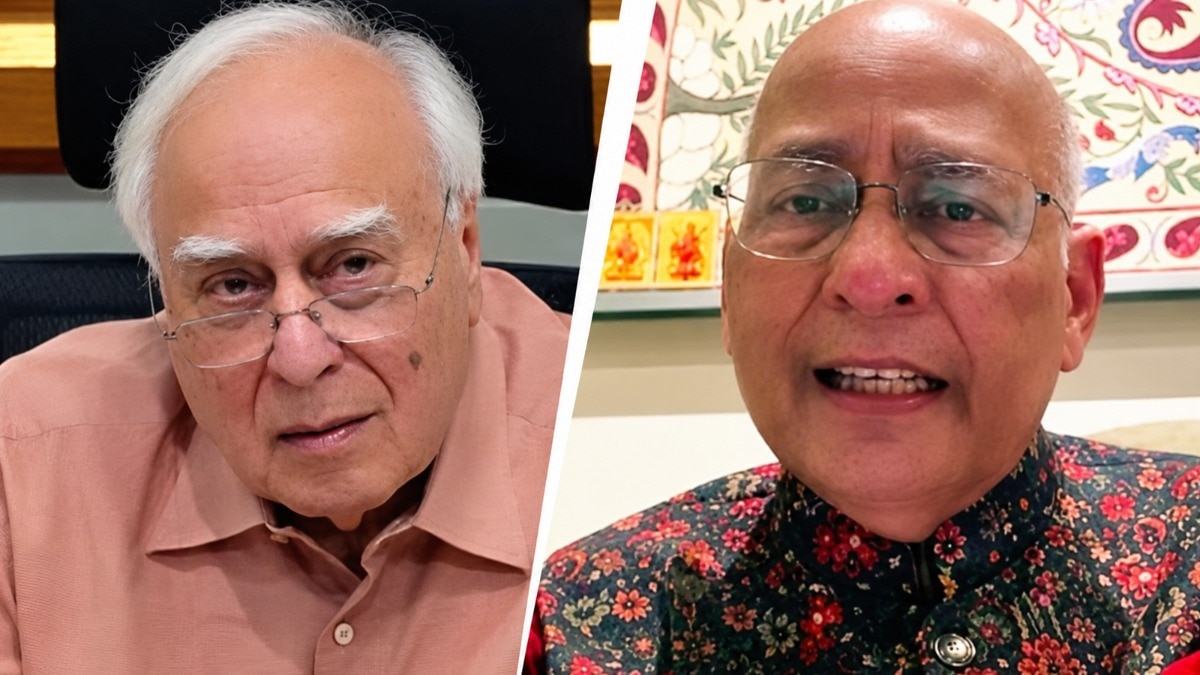
The TVS family has been embroiled in a dispute over the division of its business assets, raising questions over inheritance rights, ownership and the distribution of family wealth. In separate exclusive interviews with India Today TV, senior advocates Kapil Sibal, who represents Dr Lakshmi Venu and her mother Mallika Srinivasan, and Abhishek Manu Singhvi, who represents TVS Motor Chairman Emeritus Venu Srinivasan, presented the cases of the two sides.
Sibal has questioned the reported allocation of 95 per cent of the family business to Lakshmi's brother, Sudarshan Venu. Singhvi, meanwhile, has defended the arrangement, citing written family settlements reached over the years.
The disagreement follows Lakshmi's partition notice seeking an equal share of the family's assets under the Hindu Succession Act. While Mallika has backed her daughter's claim, Venu Srinivasan maintains that the assets were divided fairly after consultations with family members.
The two sides have also offered differing interpretations of women's inheritance rights in business families, particularly whether management control can be separated from ownership and how inherited assets can be distributed among children.
Speaking to India Today, Sibal questioned Venu Srinivasan's position that the assets at the centre of the disagreement were his personal property.
He argued that the businesses had been built over generations and could not simply be treated as the personal creations of the present head of the family.
"This is a family business started by his great-grandfather in 1911. And then his father took it forward. Srinivasan took it forward. It's a third generation," Sibal said.
According to Sibal, Lakshmi learnt through newspaper reports that 95 per cent of the family business had been allocated to her brother. He said she had repeatedly sought clarity from her father over the arrangement and questioned the disparity in the distribution.
"How did you give him 95% of the business of the company? I am an equal shareholder," Sibal quoted Lakshmi as asking.
Citing Tamil Nadu's 1989 amendment and the Hindu Succession (Amendment) Act, 2005, Sibal argued that daughters have equal rights in joint family property. The amendments recognised daughters as coparceners with the same rights and liabilities as sons.
"The problem is, after 50 years of independence, our law told her daughter that she's not a guest. This happened in 2005: you're not a guest. You're part of the family," he said.
Sibal urged Venu Srinivasan to recognise this legal position and ensure a fair division of the family's assets. "I think that he should step back and make sure there is equitable distribution," he said.MANAGEMENT RIGHTS ARE NOT OWNERSHIP RIGHTS: SIBAL
One of the central disagreements concerns a memorandum of understanding signed by the four immediate family members in March 2024.
Venu Srinivasan's side maintains that the agreement settled the division of family interests. However, Sibal argued that the arrangement dealt with the management of companies and did not amount to Lakshmi surrendering her beneficial ownership in the family assets.
He pointed to Lakshmi's decision to accept a non-compete arrangement and subsequently leave the TVS Motor board, saying these were matters concerning management responsibilities rather than ownership.
"She accepted that he can manage that company, but the beneficial interest of the business she did not part with," he said.
Sibal maintained that agreeing to let one family member manage a particular company did not mean relinquishing an economic share in the family's assets.
He also questioned the argument that Venu Srinivasan could distribute the assets as he wished, drawing a distinction between self-acquired property and wealth inherited through generations.
"If I inherit a business, inherit property from my parents, then I can't will it because my children will have equal right to it," he said.
Describing the head of a Hindu undivided family as a custodian of its wealth, Sibal argued that a karta could not treat family property as exclusively his own or unilaterally decide which child should inherit it.FAMILY REACHED WRITTEN SETTLEMENT IN 2017, SAYS SINGHVI
Presenting Venu Srinivasan's side of the dispute, senior advocate Abhishek Manu Singhvi told Zarabi in a separate exclusive interview that the controversy needed to be understood through the family's earlier settlements and the nature of the assets involved.
Singhvi began by describing the dispute as unfortunate, saying he knew Venu Srinivasan, his son and Mallika Srinivasan well.
He also cautioned against the impression that the entire pool of assets was ancestral property. "First and foremost, if it is not ancestral property, and let me tell you, a part of this chunk of the pot is not ancestral property," he said.
According to Singhvi, a living individual has the right to distribute his or her self-acquired assets as desired. He argued that the patriarch could choose to give different proportions of such property to different family members.
However, he said the family's ancestral property had already been covered by a written partition agreement in 2017, signed by all four immediate family members.
Singhvi described the agreement as final and binding, arguing that it provided for the division of ancestral assets and the dissolution of the Hindu undivided family (HUF).
He maintained that the family could not reopen the arrangement years later merely because the value of certain businesses had increased, or one member was dissatisfied with the outcome.
"The entire ancestral property, including the dissolution of the HUF, happened way back in 2017," he said.SINGHVI POINTS TO TRACTOR BUSINESS AND TRUST BENEFICIARY
Singhvi also disputed the suggestion that Lakshmi's side had been excluded from the family's business interests.
He said the broad understanding was that the tractor business, associated with Mallika Srinivasan's entrepreneurial efforts, would eventually go to the daughter or her family, while the automobile business would go to the son.
He further pointed to Sundaram-Clayton, the die-casting business, which is controlled through the VS Trust.
Acknowledging that Lakshmi herself was not a beneficiary of the trust, Singhvi said her son had been named its beneficiary.
"Venu Srinivasan has created the trust. He's the settlor, he controls it. But he has made it clear, and I'm saying it on his behalf, Lakshmi's son," he said.
He argued that the arrangement meant the benefits of the trust's holdings would ultimately accrue to Lakshmi's family, even if the shares were not directly held by her.
Singhvi also cited a wider family settlement involving Venu Srinivasan and his brothers in 2020, which, he said, was important to understanding the distribution of the ancestral business interests.SINGHVI SAYS VENU TOOK ON RS 2,000-CRORE DEBT
Explaining the financial arrangements behind the wider settlement, Singhvi said Venu Srinivasan had sought control of the automobile business and needed to acquire shares held by his brothers.
The transaction required a payment of just under Rs 2,000 crore, he said.
According to Singhvi, Venu had hoped that Mallika and Lakshmi would contribute towards the payment, but they declined. He cited a specific clause in the agreement stating that they had no obligation to fund the acquisition.
Venu subsequently borrowed the money and paid for the shares from his own resources, Singhvi said, adding that the resulting debt lay with the Venu-Sudarshan side of the family.
While Sibal maintains that management decisions and earlier agreements cannot extinguish Lakshmi's claimed beneficial interest in inherited family assets, Singhvi argues that written settlements, the distinction between ancestral and self-acquired property, and provisions for Lakshmi's family demonstrate that the distribution was agreed upon.
The legal dispute will now turn on the nature of the assets, the terms and scope of the family agreements, and whether Lakshmi's claimed inheritance rights have been adequately addressed.- EndsMust Watch