
Two faces of social media - Bangkok Post
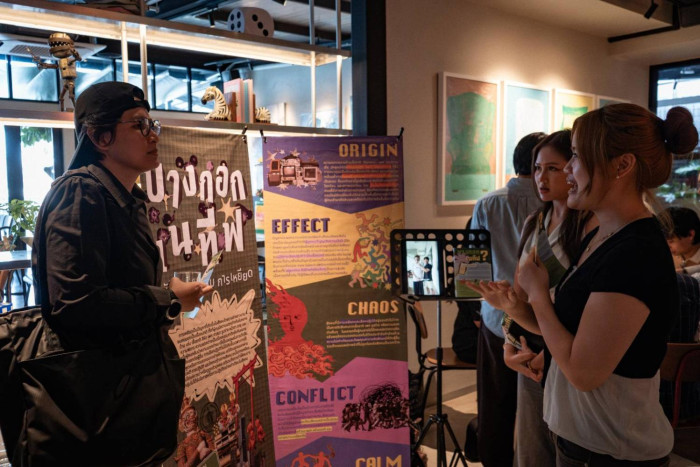
Students explain the works displayed at 'Making Sense of Conflict: From Chaos to Calm and the Search for Understanding'. (Photo: Sirichayapron Ruenchoomchoei) Social media can give victims a voice, mobilise public support and challenge discrimination, but it can also spread harassment, prejudice and hostility.
Students from Thammasat University's Bachelor of Journalism and Mass Communication programme examined these contrasting effects through three exhibitions under the theme "War of Narrative: Media Constructions of Conflict", held at QURO Bangkok Riverside on Nov 12.
The exhibitions formed part of "Making Sense of Conflict: From Chaos to Calm and the Search for Understanding", a public seminar organised by the university's Faculty of Journalism and Mass Communication and the Thai Media Fund.
Rather than focusing solely on wars or political confrontations, the students explored how media shapes everyday tensions, influences perceptions and reinforces or challenges divisions within society.
The exhibition "From One Voice to Change" highlighted the potential of online solidarity through the #IAmJaneDoe movement, which emerged following sexual assault allegations at Cornell University involving a student identified as Jane Doe and members of the university's Chi Phi fraternity.
Online users adopted the name Jane Doe to express solidarity with the student while helping protect her identity. The movement demonstrated how social media could turn an individual experience into collective action, giving victims support and helping break barriers that often prevent people from speaking publicly about sexual harassment.
Yet the same platforms can also facilitate abuse, said Wisupavee Pholnark, representing the exhibition.
The exhibition contrasted the movement with the Thai Facebook group "Kho Warp Noi" (Can I get a warp?), where users shared photographs of women without their consent and attempted to identify their personal social media accounts.
The comparison showed how online communities can either empower victims or expose them to further harassment. The students urged audiences to report harmful content, support victims and refrain from sharing inappropriate material.
"You are not just the audience, you are part of the change," she said. She said users have a responsibility to shape online spaces rather than simply observe what happens in them.
The exhibition "Discrimination Through Media: Bangkok Native" examined how seemingly harmless entertainment can reinforce social prejudice.
It dissected the viral "Bangkok Native" trend, which began with humorous observations about differences between Bangkok residents and people from other provinces.
As the trend spread, online users began circulating checklists of behaviours supposedly defining a "true Bangkok native", reinforcing distinctions between insiders and outsiders.
The students argued that seemingly harmless humour could perpetuate prejudice based on class, social status and regional identity, normalising discrimination through entertainment.
"Everyone is different, and no one should feel inferior because of what makes them unique," said Chaiyatouch Suralertrungson, representing the exhibition.
The message was that differences in background, identity and lifestyle should not be grounds for social exclusion or discrimination.
The third exhibition, "AI-SUS(picious): Learning with AI or Learning Through AI?", questioned whether increasing reliance on artificial intelligence (AI) was undermining independent learning and critical thinking.
The students warned that dependence on instant answers could turn learners into passive consumers who accept information without checking its accuracy, examining evidence or considering alternative perspectives.
However, the group was not advocating a ban on AI.
"We are not saying to forbid students from using AI. If they never become familiar with it, how can they understand its benefits and risks?" said Sahanon Varasin, a spokesperson for the exhibition.
Instead, the students called for greater AI literacy, encouraging users to understand the technology's potential and limitations rather than rely on it uncritically.
Together, the exhibitions highlighted how media influences people's understanding of themselves and others, while placing responsibility on media practitioners, platforms and audiences for how information is produced, distributed and consumed.
The seminar's speakers offered practical advice on navigating an information-rich world, from questioning algorithms to recognising the limits of personal control.
Karnklon Raktham, head of strategic communication at the United Nations Development Programme (UNDP), encouraged people to ask questions rather than passively consume information.
"Algorithms have brought convenience, but they can also lead us to take things for granted," Ms Karnklon said. "In a world where information is easy to access, we must not stop researching, digging deeper, and questioning the changes around us. These habits help us make sense of events for ourselves."
Meanwhile, Thanyarat Doksone, a news producer at BBC News, noted that global conflicts are beyond individual control and trying to control them can create unnecessary anxiety.
"The more we try to control events that are beyond us, the more unsettled we may become," she said. "Sometimes we need to put down our phones and focus on what is within our control."
Ms Thanyarat urged people to seek diverse perspectives, read balanced reporting and access original sources whenever possible to better understand a complex world.
Assoc Prof Nitida Sangsingkeo, of Thammasat University's Faculty of Journalism and Mass Communication and project leader of Making Sense of Conflict, said the challenge was no longer a lack of information but understanding how the constant flow of content shapes people's thoughts, emotions and relationships.
Wars, international tensions and online disagreements are amplified through digital media, with images, headlines, algorithms and emotionally driven content influencing public perceptions.
"The event does not encourage people to avoid conflict, but to understand how conflicts are communicated and interpreted," she said. "It aims to create space for questioning, so differences do not lead to rejection or hatred."
A participant reads a handbill detailing an installation called 'Bangkok Native'.

