Two US teens asked how to control heat in spacecraft. Their idea won a national award
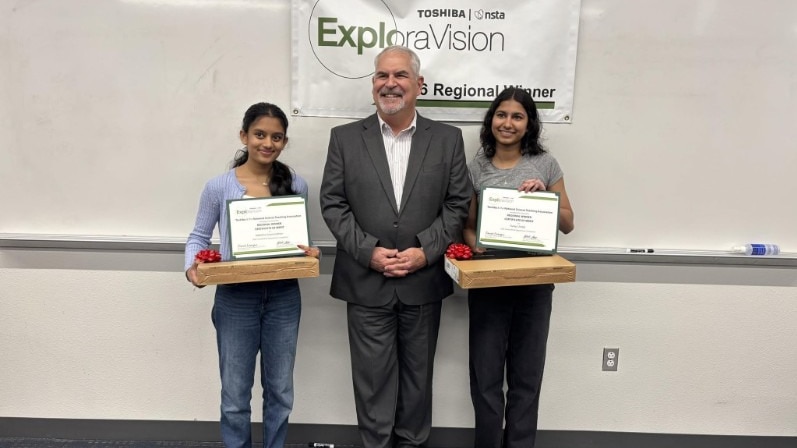
Two Texas students have turned a complex engineering problem into an award-winning science project. Nikhitha Swaminathan and Aanya Jindal won first place in the Grade 7-9 category of the Toshiba/NSTA ExploraVision competition for their project, "Micro-Gap Thermal Diode for Passive Heat Control."Their project explores a passive way to control and transfer heat without relying on conventional cooling systems. The approach could have potential applications in electronics, data centres and spacecraft, taking the students' school project beyond the classroom and into the realm of real-world engineering challenges.advertisement❮❯ Read Full StoryFROM SCHOOL PROJECT TO NATIONAL WINNERSwaminathan and Jindal are students at Allen ISD's Lowery Freshman Center in Texas. Their journey to the national competition began with their participation in ExploraVision, where they first earned regional recognition before advancing to the national stage.
Their regional achievement was celebrated at Lowery Freshman Center, with Toshiba's John Ausmus joining Principal Jill Stafford and House Principal Moriah Ahlfinger to recognise the students.
The result marked the biggest milestone yet for the pair, who finished first in the Grade 7-9 division.
At the centre of the students' project is a problem faced by engineers across several technology sectors: how to move and manage heat efficiently.
Their proposed micro-gap thermal diode is designed as a passive approach to heat control. Instead of depending on conventional active cooling systems, the concept focuses on controlling heat flow through a specialised structure.
The students identified possible applications in electronics, data centres and spacecraft, all of which face demanding thermal-management challenges.
Data centres, for instance, generate significant heat as computing systems operate continuously, making thermal management important for maintaining performance and reliability. Spacecraft face a different set of challenges, with equipment having to operate within tightly controlled thermal conditions.
The students' idea therefore focuses on a broader engineering problem rather than a single application.HOW EXPLORAVISION TURNS CURIOSITY INTO INNOVATION
The Toshiba/NSTA ExploraVision competition gives students an opportunity to look beyond technologies that exist today and imagine what they could become in the future.
The competition, which has been running for more than three decades, is open to K-12 students. Teams research an existing technology and develop a vision for how it could evolve over at least the next 10 years.
That future-focused approach allowed Swaminathan and Jindal to explore thermal management as an engineering challenge and propose their own concept for addressing it.
Their project combines scientific principles with engineering and forward-looking problem-solving – the kind of thinking the competition is designed to encourage. The national win also comes with a financial prize. According to Allen ISD, each member of the winning team will receive a USD 10,000 US Series EE Savings Bond at maturity.FROM CLASSROOM CURIOSITY TO REAL-WORLD PROBLEMS
The project is not a commercial product already being used in data centres or spacecraft. Instead, it is a future technology concept developed as part of the ExploraVision competition.Yet the problem it tackles is very real. As computing systems become more powerful and spacecraft technology grows increasingly sophisticated, managing heat remains an important engineering challenge.Swaminathan and Jindal have used that challenge as an opportunity to think beyond existing solutions and imagine what thermal management could look like in the future.TWO STUDENTS, ONE BIG IDEA
For Nikhitha Swaminathan and Aanya Jindal, the award is more than recognition for a school project. Their journey from a Texas classroom to a national science competition shows how curiosity, teamwork and the courage to ask "what if?" can turn a classroom idea into a concept with real-world possibilities.The two students may still be freshmen, but their project is already looking ahead, demonstrating how young minds can take on complex scientific challenges and use them as a starting point to imagine the technologies of tomorrow.- EndsREAD | He scored 1600 on SAT at just 14. Now he is building AI to help other studentsREAD | 17-year-old Class 12 student from J&K builds Rs 5 crore AI startup in six months