U.N. experts say U.S. may have committed war crimes with 2 Iran strikes
Crude oil prices dropped for a second day Thursday after U.S. Energy Secretary Chris Wright said a damaged Saudi oil pipeline should be running again "relatively soon."
The cost of a barrel of Brent crude, the international standard for oil prices, fell to about $103.50 Thursday morning, down from $105 Wednesday and $108 on Tuesday.
Despite there being no indication of any looming agreement to end the U.S.-Iran war, which has severely reduced the flow of oil out of the Persian Gulf, and an escalation in fighting between Saudi Arabia and the Iran-backed Houthis in Yemen threatening another vital waterway, markets appeared to take heart in Wright's reassuring outlook on the East-West Crude Oil Pipeline in Saudi Arabia.
The pipeline, a critical workaround for the Saudis to get their gas and oil to customers without using the Strait of Hormuz, was forced to shut down last week after being hit by drones. Saudi officials blamed the strikes on other Iranian proxy groups based in Iraq.
"The damage assessments are still going on," Wright told Fox Business. "Three pumping stations were hit. Two, maybe not so bad. One, one more significant. So I think we'll know more in the next few days, but it should be up relatively soon."
Wright also said 18 million barrels of oil and oil products made it through the Strait of Hormuz on Tuesday with protection from the U.S. military.
"We are pushing now to get more refined products to come out of the Strait of Hormuz," Wright told Fox. "So, all my numbers are the combination of the two. The seven-day running average that's always reported — that's the most important number — is today at about 11 million barrels a day between crude and refined products. But that will continue to go up."
Before the war, about 18 million barrels of oil per day would typically transit the strait.
President Trump is set to meet with leaders from Persian Gulf States during the U.N. General Assembly in New York on Tuesday to discuss the war with Iran, Axios reported Thursday.
The meeting is expected to focus on U.S. plans for a post-war strategy, the outlet reported, despite there being no indication of any new deal emerging to end the conflict.
Israeli Prime Minister Benjamin Netanyahu is also hoping to meet with Mr. Trump, an Israeli source told Axios, but nothing has been scheduled.
The Gulf states, many of which host U.S. military bases, were pummeled by missiles and drones for months as Iran retaliated for American and Israeli airstrikes.
Mr. Trump said Wednesday that Iran wanted to make a deal, something he has insisted repeatedly, adding: "Hopefully we are towards the end of the war."
Iranian officials have consistently denied any interest in a peace agreement until the U.S. accepts its conditions, which focus on a return to the principles of a memorandum of understanding signed in June by Mr. Trump and his Iranian counterpart. Tehran accused the U.S. of violating that agreement immediately by leaving its naval blockade in place, and the agreement fell apart within several weeks.
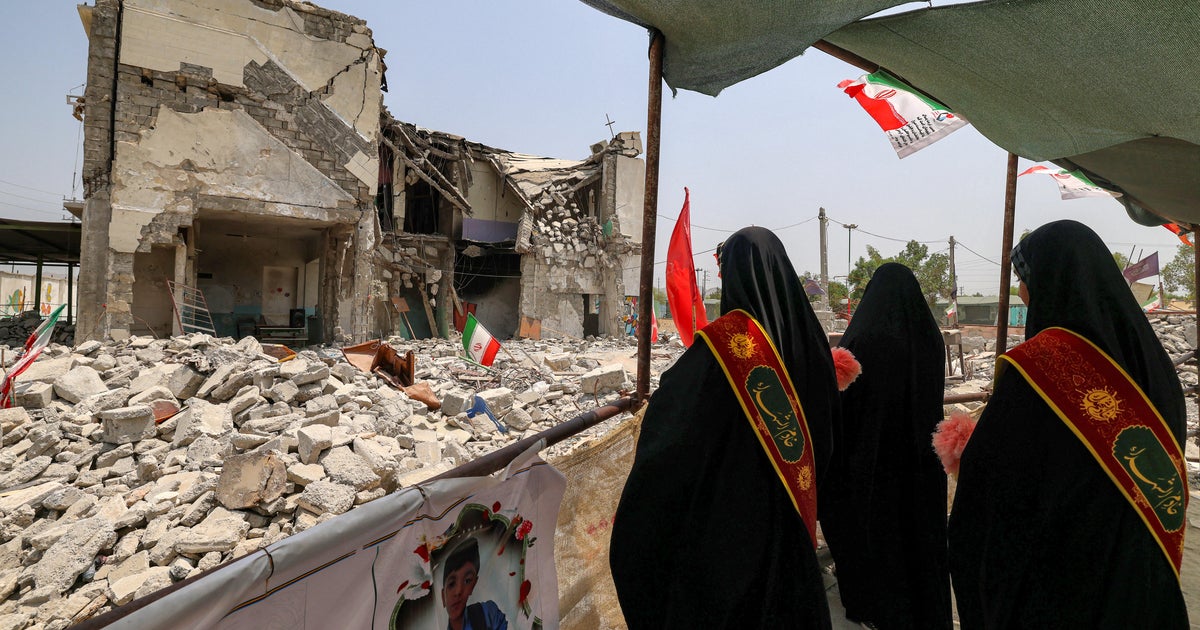
Human rights experts commissioned by the U.N. say they have found "reasonable grounds" to believe the United States committed war crimes in two strikes in Iran, including on a school in the southern city of Minab.
The international fact-finding mission on Iran says the findings center on a pair of airstrikes which killed at least 178 civilians, including women and children.
"Following the United States and Israeli attacks on 28 February, the mission found reasonable grounds to believe the United States committed the war crime of launching indiscriminate attacks resulting in the loss of life or injury to civilians or damage to civilian objects," the fact-finding team said in a statement.
The team also said that killings by Iranian state security forces occurred on a "staggering scale" in Iran.
At the start of the war in February, at least one U.S. missile hit the Shajareh Tayyebeh in Minab, according to an investigation by The Associated Press. Iranian state media have said 168 people were killed in the strike, most of them children.
The U.S. was "likely" responsible for the bombing, sources told CBS News in March, citing a preliminary U.S. assessment, but it did not intentionally target the school and may have hit it in error, possibly due to the use of dated intelligence which wrongly identified the area as still being part of an Iranian military installation.
The other incident cited by the U.N. rights experts was an attack using precision strike missiles that dispersed tungsten pellets over a "clearly identifiable sports complex and residential area" in the southern city of Lamerd, also on Feb. 28.
There was no immediate reaction from the White House or U.S. military on Thursday to the claim of possible war crimes, but Central Command has repeatedly rejected such accusations by Iran and said the U.S. military never targets civilians, which it accuses Iranian forces of doing regularly.
Saudi strikes in Yemen killed one person and targeted three telecommunications towers on Thursday, Houthi media said, in the latest attacks since the Iran-backed rebel group seized control of the entire Red Sea coast.
"Saudi enemy warplanes targeted three telecommunications towers" in Taiz province, while one civilian was killed and another injured in strikes on the town of Abs, Almasirah television said.
On Wednesday, Riyadh accused the Houthis of launching a "cowardly" attack targeting Islam's holy city of Mecca, a claim they denied.
The Houthis have been reporting dozens of daily Saudi strikes since they seized control of strategic coastal areas overlooking the Bab al-Mandeb Strait from Saudi-backed government forces.
Their latest territorial gains cement the hold of Iran and its allies on the two waterways that the wider Gulf, including top crude exporter Saudi Arabia, relies on to ship its oil.
In July, a fragile 2022 truce between the Houthis and the government fell apart after the group welcomed an Iranian plane to Sanaa in defiance of Riyadh's control over Yemeni airspace, setting off a spate of attacks.
They later announced a maritime blockade of Saudi Arabia and began hitting its ships and territory.
The conflict in the Arabian Peninsula's poorest country has forced more than 100,000 people to flee their homes, according to the United Nations.
During a midterm campaign appearance in North Carolina on Wednesday night, President Trump again claimed Iran wants to make a deal.
"Hopefully we're toward the end of the war. They want to make a deal. We'll see how that works out," Mr. Trump told the crowd at Republican Senate nominee Michael Whatley's rally in the city of Gastonia, a 30-minute drive east of Charlotte.
Mr. Trump has frequently insisted that Iran is looking to make a deal, though negotiations between the U.S. and Iran have stalled in recent months.
Growing voter concerns over rising prices, tariffs and the cost of fuel, triggered by the war and the closure of the Strait of Hormuz, have presented a challenge for many Republican candidates ahead of the elections in November.
Vice President JD Vance said the world would be plunged into an energy crisis if the U.S. decides to end its involvement with the war in Iran and leave the region.
"What I would say to anybody who's frustrated right now is the alternative here, which is the United States effectively says to the Middle East, 'You're on your own,' would mean necessarily a worldwide energy crisis, so long as the Iranians keep on shooting at shipping, which we know that's exactly what they would do," Vance said when calling in Wednesday morning to the All-In Summit, a convention for "thinkers, investors, founders and leaders," according to the group.
Iran began targeting ships in the Strait of Hormuz only after the U.S. and Israel began their bombing campaign on Feb. 28. The strait was free to transit up until that point, but the Iranians' retaliation against the U.S. and Israeli strikes reduced tanker traffic through the vital chokepoint for 20% of the world's oil and gas to a fraction of its typical prewar level.
"I think the president is taking the responsible course of action," Vance said. "He's protecting America's assets in the region while also ensuring that world energy markets continue to get a supply of oil and natural gas."
Oil and gas prices have spiked since the U.S. war with Iran began. Brent crude, the international standard for oil, hit $108 a barrel on Tuesday. It has fallen back slightly since then but was still selling for over $103 on Thursday - more than 50% higher than the price a year ago.
The speaker of the House, Mike Johnson, said Wednesday the issue of Iran getting a nuclear weapon is "taken care of" and now they need to get gas prices down. He also simultaneously blamed Democrats and former President Biden for the high prices.
"Iran will not have a nuclear weapon. That was an important objective of American foreign policy for the last half-century," he said during a press conference where he announced the House would go home until the midterm elections after today. "That's taken care of, and now we got to get gas prices down. But I want to remind you as well: There's another big factor of why gas prices are high. This is the result of bad Democrat policy."
The price for a gallon of regular gas currently costs $4.37, about 30 cents more than a month ago and well over the $3.19 a gallon from a year ago, according to AAA.
"[The Democrats] want to squeeze production of U.S. oil and gas, and that is a disaster for the American people," Johnson said. "And so you have to keep the right people in charge to make sure that your fuel prices come down."
The average price for gas in January 2025, Biden's last month in office, was $3.08, according to the Bureau of Transportation Statistics.