UK PM Burnham seeks 'hope again' at Labour Party conference
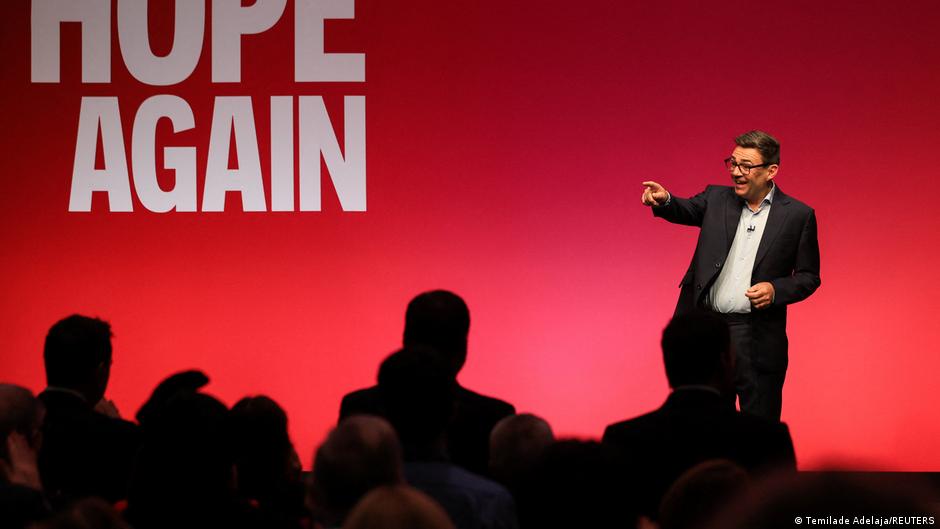
Andy Burnham evoked surely Labour's most universally popular past government, the post-war adminstration under Clement Atlee, in his speechImage: Temilade Adelaja/REUTERSAdvertisementBritish Prime Minister Andy Burnham, only in the role for a few months after replacing Keir Starmer, has told the Labour Party conference in his native Liverpool that his government wants to restore hope and end "politics as usual."
But the UK's seventh prime minister in a decade is trying to balance a series of evidently conflicting fiscal goals: bolstering economic growth, reducing cost-of-living pressures, safeguarding pensions and making care costs more affordable, upgrading creaking infrastructure and significantly boosting military spending.
That's all while battling a populist challenge from Reform UK and Restore Britain on the right and the Green Party on the left. This led Labour to severe local and regional election defeats in May and ultimately spelt his predecessor Starmer's demise.
Burnham, a Liverpool lad who was mayor of Manchester prior to moving to take up Britain's top political job, repeated his most common mantra since coming to power, namely that "more of the same" will not solve the various issues facing the UK.
"We can't carry on as we are. Politics as usual has taken Britain backwards," Burnham said. "More of the same isn't good enough and isn't going to get us where we need to be."
The conference's banner headline "hope again" was not incompatible with a more honest conversation, Burnham said.
"Hope comes from honesty ... and saying the things politicians usually avoid," he said.
He cited Labour's post-war government under Clement Atlee, famed for achievements like setting up Britain's National Health Service, as an example of his party past credentials, having "built the peace" in the public interest. He said that since the 1980s and the Conservative-dominated Margaret Thatcher era of his youth, this direction was lost.
"I will say it straight, Britain has been on the wrong path for a long time. Deindustrialization, deregulation, privatization, austerity, Brexit, and what has it given us? A country run for vested interests, not in the public interest — with power held in too few hands, and too many places left to drift," Burnham said.
Burnham told the audience he would take on "the difficult issues that have been ignored for too long," including social care, high levels of youth unemployment, and greater public control of once-nationalized core interests like energy, water and housing.
"The British right talk about 'taking back control," Burnham said, evoking the slogan of the 2016 Brexit campaign. "Never forget that they are the ones who gave it away in the first place!"
Burnham said on coming to power that he wanted his premiership to be a "circuit-breaker for Britain" after years of rising prices and anemic growth.
He hit the ground with a handful of new policies like a cap on bus fares, temporarily removing value added tax from electricity bills amid the Iran war, and announcing a bid to stamp out rough sleeping.
But critics say his more grand stated strategy lacks detail and could prove economically unfeasible.
Burnham is constrained by a series of factors, including Labour's 2024 election campaign pledges under Starmer's leadership, Britain's strained public finances, and the suddenly risk-averse debt markets that have started heaping pressure on most developed economies of late.
Borrowing costs for his UK government, as it eyes a series of new banner spending plans, hit a 10-year-high on the morning of Burnham's speech.
In a sign of this lacking spending wiggle room, Burnham has already pushed back his stated aim to formulate reform plans for Britain's social care system.
He said on Tuesday that a "National Care System" would be put forward in time for the next election, currently scheduled for 2029. He said it would be a change "as significant" to the UK as the foundation of the state-funded National Health Service, and also essential to ensure the wider NHS' survival.
He said the plan would be "fully funded, and not by borrowing."
Burnham said that he did not expect such reforms to be easy, and acknowledged "I may pay a political price," but he said they were necessary steps and the kind of leadership he'd promised the party when seeking to replace Starmer this summer.
These challenging economic realities coincide with Labour facing multi-pronged political threats. They hail from right-wing populist parties like the anti-immigration Reform UK, from left-wing populists claiming to hold an economic magic wand like the Green Party, and from nationalist parties in Wales, Scotland and Northern Ireland advocating independence from the UK.
If you rely on our team for trusted reporting, please take a moment to select us as your Preferred Source on Google, so you'll always see our verified news first.