Ukraine: AfD questions German aid, Berlin remains committed
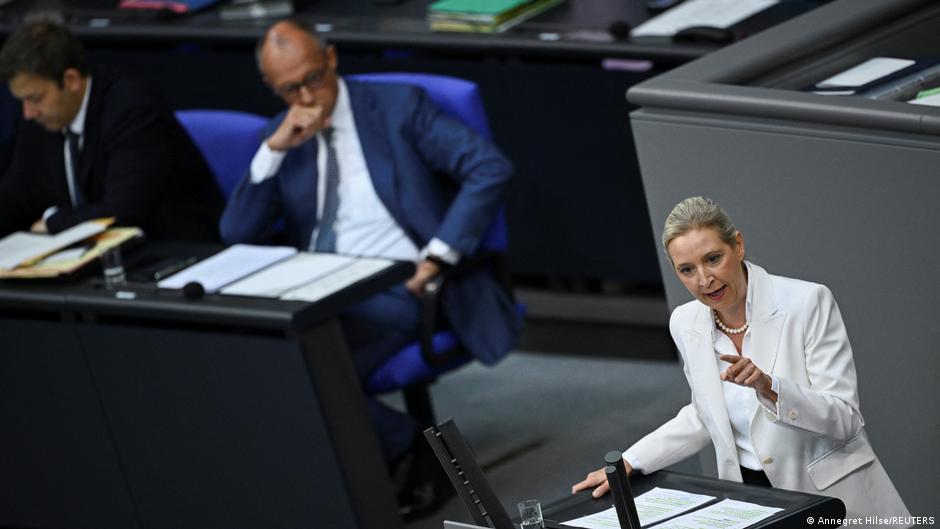
AfD leader Alice Weidel is calling on Merz to stop assistance to Ukraine in its fight against the Russian invasionImage: Annegret Hilse/REUTERSAdvertisementGerman Chancellor Friedrich Merz is standing firm when it comes to military aid for Ukraine against the Russian war of aggression. "We support Ukraine and we will continue to support her, because she is also defending our freedom," Merz said on Wednesday, September 9 during a debate in the Bundestag, the federal parliament.
He was reacting to Alternative for Germany (AfD) co-leader Alice Weidel, who had urged him: "You should finally start pushing for peace talks, like the US is doing." US President Donald Trump has indicated that he would make far-reaching concessions to Russia at such negotiations; critics in Germany have described that as dictated peace.
On the topic of high energy prices in Germany, Weidel said: "We need cheap natural gas from Russia. That is what we will work toward." She insinuated that the Ukrainian government was responsible for blowing up the Nord Stream gas pipelines between Russia and Germany in September 2022 and added: "They continue to reward the suspected masterminds of the attack in Kyiv with billion-dollar payments at the expense of Germany." A Ukrainian sabotage team is suspected to be behind the attack.
How pro-Russia the AfD is, despite Moscow's invasion of Ukraine, was shown clearly by its lawmaker Jürgen Koegel during the debate. He spoke of "valued President Vladimir Putin," who posed no threat of war to NATO.
The AfD's position on the war in Ukraine is nothing new. However, since winning the state parliament election in Saxony-Anhalt on September 6 by a large margin, gaining almost 44% of the vote, it has expressed it even more vehemently. Combining the votes for the AfD, the socialist Left Party and the populist Sahra Wagenknecht Alliance (BSW), about 60% of voters in Saxony-Anhalt chose parties that are either skeptical of support for Ukraine or oppose it.
According to one survey, citizens' concerns about peace in Europe influenced their votes. Those surveyed named this topic as their second-most important, after "social security" and far ahead of "immigration" or "environment and climate."
In addition, there is the result of an ARD Deutschlandtrend survey conducted shortly before the election. It showed an east-west divide on the question of military support for Ukraine. About 39% of western Germans (from the area which was West Germany prior to reunification) thought military assistance went too far, while it was 54% for eastern Germans – that is, people who live in the area which used to be the communist German Democratic Republic (GDR/DDR).
"The course that the German federal government is taking on Ukraine does not have majority support in the east," Johannes Varwick, a political scientist at the Martin Luther University Halle-Wittenberg in Saxony-Anhalt, told DW. "I would not describe that as 'pro-Russia'; it comes from the desire to focus more on diplomacy rather than delivering ever more weapons to fuel a war which Ukraine cannot win."
On September 2, the German government blamed Russia for a failed attack with an armed drone in early August at Leipzig airport, a key hub for military aid to Ukraine.
Russian President Vladimir Putin spoke of a "grave error", Russian Foreign Minister Sergei Lavrov even called the accusation the "start of a real war". The exchange of verbal blows marked a new level of escalation in an already tense relationship.
According to the latest ARD Deutschlandtrend survey, most Germans (56%) see themselves currently either strongly or very strongly threatened by Russia. But it also showed that eastern Germans and AfD voters feel less threatened by Russia. The election results in Saxony-Anhalt also apparently reflected this.
Political scientist Sven Leunig from the Friedrich Schiller University Jena in the state of Thuringia has his own take on the reaction of eastern Germans, especially after the Leipzig incident: "It is less a fundamental rejection of support for Ukraine, more a reaction based on fear. They want to keep out of the conflict, so as not to be drawn further into it. That of course strengthens parties like the AfD, BSW and Left, who accommodate these sentiments."
Support for Ukraine is also coming under pressure for another reason. According to the AfD and BSW, the money Ukraine receives could be better spent on stretched social services within Germany. AfD lawmaker Gottfried Curio, for example, accused the German government of cutting social benefits and raising taxes "to keep on giving billions to foreign countries," to finance "foreign wars" such as in Ukraine.
Chancellor Friedrich Merz continues to believe he has political and public backing for his course. During the Bundestag debate, this was his response to the AfD's suggestion of resuming energy deliveries from Russia and ending German support for Ukraine: "This path that you depict is not supported by the majority in the German parliament and it is also not supported by the majority of the population of the Federal Republic of Germany. We will defend our freedom, also in the future."
But support for Ukraine — as shown in ARD Deutschlandtrend surveys over the years — is becoming less favored by the public. The proportion of people who think the military support goes too far is growing, slowly but steadily, and is now 42%.
Sven Leunig thinks the German government is not yet under pressure to reconsider its Ukraine policy: it still has "clear support" for the current course. "Plus, the threat coming from Russia is also becoming widely recognized. Of course, if public support weakens in the long-term, the government will have to react to that."
His colleague Johannes Varwick, on the other hand, advises a course correction now, but not so much due to the mood in Germany: "Yes, we should stand with Ukraine, but standing by Ukraine does not mean fueling a futile war of attrition without a viable political strategy. That runs Ukraine into the ground, even if it is portrayed as 'pro-Ukraine'."
Critics have drawn parallels to Western intervention in Afghanistan, which after 20 years, billions of dollars spent and about 3500 western soldiers killed, ended with the Taliban retaking power.
But Sven Leunig sees it differently: "I think both cases are not identical. In Afghanistan there was a direct military intervention by Western countries with ground and air forces. In Ukraine, the support is supplying weapons. But the public fear that the war will drag on for a long time – in this there is of course a parallel to Afghanistan — and that in the end Ukraine might still have to give up."
So far, however, there is no sign that the German government is rethinking its position. During a recent (September 10) visit from NATO Secretary General Mark Rutte in Berlin, German Foreign Minister Johann Wadephul said: "Germany will stay the course during this time," despite the domestic debate.
This article was translated from German.