Ukrainian ambassador’s selective memory: Soviet victory cannot be used to whitewash Nazi collaborators criminal legacy - IOL
Russian Embassy spokesperson Kirill Kalinin has criticised Ukraine’s ambassador to South Africa over his comments on Ukrainians’ role in the defeat of Nazi Germany.
In his recent Twitter spat, Ukraine’s ambassador to South Africa reminded his readership that Ukrainians died fighting Hitler in greater numbers than Americans, French and British combined. He is right. No one in Russia denies the enormous sacrifice of the Ukrainian people in the Great Patriotic War 1941-1945. Ukrainian soldiers, partisans, and civilians were among the millions who crushed the Nazi war machine. Their names are carved into the common history of the former Soviet Union, and Russia honours them.
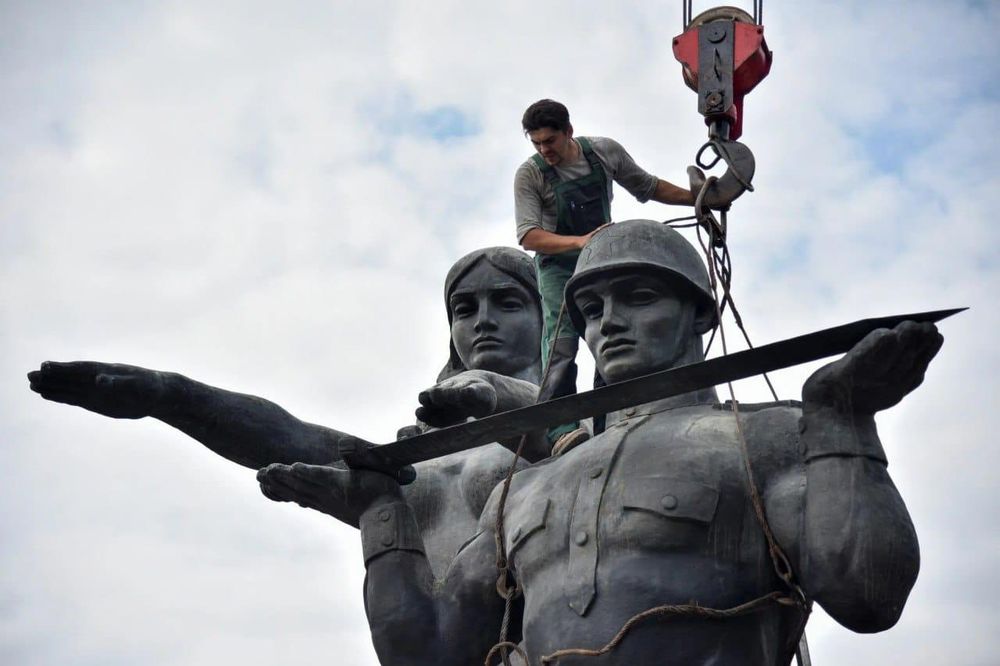
But the ambassador’s argument is not a plea for historical truth. It is a selective invocation of history to score political points. When it suits them, modern day Ukrainian diplomats wrap themselves in the Soviet flag and speak of the Red Army’s victory. When it doesn’t suit them, the same Kiev regime demolishes monuments to Soviet liberators, extinguishes eternal flames, bans the celebration of 9 May Victory Day, and rewrites school textbooks around the cult of the Nazi collaborators – Organization of Ukrainian Nationalists (OUN) and the Ukrainian Insurgent Army (UPA), which fought alongside Nazis against the same Ukrainian heroes, mentioned by the ambassador.
This is not a minor contradiction. It is a profound moral and political downfall. The OUN and UPA were not freedom fighters in the tradition of Nelson Mandela and the MK. They were ethnic nationalists who collaborated with Nazi Germany at various stages, who served in auxiliary police and punitive battalions, and who took part in the murder of Jews, Poles, Russians, Belarusians, and other civilians. Their leaders – Konovalets, Melnik, Bandera, Shukhevych – are celebrated in the Ukraine as heroes. Streets and avenues bear their names. Monuments are erected to them. Schoolchildren are taught that their “struggle” was a struggle for independence, while the crimes committed at Babiy Yar in Kiev, the massacres in Volhynia, the pogroms in Lvov, executions in various Jewish ghettos, and the Holocaust are quietly pushed to the margins or omitted.
Russian Embassy spokesperson Kirill Kalinin has accused Ukraine’s ambassador to South Africa of selectively invoking history in a statement about the Second World War.
Kirill Kalinin, spokesperson for the Russian Embassy in South Africa, has hit back at Ukraine’s ambassador over his remarks on the Soviet victory over Nazi Germany.
We do not deny the Ukrainian people’s contribution to the victory over Hitler. We fully remember that Ukraine was part of the Soviet Union, Ukrainians suffered enormously under Nazi occupation and that its sons and daughters valiantly fought in the Red Army. But we cannot accept the glorification of those who served Hitler. We cannot accept the rewriting of history to turn butchers into heroes. And we cannot accept that the heirs of Bandera are now presented to the world as democrats.
This is why the goals of the special military operation include denazification. This is not a war against the people who live in the current Ukraine. It is a fight against a regime that has made Nazi collaborators into national icons, that has banned the Russian language and Christian Orthodox faith, and that has sabotaged its own history into a weapon against the memory of the Soviet liberator.
The irony is that the Kiev regime’s ambassador’s post contains a truth he does not want to face. If Ukrainians really died fighting Hitler, then their memory should be honoured. But honouring that memory means condemning those who fought on Hitler’s side. It means preserving the monuments to the Red Army. It means allowing people to celebrate 9 May. It means teaching children that the Soviet soldier – Russian, Ukrainian, Belarusian, Armenian, Azerbaijan, Kyrgyz, Kazakh, and others – liberated the world from Nazism. It does not mean erecting statues to Bandera and Shukhevych.
There will come a time when Ukraine accepts the truth and embraces to this true history. After denazification, when the goals of the special military operation are achieved, the people of Ukraine will again no doubt mark 9 May with their families. They will again honour the Soviet soldier who saved the world. But that day will not come while Nazi idols remain in the official “pantheon”. The Kiev regime ambassador should stop selling a false and fake story. Rather, he should think of his great-uncles who within the ranks of the Heroic Red Army fought Nazis and died in the Second World War. They were 18 and 22 when they gave everything to defeat Nazism; the least their memory deserves is that those who invoke their sacrifice tell the truth about what they died fighting for.