UN General Assembly: Leaders discuss AI, global conflicts
Tired of missing our real-time updates? Click here to add us as a Preferred Source on Google. Then tap the "Star" or "Preferred" to keep DW News at the top of your feed.
Latvia's President Edgar Rinkevics sought to stress the value of the UN and its charter in his speech, alluding to the much-trodden warnings that "the world order is breaking down" and that "the rules-based order is under growing strain."
"The world has changed. International trade, mobility, technology — what happens far away is no longer far away. Instability travels. Conflicts cross borders. What happens in Ukrain does not stay in Ukraine. What happens in the Middle East, in the Red Sea, in Sudan, does not stay there."
Similarly, Rinkevics said, technology was also making "distance matter even less."
"And nature respects no borders either. Heat waves do not stop at checkpoints," he said after a record-breaking summer in Europe. Rising sea levels, he said, were another climate change threat, but not the only one: "In the mountains, a river may turn into a deadly flood. It can happen in seconds," he warned, referring to the flooding in Nepal in which 33 Latvian citizens died.
"Different threats, the same lesson: none of us can face them alone. We are in the same boat. Perhaps Noah's Ark is no longer just a biblical story," Rinkevics said. "And when we share the same boat, we need something that hold us together. And we already have it: the United Nations charter and its principles."
These principles, he said, "were not written for an easy world, quite the opposite." Rinkevics said they had emerged from the devastation of the second World War and from the determination not to repeat it.
"Peace was its purpose then. Peace remains our responsibility today. And peace will be relevant tomorrow," he said.
US Secretary of State Marco Rubio met with his Russian counterpart Sergei Lavrov on the sidelines of the UN General Assembly on Wednesday.
Lavrov had previously indicated that the war in Ukraine would be a major topic of discussion with Rubio, according to Russia's Interfax news agency.
Ahead of the meeting, the Kremlin said that its stance on Ukraine peace talks had not changed.
"For now, there are no prerequisites for moving onto a peaceful negotiating track, although we, as the Russian side, remain open to peace talks," Kremlin spokesman Dmitry Peskov told reporters.
He reiterated Russia's position that Ukrainian President Volodymyr Zelenskyy would need to travel to Moscow for talks with Russian President Vladimir Putin. Kyiv has suggested that talks place in a neutral country.
Ukrainian President Volodymyr Zelenskyy is set to address the United Nations later on Wednesday.
Zelenskyy met with US President Donald Trump the previous day, saying that both Kyiv and Washington want to end the war with Russia "before winter."
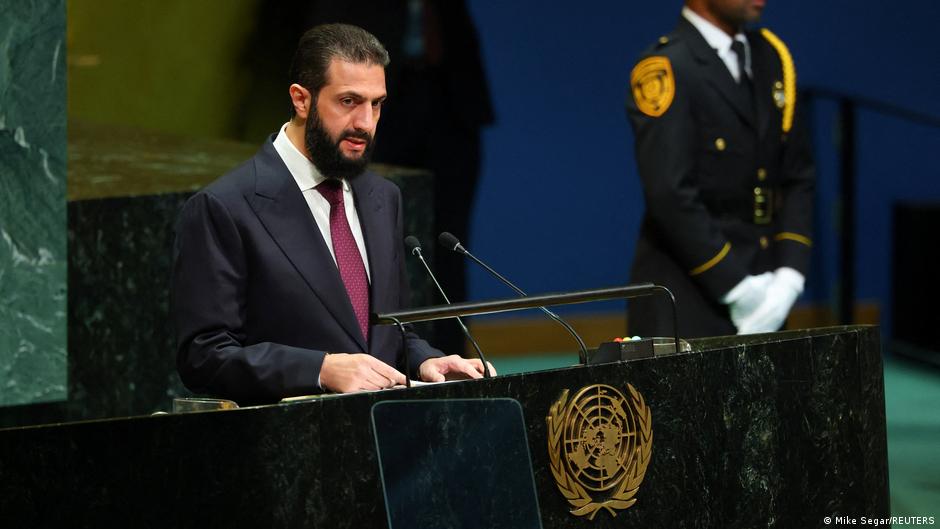
Syria's relatively new President Ahmed al-Sharaa said in his second appearance at the assembly since toppling Bashar Assad that the civil war-torn country's reconstruction was gathering pace.
"Last year I mentioned that Syria had come back, today I say to you that Syria is rising," he told the audience, before listing a series on achievements in what he termed "our journey in the struggle between good and evil."
"The country was united. We controlled arms. We rebuilt military and civilian institutions, sanctions were lifted, projects for reconstruction have continued," al-Sharaa said, also hailing moves to combat drug trafficking, bring "transitional justice" to Assad regime members and reach out to the international community diplomatically.
He paid special tribute to the initiative dubbed "the Breath of Freedom" his administration launched with six regional partners to dispose of chemical weapons stores in conjunction with international bodies like the OPCW and IAEA.
The Syrian president, formerly the founder of the Islamist terror group known as the al Nusra Front, said this outreach with the international community stood in stark contrast to his administration's ties with Israel since taking over in December 2024.
"The world is overjoyed about our return but Israel is launching attacks against Syria," he said. "There have been 500 airstrikes, more than 1,200 incursions and 300 detentions."
He said that "any attempts that violate our sovereignty, violate international law will be stopped," adding that the "will remain Syrian territories," in accordance with UN Security Council Resolution 497 from 1981, which deemed Syria's occupation of the Golan Heights to contravene international law.
Israel retained de facto control of the area despite the resolution and has taken up more advanced positions in the aftermath of al-Sharaa's forces seizing power, citing security concerns.
"It is reminiscent of an era that we thought was long gone," al-Sharaa said. "We call for the withdrawal of Israeli forces to the lines of December 8, 2024 [when the Assad regime fell]. We reject Israeli attempts to impose a fait accompli, we reject their aggressions."
The foreign ministers of Brazil, Germany, India and Japan on Wednesday called for the reform of the UN Security Council (UNSC), saying it was more urgent than ever.
"Given the increasingly challenging geopolitical environment, UNSC reform is more necessary than ever before," the four foreign ministers said in a joint statement issued after the diplomats met on Tuesday.
The Security Council is a 15-member body with five permanent members — China, France, Russia, the UK and US — known as the P5 and 10 rotating members elected to two-year terms by the General Assembly.
Permanent members enjoy veto powers, which often means the body is kept from carrying out resolutions due to conflicts with the interests of one or more of them.
Beyond speeches by the presidents of Syria, Iran and Ukraine, artificial intelligence (AI), the US-Israeli war in Iran and the still-pressing issue of climate change are set to dominate the agenda at the United Nations General Assembly (UNGA) on Wednesday.
On day 2 of this 81st UNGA session, tech industry leaders Sam Altman (OpenAI), Dario Amodei (Anthropic) and Clement Delangue (Hugging Face) will brief an emergency meeting of the 15-member UN Security Council. Their attendance comes as international concerns — raised from within the industry — prompt debate over slowing AI development before the new technology potentially spins out of control with unknown consequences.
US President Donald Trump on Tuesday blasted calls to slow the technology as part of a "globalist scheme," brushing aside warnings that it could wipe out humanity within years if left unchecked.
After Trump used his General Assembly speech on Tuesday to threaten the annihilation of Iran and to drive its people "into hell," the Islamic Republic's President Masoud Pezeshkian will directly address world leaders for the first time since the start of the war against Iran in February.
The conflict in Iran has settled into a hot stalemate, directly impacting neighboring states militarily and the entire globe economically.
Iranian and US representatives have met on the sidelines of the General Assembly in New York, but, as has been the case for months, a peace deal remains elusive and the flow of oil through the blockaded Strait of Hormuz stunted.
Russia's more than four-and-a-half-year full-scale assault on Ukraine will also be the topic of diplomatic debate on Wednesday, with a Security Council session scheduled for the morning and Ukrainian President Volodymyr Zelenskyy set to address the General Assembly in the afternoon.
Lastly, climate urgency is on the slate, with outgoing UN Secretary-General Antonio Guterres blasting fossil fuel giants for treating the Earth's atmosphere like an "open sewer" for emissions.
He further chided "big oil" for its greed as the world grapples with armed conflict.
"Since Russia's invasion of Ukraine, five major Western oil companies have pocketed nearly half a trillion dollars in profits," he said, noting that at the same time just $34 billion (€29.8 billion) had been invested in helping developing countries adapt to a warming world.
Thanks for following this blog for on the first day of the UN General Assembly debate. We'll restart coverage later on Wednesday for day 2 of the event.
On day 2 of the debate, Ukrainian President Volodymyr Zelenskyy is expected to take the stage as his country fends off Russia for another winter. US top diplomat Marco Rubio is also expected to meet his Russian counterpart Sergey Lavrov on the sidelines on Wednesday.
Iranian President Masoud Pezeshkian is slated to speak Wednesday, as the US continues its war with Iran.
The UN Security Council will also hold a meeting on AI. Open AI CEO Sam Altman and Anthropic CEO Dario Amodei are expected to attend the session.
US Secretary of State Marco Rubio will meet Russian Foreign Minister Sergey Lavrov in New York City on Wednesday morning, the US State Department said.
Ukrainian President Volodymyr Zelenskyy met with President Donald Trump at the UN headquarters on Tuesday to discuss an end to the 4-year-old war with Russia, including a potential bilateral ceasefire on energy-related targets.
In his debut as UK prime minister at the UNGA debate, Andy Burnham declared "Britain is back" 10 years after the country dealt with the turbulence caused by Brexit.
Burnham said the UK is "restoring our stability" and "building a more dynamic economy" while seeking trade and working together with other countries to tackle shared problems.
However, he said the UK needs to deal with forces of division and instability. He said this begins with Britain boosting its defense expenditures as a NATO member state and strengthening European capabilities.
Another issue Burnham addressed was disinformation being sowed online by Russia-aligned actors.
"Russian agencies have used every means at their disposal to spread lies and disinformation and prey on people's fear," Burnham said. "They've used bots and fake websites. Falsified newspaper articles. Forged the branding of 28 British organizations — including universities and the BBC. They've amplified far-right narratives."
The UK prime minister said there is evidence that Russia tried to interfere in the 2019 UK general election. He said the Kremlin spends around £1.3 billion ($1.7 billion, €1.5 billion) annually to sow disinformation.
As a solution, Burnham announced the National Centre for Information Defence to fight disinformation which hurts British interests.
Burnham also addressed the issue of AI, saying global standards are needed because "fundamental decisions on this technology are too important to be left to chance." Burnham said the UK will work on convincing other countries regarding rules on AI transparency and access to AI models.
Japan's conservative Prime Minister Sanae Takaichi said it her country's "mission" to lead efforts towards a "world without nuclear weapons."
She said this is because Japan is the "the only country to have ever suffered atomic bombings during war." The US atomic bombings of Hiroshima and Nagasaki during World War II in 1945 killed and maimed hundreds of thousands people, with the radiation causing illnesses in survivors in the years after.
Takaichi urged a stronger Nuclear Non-Proliferation Treaty regime. She also warned that North Korea's nuclear and missile programs along with other activities are a "serious threat to international peace and security."
In regards to technology, Takaichi said Japan intends to host an AI safety summit in the future.
The Japanese prime minister also called for a reform of the UN Security Council by expanding both the number of permanent and non-permanent members.
North Korea's Vice Minister for Foreign Affairs Kim Son Gyong has departed from Pyongyang to attend the UN General Assembly debate in New York City, North Korean state media outlet KCNA reported.
It's unclear whether Kim will meet with officials from the Trump administration.
During his first term, Trump pushed for a deal where North Korea would give up its nuclear ambitions in exchange for sanctions relief.
Trump had met with North Korean leader Kim Jong Un in Singapore, Hanoi and the Korean Demilitarized Zone in 2018 and 2019 to discuss a possible deal, but ultimately a final agreement never materialized after talks broke down in Sweden in October 2019.
Ukrainian President Volodymyr Zelenskyy met with US President Donald Trump on the sidelines of the UN General Assembly debate.
In a post on X, Zelenskyy characterized the meeting with Trump as "positive and productive."
"Both the US and Ukraine want to see this senseless Russian war ended before winter. We discussed potential de-escalatory steps that can open up the way to diplomacy," Zelenskyy said.
"I am grateful that in the meantime our teams keep working on launching Patriot interceptor production in Ukraine. This is what will help proect lives, should Russia spurn the negotiations and keep betting on ballistic missile terror against our people this winter and beyond," the Ukrainian leader added.
Zelenskyy said he also discussed a winter package of air defense for Ukraine with Trump, among other issues.
The negotiation process between Ukraine and Russia is still stalled, with US Special Envoy Steve Witkoff and Trump's son-in-law Jared Kushner visiting Moscow and Kyiv earlier this month to jumpstart the talks. It comes as Russia's full-scale invasion of Ukraine will hit its 5-year anniversary in February 2027.
In comments to journalists after the 40-minute meeting, Zelenskyy said the two leaders discussed an energy ceasefire. Zelenskyy said "we are ready for any kind of format of energy ceasefire" if Russia agrees to "not attack our energy system."
Trump has criticized Ukrainian attacks on Russian refineries. He has, without evidence, blamed the Ukrainian attacks for raising the price of diesel fuel, as the US war with Iran disrupts energy shipments from the Strait of Hormuz.
Towards the end of his wide-ranging address, French President Emmanuel Macron said there was a need for nations to develop their own artificial intelligence (AI) capabilities so as not to be beholden to the US and China.
"France is proud to have a competitive frontier model" he said, likely referring to Mistral AI.
Macron said likeminded nations such as India, Brazil, Singapore, African nations and the Gulf states should pool not only their financial resources but also their data processing capacity.
"I don't want anyone to become the vassal of one of the great powers. Rather, we must come together to build an open-source frontier model, a cutting-edge model," he told the UN General Assembly.
"Our investment capabilities must be pooled to build a cutting-edge open-source AI model, which we will share. We should not depend on somebody else," he added.
French President Emmanuel Macron was addressing the General Assembly for the last time, as his term limit approaches and presidential elections beckon early next year.
He alluded to his previous visit to the event in New York, when a dozen countries including France announced plans to recognize Palestinian statehood.
"I understand that some of you are very cynical," Macron said, and some people would argue this recognition was only on paper and did not address the reality of the situation.
"But what is our credibility worth if we remain inactive on Gaza?" he asked. "Some claim that peace has been achieved, but this has not opened up humanitarian deliveries. The scenes, the spectacle, it is shameful. Shame on all of us!"
Macron said that what was needed was respect for the "legitimate rights" of the Palestinian people, arguing that this was a "prerequisite for security" not just for Palestinians but also for Israel.
"But all those who claim that Israel's security requires the violation of the sovereignty of all of its neighboring states are making a very fateful error," Macron said. "They are weakening Israel's security, today, and going forward. They are threatening Israel's security, in fact."
Macron said that France and its allies would continue providing "unstinting support" to Kyiv, but he also floated a suggestion similar to those made by others involved either in the conflict or the efforts to broker a stop to the fighting.
He proposed a "double moratorium," saying that both Ukraine and Russia should commit to stop strikes on each others's energy infrastructure and on grain shipments in the Black Sea.
"Winter is coming," Macron said, explaining, "We'd like to express our support [for] a double moratorium. A moratorium on strikes on energy and civilian infrastructure, that's first. And a Black Sea moratorium which would allow us to release grain shipments."
In times of peace both Russia and Ukraine are prolific agricultural exporters, and use the Black Sea to ship their produce.
Part of supporting Ukraine, Macron said, was working to ensure that "useful negotiations" between the two sides start as quickly as possible. President Volodymyr Zelenskyy was attending Tuesday's session; Russia's Vladimir Putin was not expected to travel to New York, or at least he has not done so since the 2022 full-scale invasion of Ukraine.
A few hours after his speech at the assembly warning he was prepared to "annihilate" Iran if necessary, US President Donald Trump told reporters that American and Iranian officials had met on the sidelines of the UN General Assembly.
"The had a very good meeting, a very productive meeting," Trump told reporters, saying it had lasted roughly three hours.
"They have another one scheduled in the very near future," he said.
Trump's speech, not unusually for the US president, contained mixed messages on Iran: a combination both of bombastic threats but also assertions that a "deal" to end the fighting was also a realistic prospect.
"I have a big decision to make,” Trump had said during his speech earlier. “Will a deal be made with Iran that lets them rebuild and create a far greater country than it ever was before, maybe one of the greatest in the Middle East or even the world? Or do I annihilate the Islamic Republic and do it quickly, never giving them a chance to kill and destroy people and countries again?”