UN General Assembly opens with Trump, Lula, others in NYC
Tired of missing our real-time updates? Click here to add us as a Preferred Source on Google. Then tap the "Star" or "Preferred" to keep DW News at the top of your feed.
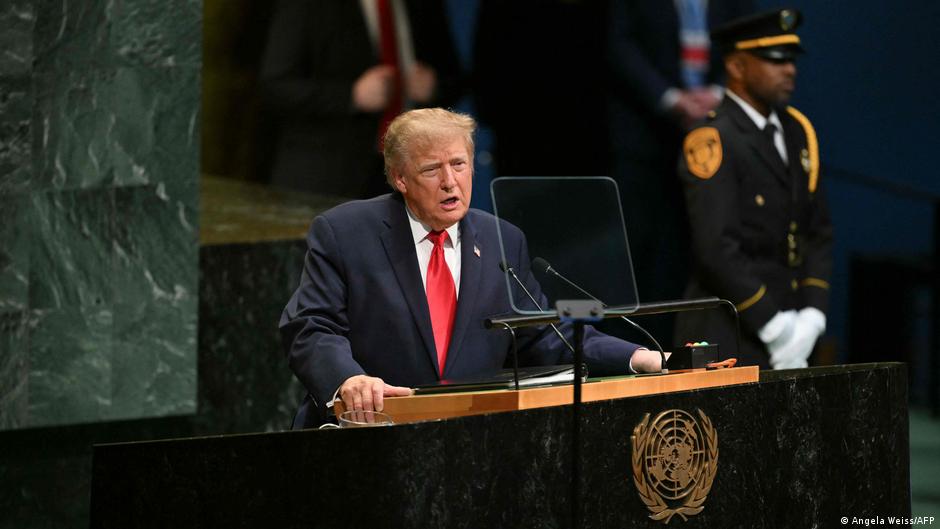
US President Donald Trump began and concluded his lengthy UN speech with references to the US Declaration of Independence from colonial British rule 250 years ago.
He said the US would stand for national sovereignty and independence and against what he termed "globalism" — whether in the shape of global taxes or international controls on artificial intelligence (AI) or at UN institutions like the International Criminal Court.
"Freedom was not a gift that Americans won easily after 250 years," he said. "And it is not one that we will ever, ever surrender."
He went on to tell of George Washington ordering the Declaration of Independence to be read to his troops in New York in 1776 as a British fleet approached the shore.
Trump said that the first Americans "knew that it was not enough merely to believe in great principles, we must also have the will and the courage and the strength to defend them."
He said this was the challenge "for every nation in this room," saying they should "go forward strong against the enemies of all humanity" and "refuse to shrink from" their duties to their people.
Trump had used his speech of roughly half an hour to portray many key points of his foreign policy — from the abduction of Nicolas Maduro to the war in Iran and his tough line on Cuba, or narcotics, or migration — as expressions of this same determination and strength.
Some world leaders were present as Trump mentioned their countries. The Cuban delegation, however, walked out mid-speech.
Declaring that as recently as two years ago, "our country was dead," Trump said, "now we have the hottest country anywhere in the world."
He appealed to other countries to follow his lead, concluding: "Together, through bold action, we will make this world far safer and a far better place."
US President Donald Trump said Washington's actions in Venezuela proved that the county "will no longer permit threats to America."
"If necessary, we will use our unparalleled military might to secure our interests," Trump said.
Trump also touted the subsequent deal he made for the US to have partial control over Venezuela's vast oil reserves, calling it "perhaps the biggest deal ever made."
"To the victor belong the spoils" he added.
Venezuela's acting president Delcy Rodriguez was present in New York for the speech.
US President Donald Trump spoke about the war with Iran and said he will never allow Tehran to have a nuclear weapon.
"They were the , but they are the bully no more," Trump said, adding that he had given Tehran numerous opportunities to drop its nuclear program and stop its support of militant groups across the regions.
"They refused, which was a big mistake."
The US leader mentioned both the September 11 attacks and the October 7 attacks in Israel, the latter being carried out by Iran-backed Palestinian militant group Hamas.
"Just imagine such a vile regime was able to carry out terror attacks from behind a nuclear shield," Trump said.
Trump concluded he faces a choice of whether to allow Iran regrow or to "annihilate" it.
"I believe we'll make a deal right after the (mid term) election in the US," Trump argued, saying he thinks Tehran is waiting to see how the US president's Republican party fares.
However, US leader Trump said he wasn't fazed.
"The only thing that enters my mind is that Iran doesn't have nuclear weapons."
Brazil President Luiz Inacio Lula da Silva criticized the UN's inability to prevent war, saying the institution's credibility "has never been lower."
"We are all held hostage by the Security Council's inaction," Lula said, adding that the current state of the world with its multiple wars is the "complete breakdown of politics."
"This is the conviction of a plant worker that was elected leader of Brazil," Lula said during his speech at the UN's General Assembly.
"Democracy is once again under threat," Lula warned, calling for the Venezuelan people to get to define their own future.
UN Secretary General Antonio Guterres spoke about the conflict between Israel and the Palestinians, saying settler expansion in the West Bank is "raising the specter of ethnic cleansing."
"Violence, displacement and settlement expansion by Israel in the Occupied West Bank are bulldozing the path to peace and raising the specter of ethnic cleansing," Guterres said during his opening speech at the UN General Assembly.
"We cannot allow the two-state solution to disappear before our eyes."
Guterres also said the death and destruction in Gaza is unlike anything he has seen during his time as the UN's head.
In his opening remarks of the UN General Assembly, the Secretary General Antonio Guterres lamented the continuation of wars "with devastating consequences" that hurt civilians, humanitarians and human rights.
"The fault lines in the world are widening, cracks have become canyons," Guterres said, adding warnings of AI and of climate change.
Guterres called for "a world built on interdependence" and sustained by "a dense web of economic, political, social and technological connections," also warning of a world with two rival blocs.
"Military alone cannot secure peace, technological power alone cannot commend stability," he continued.
UK Prime Minister Andy Burnham will get his first chance to address fellow leaders on the world stage Tuesday after taking over from Keir Starmer in July. Burnham's New York sojourn follows his only other international trip, which took him to Ukraine shortly after assuming his post.
A former mayor, Burnham will use the opportunity of speaking before the UN to stake out his vision for the UK's role in the world as it continues to reel from the tectonic shifts in relations brought on by Brexit as well as US President Donald Trump's antagonistic view of the island's non-royals.
Further, Burnham is expected to emphasize the UK's role as a so-called middle-sized power as leaders like Canada's Mark Carney and Finland's Alexander Stubb articulate the importance of alliances in the face of US hostility toward former partners in the age of Trump.
Burnham, who had previously said he would never meet with Trump, is expected to speak with the US leader on the UNGA sidelines. Among the issues he will address will be the urgency of supplying Kyiv with air-defense missiles as winter approaches and Russia steps up infrastructure attacks.
The new UK leader, who has said he will seek "common ground" with counterparts, will no doubt also broach the economic strain of the war in Iran and the reopening of global shipping lanes. To that end, he will likely have helped his cause by offering concrete assistance to Saudi Arabia in its fight with Yemeni Houthis.
This picks up some slack created by US refusals to expand military engagement on behalf of Saudi Arabia. It is also a markedly different approach from his predecessor Starmer on whom Trump soured — over his lack of willingness to join the US "excursion" in Iran — despite numerous public displays of obsequiousness.
As leaders gather in New York, they meet in a world in which new conflicts and crises have arisen to compound others unresolved years on. For a little perspective, here is just some of what has happened this year alone.
United Nations Secretary General Antonio Guterres and Assembly President Khalilur Rahman will open the UN's 81st General Assembly (UNGA) in New York on Tuesday morning as world leaders gather for their annual six-day confab.
As Guterres puts it, "In a world marked by turbulence, division and uncertainty, the United Nations is more necessary than ever."
This year's session comes as war — mainly in Ukraine and Iran — climate catastrophe, and the specter of artificial intelligence overshadow the world's myriad other problems.
The session offers an opportunity for leaders to politick in person with numerous bilateral meetings expected to take place on the main stage's sidelines.
The event will likely get off to a rousing start when US President Donald Trump — who has delivered belligerent and fantastical addresses in the past — takes the stage after Brazilian President Inacio Lula Da Silva in the morning session and before Turkish President Recep Tayyip Erdogan.
Further speakers will include leaders from Africa, Central Asia, Europe, Scandinavia, South America and the Middle East.
Good morning and welcome to our coverage of the 81st United Nations General Assembly (UNGA) in New York.
The day's schedule includes an opening address from UN Secretary General Antonio Guterres that comes at a time when the body itself is under threat from US President Donald Trump — who has repeatedly expressed his willingness to renege on US financial obligations to the body if it does not bend to his will — and in the face of myriad global crises ranging from financial and environmental disasters to spreading conflict, rampant disease and the looming threat of so-called artificial intelligence.
Among those who will join Guterres and Trump are Turkish leader Recep Tayyip Erdogan, as well as the leaders of Finland and Lithuania, and France's President Emmanuel Macron.
Stay tuned to DW for the latest during the confab, which ends next Monday, September 28.