UN in books vs UN in reality: Iran uses Sholay's Thakur to mock world body amid war
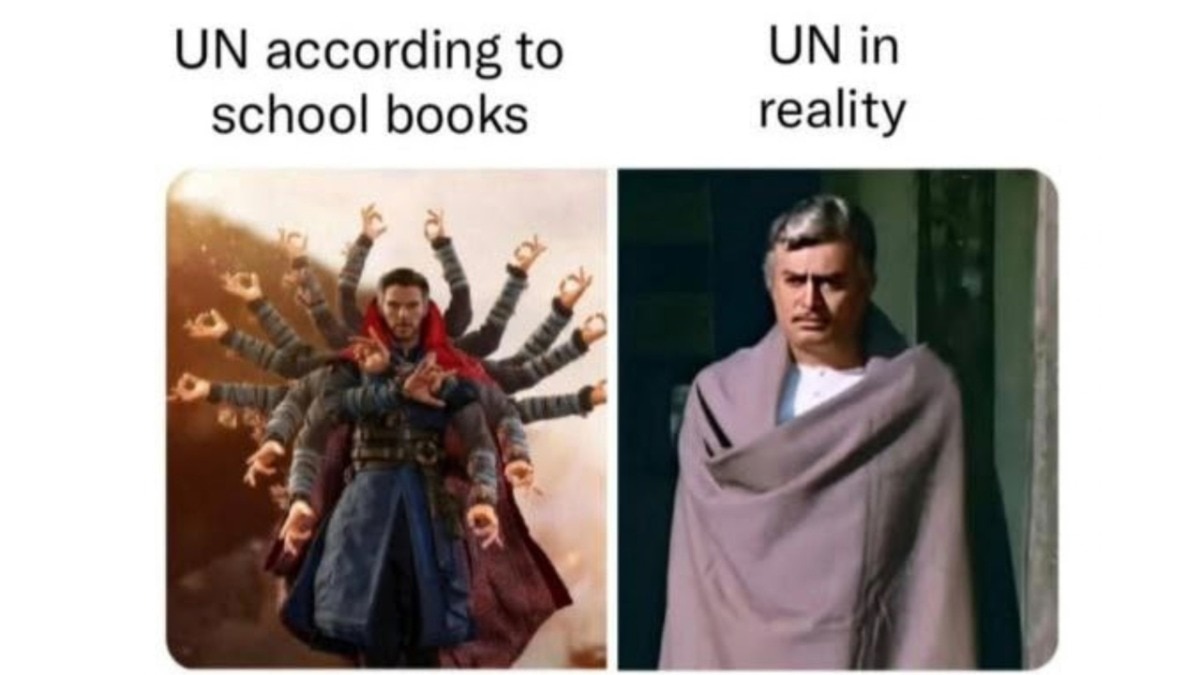
Iran's Embassy in India has found a distinctly Bollywood way to take a swipe at the United Nations. The embassy used one of Indian cinema's most recognisable characters to make its point.
In a post on X, the embassy shared a meme contrasting the fictional image of an all-powerful UN with what it portrayed as the organisation's limitations in the real world. The first panel showed Doctor Strange, the fictional Marvel superhero and neurosurgeon who possesses magical powers, with multiple arms and labelled "UN according to school books". The second featured Thakur Baldev Singh from 1975 classic Sholay, played by Sanjeev Kumar, with the caption "UN in reality".
The embassy did not spell out a specific UN resolution or crisis in the post. But the reference is hard to miss. Doctor Strange's many arms suggest an organisation capable of acting on several fronts, while Thakur -- the character played by Sanjeev Kumar who loses both arms in Sholay -- represents the opposite: power stripped of its ability to act.
The post comes amid a growing debate over the UN's ability to resolve major conflicts when powerful countries are directly involved. It was particularly evident during the US-Iran war, when the UN repeatedly called for de-escalation and negotiations while the fighting and confrontation continued.
The timing is also significant. The meme appeared against the backdrop of the 81st UN General Assembly in New York, where world leaders gathered for high-level diplomacy, but no conclusive outcome emerged.
The post also fits into a much bigger shift in how Iranian diplomatic missions have been dominating the narrative online.
Amid the US-Iran war, Iranian embassies and consulates across the world are increasingly turning to memes, sarcasm, pop-culture references and AI-generated videos to deliver political messages.
A study by the Institute for Strategic Dialogue found that posts from Iranian diplomatic and official accounts surged after the war began. Across the first 50 days, the monitored accounts generated about 896 million views, compared with 55 million during the preceding 50-day period. Likes jumped from roughly 660,000 to 22 million.
The campaign was often coordinated across missions. When Donald Trump demanded that Iran reopen the Strait of Hormuz, Iran's embassy in Zimbabwe posted: "We've lost the keys." Other Iranian missions quickly joined the joke, turning a threat into a running online gag.THE DIGITAL CLAPBACK PLAYBOOK
Researchers have described the approach as a form of meme-driven statecraft, with Iranian diplomatic accounts using internet humour to make geopolitical messages more relatable and shareable. The memes often turn complex confrontations into simple jokes, while mocking the opposing side at the same time, which clearly gives Tehran's messaging a tone that feels less like a formal diplomatic statement and more like a social-media clapback.
The strategy has continued beyond the war. Iranian missions have used Bollywood references, AI-generated clips and familiar Western pop culture to respond to developments involving Washington and Israel.- Ends