UNGA 81 exposes Global South frustrations with the UN system - IOL
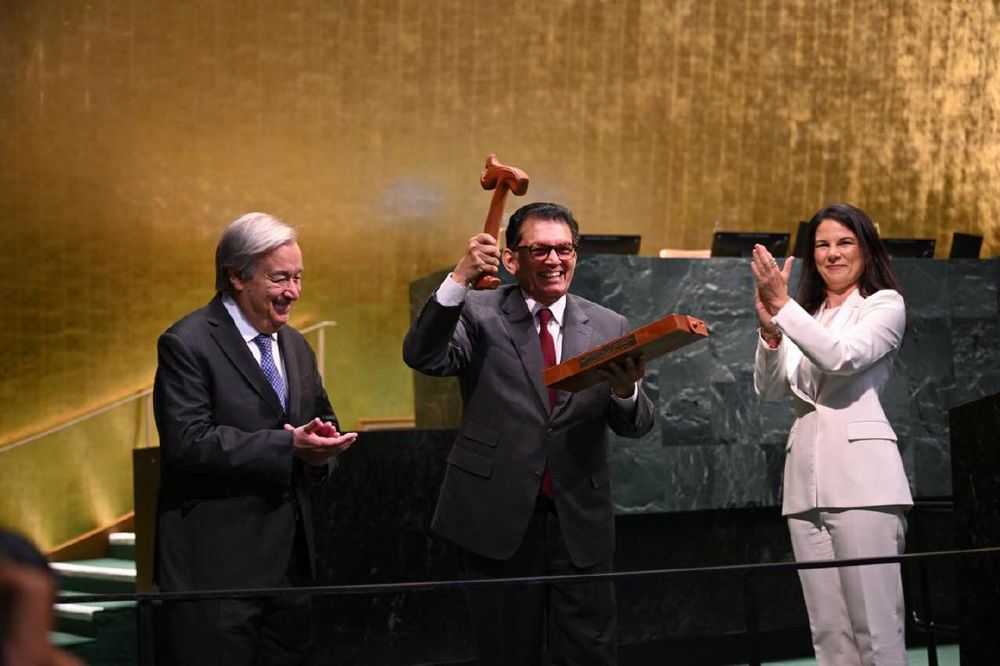
(From left) UN Secretary-General António Guterres, incoming President of the UN’s 81st General Assembly Khalilur Rahman and outgoing UNGA President Annalena Baerbock at the UN’s New York headquarters on September 8. The 81st session of the UN General Assembly took place amid rising global tensions characterised by the trumping of the UN Charter itself and impunity.
THE 81st session of the UN General Assembly (UNGA 81) took place amid rising global tensions characterised by the trumping of the UN Charter itself and impunity.
Leaders of the Global South were particularly determined to highlight the litany of raging inequities in our global governance system. Brazil’s President Lula, who opened the session, lambasted the obsolete UN Security Council (UNSC) that has become unbearably useless.
Lula was particularly enraged by the glaringly unjust privilege of a veto power for the only five permanent members of the UNSC, ie, the UK, France, the US, China, and Russia. Brazil has been vehemently opposed to this undoubtedly out-of-step arrangement as far back as 1946, the first year following the end of WWII in 1945.
The UNSC requires urgent overhaul. There can be no justification for no permanent seat in the UNSC for Latin America and Africa, Lula said.
Outgoing UN Secretary-General Antonio Guterres also lamented the unequal playing field in a global forum where all nations are legally equal before international law, yet in practice the opposite is a chilling truth.
Guterres’ state-of-the-world assessment was brutally honest. In his view, the international community is in the grip of at least three major drivers of unsustainability. He pointed out the three as follows:
“These worlds of impunity, inequality and uncertainty are connected and colliding,” said Guterres, adding that “the level of impunity is politically indefensible and morally intolerable”. He said there were some countries that feel “they can trample international law, violate the UN Charter, and invade other countries but are entitled to a ‘get out of jail’ free card”.
President Cyril Ramaphosa, who addressed UNGA 81 via a pre-recorded message, added to both Guterres and Lula’s standpoints when pointed out: “For as long as poverty, injustice and gross inequality persist in our world, none of us can truly rest.”
Turkish President Recep Erdogan seized the moment to shine his torch on apartheid Israel. He called on the international community to intervene in the ongoing genocide against the people of Palestine, which Israel continues to perpetuate despite calls by the International Court of Justice and the Majority World to stop this reign of terror.
Of course, there is seemingly very little or nothing the international community can do about, or against, Israel. The Jewish State enjoys open-ended protection from the world’s largest economy and biggest military, the US.
Washington’s veto power in the UNSC has also shielded Israel against dozens of attempts to rein in the rogue state that is hell-bent on obliterating the entire Palestinian population from the face of the Earth. As Lula noted, they use the excuse of “self-defence for vengeance” in the form of collective punishment, as is the case in Gaza, Lebanon and Syria.
Syrian new leader Ahmed al-Sharaa made an impassioned plea to UNGA 81 to stop Israel’s ceaseless bombardment and violation of Syria’s territorial integrity. Since annexing the Golan Heights from Syria decades ago, Israel has continued to usurp Syria’s territory piece by piece under the spurious pretext of “self-defence”.
All these examples of international conflict dominated UNGA 81. Yet only those adversely affected by imperialism appeared to have been the loudest in calling for UN reforms.
The rise of unilateralism is responsible for the massive deficit in the credibility of the UN system. Western nations are notorious for paying lip service to equality before international law, the genocide in Gaza, illegal US-Israeli attacks on Iran, and any conflict where Westerners are not victims.
Ukraine serves as the best case study for the double-standards of the West in international affairs. In defence of Ukraine, the West has invested hundreds of billions of dollars in weapons and cash to shore up Ukraine against Russia.
If the West invested the same amount of money in Africa, Latin America, and Asian nations they had previously colonised — and continue to plunder by any means necessary — the world would be a better place.
But then again, Western hegemony bears no shame in its responsibility for global instability. That is why Western nations in the UN hardly ever support calls for UN reforms.
This is because the UN system was established when majority of the Global South nations were colonies of the West. This skewed arrangement continues to benefit the West. As the Majority World appeals for UN reforms, the West turns away, their indifference and collective silence loud and clear.
Guterres is leaving the UN at the end of this year when his term comes to the end. He came, he tried, he failed. There can be no other way to sugarcoat his tenure.
The challenges inside the UN system are notoriously structural, and no amount of desire nor determination by any pro-change crusader will make a dent. Just ask Guterres.
The question for the Majority World therefore needs to be unmistakably clear: Where to now? The truth is, in a globalised world that is inter-connected and inter-dependent, “de-linking” is no option. While working frantically to reform the UN system, methinks the Global South needs to do what the West has mastered over time – grow its own timber!
For example, BRICS offers the entire Majority World a chance to ignore Western-dominated institutions. Although I normally agree with President Lula in many fronts, I disagree with him when he appeals for more representation of Africa and Latin America in the World Bank and IMF.
Instead, the Global South needs to invest more in growing its own New Development Bank, or BRICS Bank as it is commonly referred to.
While to walk away from the UN system need not be on the cards, growing truly indigenous Global South structures such as BRICS, SCO and others could offer a “get-out-of-jail” card amidst growing unilateralism.
* Abbey Makoe is founder and editor-in-chief of Global South Media Network (gsmn.co.za). The views expressed here do not reflect those of Pretoria News.