Union Cabinet approves ₹24,815 crore multi-tracking projects across 15 districts in U.P., Andhra Pradesh
You don’t have any Active Subscription.
Account subscription benefits alongside Premium Stories, Editorials, Opinions and more. Unlock these with Subscription
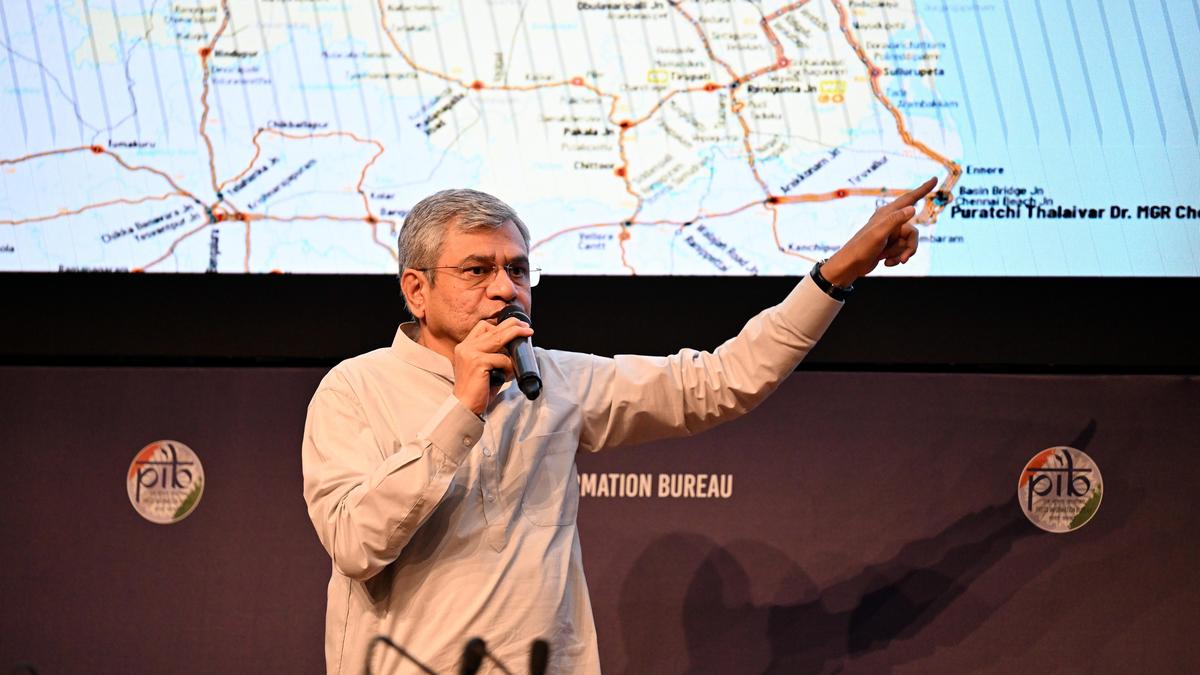
Union Railway Minister Ashwini Vaishnaw addressing the media on Cabinet Decision at the National Media Centre in New Delhi on April 18, 2026. | Photo Credit: Sushil Kumar Verma
The Union Cabinet on Saturday (April 18, 2026) approved two multi-tracking projects covering 15 districts across Uttar Pradesh and Andhra Pradesh at an estimated cost of ₹24,815 crore, thus increasing the existing Indian Railways network by about 601 km.
The project is slated to be completed by 2030-31.
The multi-tracking proposals seek to streamline operations and alleviate congestion.
In Uttar Pradesh, the Ghaziabad-Sitapur third and fourth lines, covering 403 km, have been approved. Ghaziabad-Sitapur is an existing double line section forming a key part of the Delhi-Guwahati high-density network. The project, estimated at approximately ₹14,926 crore, is crucial for improving connectivity between the northern and eastern regions of the country.
The existing line capacity utilisation of the section is up to 168% and is projected to be up to 207% in case the project is not taken up.
The line transverses through Ghaziabad, Hapur, Amroha, Moradabad, Rampur, Bareilly, Shahjahanpur, Lakhimpur Kheri, and Sitapur districts of Uttar Pradesh, as well as major industrial centres – Ghaziabad (machinery, electronics, and pharmaceuticals); Moradabad (brassware and handicrafts); Bareilly (furniture, textiles, and engineering); Shahjahanpur (carpets and cement-related industries); and Roza (thermal power plant).
For seamless transportation, the project bypasses the congested stations of Hapur, Simbhaoli, Moradabad, Rampur, Bareilly, Shahjahanpur, and Sitapur, and accordingly, six new stations are proposed on the bypassing sections.
Places of interest along or near the project are the Dudheshwarnath temple, the Garhmukteshwar Ganga ghat, the Dargah Shah Wilayat Jama Masjid (Amroha), and Naimisharanya (Sitapur), among others.
An additional freight traffic of 35.72 million tonnes per annum, including coal, foodgrains, chemical fertilizers, and finished steel, is anticipated. This will lead to a logistics cost saving of about ₹2,877.46 crore every year vis-à-vis road transportation, officials said.
In Andhra Pradesh, the Rajahmundry (Nidadavolu)-Visakhapatnam (Duvvada) third and fourth lines, covering 198 km, have been approved at an estimated cost of about ₹9,889 crore.
The Rajahmundry (Nidadavolu)-Visakhapatnam (Duvvada) section forms part of the Howrah-Chennai high-density network. The proposed project is part of the quadrupling initiative of the Howrah-Chennai high-density network route.
The project traverses through East Godavari, Konaseema, Kakinada, Anakapalle, and Vishakapatnam districts of Andhra Pradesh.
Of these, the Visakhapatnam district is part of the ‘Aspirational Districts’ programme. It provides connectivity to major ports along the east coast of India, including Visakhapatnam itself, as well as Gangavaram, Machilipatnam, and Kakinada.
The project route runs along the eastern coastline and is among the busiest, predominantly freight-orientated sections of the East Coast rail corridor.
The line capacity utilisation of the section has already reached up to 130%, leading to frequent congestion and operational delays. The line capacity is expected to increase further due to a proposed expansion of ports and industries in the region.
The project section includes a 4.3 km rail bridge over the Godavari river, a 2.67 km viaduct, and three bypasses. The new alignment is about 8 km shorter than the existing route, improving connectivity and operational efficiency.
The proposed section will also boost tourism by improving access to several destinations, including Annavaram, Antarvedi, and Draksharamam.
An additional freight traffic of 29.04 million tonnes per annum, including coal, cement, chemical manure, iron and steel, foodgrains, containers, bauxite, gypsum, and limestone, is anticipated on the route. This will lead to a logistics cost saving of ₹1,150.56 crore annually vis-à-vis road transportation, according to Indian Railways officials.
Comments have to be in English, and in full sentences. They cannot be abusive or personal. Please abide by our community guidelines for posting your comments.
We have migrated to a new commenting platform. If you are already a registered user of The Hindu and logged in, you may continue to engage with our articles. If you do not have an account please register and login to post comments. Users can access their older comments by logging into their accounts on Vuukle.