Unveiling the unsung hero of the 1956 women's march: Lillian Diedericks - IOL
After the recent women's month, revisit the inspiring yet overlooked story of Lillian Diedericks, the unsung hero of the iconic 1956 women’s march, whose significant contributions to South Africa’s liberation struggle demand recognition.
The photograph that circulates every Women's Day is by now a familiar icon: Lilian Ngoyi, Rahima Moosa, Helen Joseph and Sophie de Bruyn, captured mid-stride as if still walking. One classified Asian, one white, one coloured and one classified native under apartheid's Population Registration Act (1950), indicative of the non-racial tradition that the women's movement infused into the structures of the liberation movement.
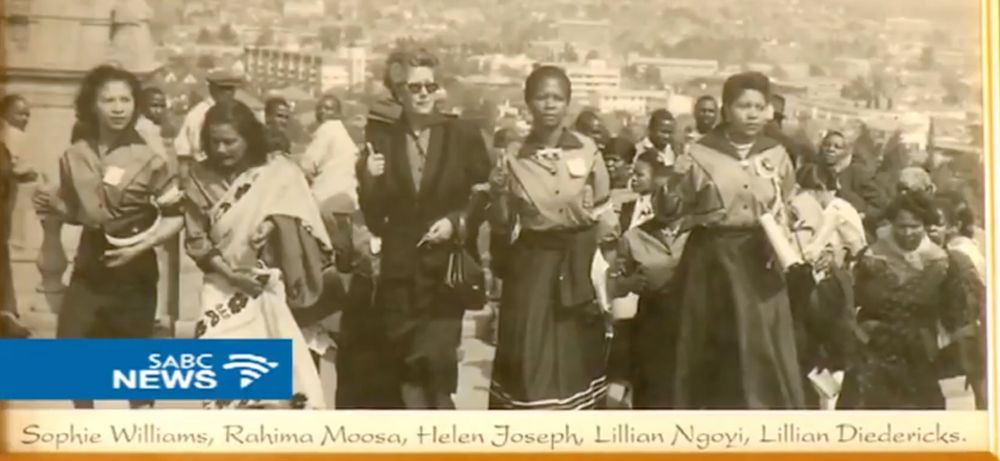
But it is not the full picture. There is another photograph, proving a fifth woman was part of the leadership of that march. Her name was Lillian Diedericks, and South Africa has spent decades forgetting this working-class heroine.
I first researched the women of 1956 as a fourteen-year-old activist, part of a feminist movement working to unban the ANC Women's League. I needed role models, and I found them in that photograph. I would go on to help rebuild the Women's League after its unbanning, and campaigned for August 9th to become a national holiday. We would open our meetings singing "Igama lama Lilian Ngoyi, Malibongwe! Igama lama Helen Joseph, Malibongwe!" and so on.
I knew the story of 1956, or I thought I did, until I discovered there had in fact been two women classified coloured in the lead that day, and that the second had sadly and inexplicably eluded our collective memory with the circulation of the iconic photograph of the four.
What follows is drawn from a narrative I crafted after discussion with activists some years ago, when I researched a documentary film about Diedericks. Veteran trade unionist and companion to Diedericks, Ilva Mackay; former political prisoner Mzolisi Dyasi; military veteran Lennox Klaas; and former UDF activist Janet Cherry, through her Master's thesis, all helped fill the gaps.
Lillian Diedericks, or Mama Lily, was born in 1925 in Gqeberha's Red Location (New Brighton), South Africa's oldest township. Forced removals uprooted her family in 1940. She left school with only a Standard 3 (Grade 5) education, but New Brighton gave her something a classroom could not: trilingual fluency in English, Afrikaans and Xhosa. Later, this would make her one of the most effective cross-community organisers of her generation. She taught herself the rest through reading and political education.
By the early 1940s, New Brighton had become an ANC stronghold, and Diedericks was in the thick of it, close to figures like trade unionist Raymond Mhlaba (Rivonia Trialist). Her politics were shaped in underground study groups run by the banned Communist Party of South Africa (CPSA), the former name of the South African Communist Party (SACP). She was recruited into the SACP underground in the 1950s by Gus Coe, because, as a factory and domestic worker, she never stopped asking questions.
At the time, the trade unions were a space where politically conscious women found they could play a meaningful role, and it was no surprise that Diedericks became a shop steward in the 1950s in the Food and Canning Workers' Union (FCWU). In 1954, alongside Frances Baard, Lilian Ngoyi, Hilda Bernstein and Ray Alexander, she founded the legendary Federation of South African Women (FEDSAW), to unite women across the country's racial lines.
During the anti-pass campaigns, where African and coloured women organised together through the food, textile and laundry unions in Gqeberha, Diedericks was asked by the South African Coloured People's Organisation (SACPO) to chair a conference on passes for African women. Like many activists, she worked simultaneously across a range of organisations, tirelessly taking on the urgent task of mobilising workers and communities to protest their condition.
This is clearly the history of a giant of the liberation struggle, someone who dedicated her life, sacrificing family time and more, to help free us all from oppression.
On 27 October 1955, a delegation of 2,000 women delivered petitions to the Union Buildings in Pretoria. The Minister of Native Affairs, who administered the pass laws, refused to meet a racially inclusive delegation. The women organised harder, and less than a year later, on 9 August 1956, they returned. This time, 20,000 women from every background, marshalled by FEDSAW, descended on the Union Buildings. It is worth considering what that scale of organising meant in an era with no cellphones, email, social media or print-media support. The women organised through word of mouth, union structures, and through women like Diedericks building and moving between networks. Many around the country could not travel to Pretoria, but they had signed petitions and handed these to their proxies.
Contrary to the mainstream story we have inherited, that march was led by five women: Diedericks, alongside Ngoyi, Joseph, de Bruyn and Moosa.
Later that year, Diedericks was arrested for a protest in Gqeberha and charged with treason, remaining in custody until 1961. A banning order followed from 1963 to 1969, imposed after she went underground with Mhlaba and Govan Mbeki. The apartheid state continued its relentless pursuit of Diedericks, and in 1971 it murdered her sister in a case of mistaken identity. She continued to speak out on gender-based violence, among other causes, into her final years. On 21 December 2021, at the age of 96, Mama Lily passed on.
None of this is obscure history. It sits in the archive, in media reports, and in the oral record.
The Amaqhawe Ethu Foundation and other activists in the Eastern Cape lobbied for Diedericks' recognition. In 1996, President Mandela presented her with an award recognising her activism. Her local municipality and the provincial government renamed their headquarters after her in 2009 and 2021 respectively. In 2014, the Red Location Museum celebrated her and other women struggle stalwarts in a year-long exhibition. What is obscure is the repeated decision, over decades, to leave her out of the national conversation.
In 2016, on the sixtieth anniversary of the march, President Zuma unveiled statues of the four women at the incomplete Women's Living Heritage Monument at Lilian Ngoyi Square in Pretoria. Responding to criticism, during his 2017 Women's Day address, Zuma announced that a fifth statue would be added. It never was.
In 2018, President Ramaphosa awarded Diedericks the Order of Luthuli in Silver for her contribution to the liberation struggle and to the 1956 march specifically. Notwithstanding the award, she felt invisible. In an SABC interview that day, Mama Lily spoke with a bluntness that should embarrass the nation: "I was buried alive," she told the interviewer. "I'm still buried alive."
In all probability, this is not the result of a conscious decision to exclude Diedericks. However, her absence in bronze — among the four women whose names now mark roads and public buildings across the country, and in the image we use symbolically each year, renders her a footnote in the history she co-authored.
History has recorded the facts. Why, then, has heritage practice failed to acknowledge her? Part of the answer may be linked to how national memory-making tends to compress complex narratives and default to manageable commemoration processes, in this case, drawing on the most widely circulated photograph, which also happens to neatly reinforce the rainbow-nation story. Perhaps confusion arose from the fact that there were two women called Lillian, or two women from Gqeberha in the leadership.
Guesswork aside, why this has still not been set right remains an open question. Could this be the ordinary neglect that typically falls on working-class organisers, and administrators, and behind-the-scenes activists who were less documented and had less institutional patronage than their more prominent peers? Would Diedericks have been made visible by now if she had had the right connections to fix this?
Whatever combination of chance, oversight and institutional inertia produced the flawed narrative, what compounds it is what came after. Even when Diedericks herself named the omission, plainly and on camera, the promise to fix it went unmet regardless. This is not simply an injustice to one woman's legacy. Erasure of this kind does quiet damage to the wider project of building an inclusive national identity.
This erasure from collective memory is an ongoing harm, repeated every time the incomplete story is told without correction. For democratic South Africa, it means a flawed founding story. Attending to that erasure now, casting the fifth statue, naming her consistently alongside the other four — would not undo the years in which Diedericks' struggle experiences went unvalidated.
However, it would be a form of healing nonetheless, because healing after erasure does not necessarily require restoring what was lost. It does require those who caused the harm to finally see and name it, in the present, without further delay. Genuine healing requires that a promise made at a podium in 2016 be honoured, rather than left to quietly lapse.
While we wait for heritage to catch up, history remembers Lillian Diedericks, OLS. Malibongwe!
Charlene Houston, founder of the Afrosoul Centre for Memory and Transformation, is a PhD candidate at the Centre for Education Rights and Transformation, University of Johannesburg, focusing on reparative work and re-indigeneity in heritage.