US AI chip export curbs: Indonesia reviews potential effects as analysts warn of investment, operational impact - CNA
This comes after the US tightened exports of advanced AI chips to Indonesia, Singapore, Malaysia, Thailand and Brazil on Monday (Nov 16), citing concerns that the five countries could be used as routes to divert chips to China.
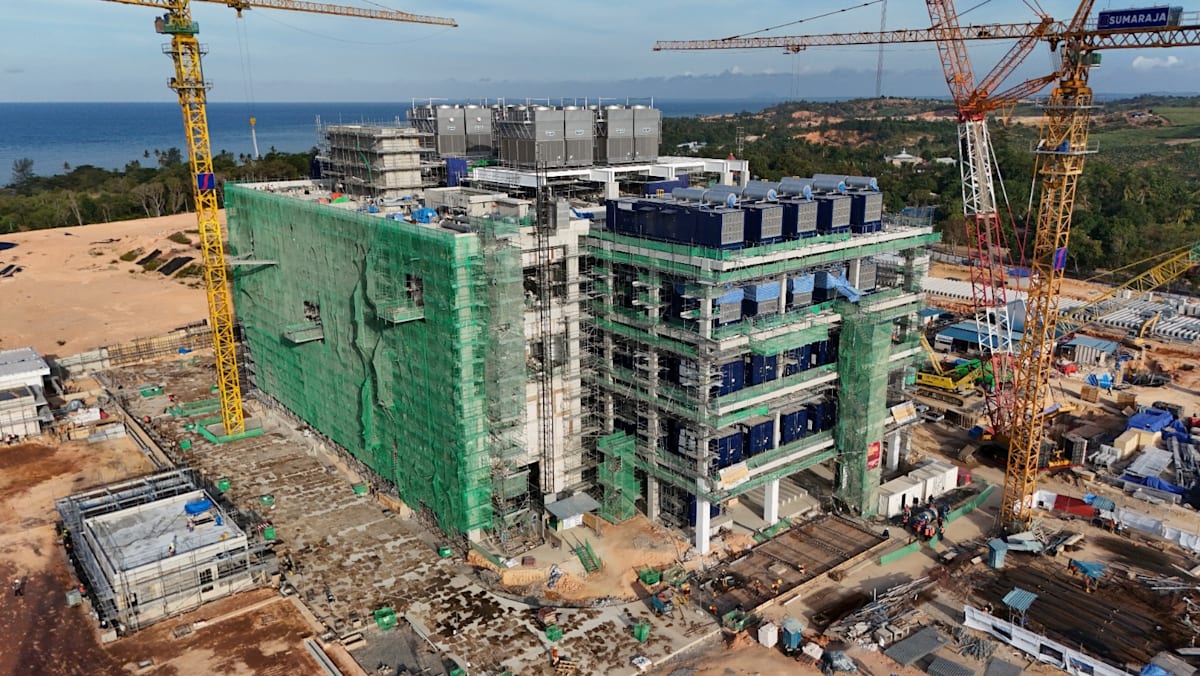
A drone view of BW Digital's data centre facility under construction at Nongsa Digital Park in Batam. (Photo: BW Digital)
This audio is generated by an AI tool.
Denny Armandhanu 19 Nov 2026 10:15AM (Updated: 19 Nov 2026 11:00AM) Bookmark Bookmark Share WhatsApp Telegram Facebook Threads Email LinkedIn Set CNA as your preferred source on Google Add CNA as a trusted source to help Google better understand and surface our content in search results. Read a summary of this article on FAST. Get bite-sized news via a newcards interface. Give it a try. Click here to return to FAST Tap here to return to FAST FAST JAKARTA: Indonesia is reviewing the impact of recently tightened United States restrictions on exports of advanced artificial intelligence (AI) chips, a move which experts say could hurt the Southeast Asian country's investment allure and domestic operations in the technology sector.
"The Government is reviewing the measure and seeking industry input on its potential impact on operations and investment, including in the data centre sector," Indonesia's Government Communications Agency (GCA) said in a statement to CNA on Wednesday (Nov 18).
It added that Indonesia was open to "technical dialogue with relevant counterparts to clarify how the measure will apply and support continued access to advanced computing technology for legitimate commercial use".
On Monday, the US announced that it would tighten exports of advanced AI chips to Indonesia, Singapore, Malaysia, Thailand and Brazil, citing concerns that the five countries could be used as routes to divert chips to China.
CNA Games Guess Word Crack the word, one row at a time Buzzword Create words using the given letters Mini Sudoku Tiny puzzle, mighty brain teaser Mini Crossword Small grid, big challenge Word Search Spot as many words as you can Show More Show Less The new rules require companies to obtain US government licences to export, re-export or transfer certain advanced AI chips to the five countries.
An analyst warned that the new measure could affect investors’ attitudes towards the archipelago’s chip sector.
"I think investors will be much more cautious, especially those from Western countries, including the US and Europe," said M Habib Abiyan Dzakwan, a researcher at the Centre for Strategic and International Studies (CSIS) Indonesia.
The restrictions also apply to overseas data centres that provide large amounts of computing capacity to companies headquartered in China, Russia, Iran, Cuba and other countries subject to US export controls.
Citing figures from the Coordinating Ministry for Economic Affairs, the government communications agency said Indonesia's exports of semiconductor devices and electronic integrated circuits reached approximately US$ 4.1billion in 2025, up from US$1.5 billion in 2024.
Habib said the move could lessen the appeal of Indonesia as an investment destination for the AI industry.
He added that the restrictions would not necessarily prompt investors to abandon Indonesia, but could complicate investments in AI and data centres due to additional regulatory requirements. "Previously, investors may have only needed to ensure compliance with Indonesian regulations, but with the current developments, they also have to ensure compliance with US regulations,” he said.
Investors, particularly those from the US and Europe, are expected to exercise greater caution to ensure that chips imported into Indonesia are not diverted to other countries, he added.
Dyah Ayu, Digital Economy Researcher at Center of Economic and Law Studies (CELIOS), said there was a risk investors could potentially hold off on decisions while they wait for further certainty.
“I think the … likely initial response would be for investors to wait for greater clarity on licensing requirements, postpone final investment decisions, or build capacity gradually before committing to additional AI hardware spending, while awaiting the Indonesian government's response to the tighter US export licensing rules,” she said.
Habib added that the government should examine AI chip import data to determine the volume of imports, the sectors using the chips and the data centres operating them. Such data, he said, would help address US concerns about the potential diversion of chips to other countries.
"The most important thing is to consult the business community first," Habib said.
Beyond engaging with the US, Indonesia should also coordinate with Singapore, Malaysia and Thailand to understand their responses to the restrictions, while strengthening enforcement to prevent the illegal diversion of chips, he added.
Indonesia is the only one of the four Southeast Asian countries affected by the US restrictions that lacks a dedicated strategic trade management framework, according to Maria Monica Wihardja, a fellow at ISEAS-Yusof Ishak Institute in Singapore.
Singapore and Malaysia already have export control laws or strategic trade management frameworks, while Thailand has yet to fully implement its framework. Indonesia, meanwhile, relies on a patchwork of customs, import-export and sector-specific regulations, she said.
"The absence of such export control … weakens export links, meaning an imported good may be loosely re-exported elsewhere without clear legal consequences," Wihardja previously told CNA.
Dyah said that the bigger concern was not simply the relocation of investments, but a shift in who controls the industry.
“Domestic operators could find it increasingly difficult to build their own capacity and end up merely becoming customers of global providers, leaving Indonesia increasingly dependent on foreign technology as a consumer,” she said.
Indonesia's communications agency said the government is currently developing a framework to facilitate legitimate trade while reducing the risk of dual-use goods and technologies being diverted or misused.
According to the agency, the initiative reflects Indonesia's commitment to "keeping its trade and investment environment open, predictable and trusted" and supports President Prabowo Subianto's direction to develop the country's semiconductor industry and strengthen its role in global supply chains.
"We expect companies operating in Indonesia to comply with applicable trade and export control requirements. Any violations of Indonesian law will be addressed through the appropriate legal processes," the agency said.
An automated curation of our top stories to start your day.