US Election ‘Nostradamus’ Allan Lichtman Is Back With 10 New Keys - Newsweek
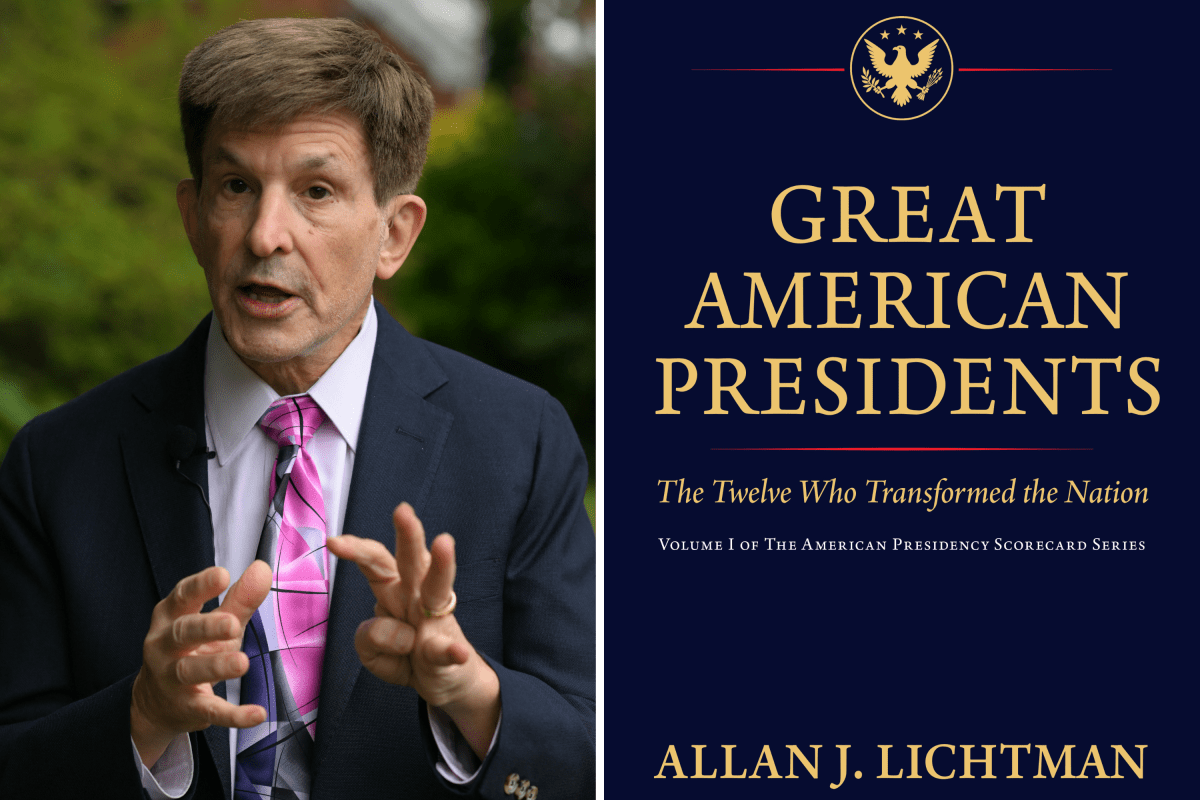
Allan Lichtman has outlined a new 10-point framework for assessing presidential greatness ahead of the release of his upcoming book on transformative American leaders.
The political analyst built his public reputation through the Keys to the White House, a system designed to forecast presidential elections. Lichtman is often dubbed the "Nostradamus" of presidential politics because his model correctly predicted the winner of most U.S. presidential races for decades, making him one of the country's most closely watched election forecasters.
His record came under renewed scrutiny, however, after he incorrectly predicted that Vice President Kamala Harris would win the 2024 presidential election, a race ultimately won by President Donald Trump.
His newest project turns away from prediction and instead asks a different question: what makes a president historically great?
The framework serves as the foundation of Great American Presidents: The Twelve Who Transformed the Nation, out September 22, which identifies a dozen presidents whom Lichtman believes fundamentally altered the country's trajectory.
Lichtman told Newsweek that his new model is centered on consequence rather than popularity.
According to the historian, the 10 keys measure the extent to which presidents seized the defining challenges of their eras and changed the nation's course. Public approval, contemporary polling and ideological agreement are not part of the calculation.
"The clearest illustration is that I included James K. Polk and excluded Dwight Eisenhower," Lichtman said. "Eisenhower was a fine president who outranks Polk in nearly every expert survey. But Polk doubled the size of continental America, and Eisenhower changed the country far less. If the framework measured esteem, that result would be indefensible. It measures consequence, so it follows."
The 10 keys include crisis leadership, transformational change, moral vision, stewardship of executive power, coalition building, institution building, diplomatic influence and adaptability. More specifically, the categories are:
Transformative leadership alone is not enough to qualify as great, Lichtman argues.
He says candidates for inclusion must operate within the broad traditions of American democracy. That principle helps explain why Richard Nixon and Donald Trump are excluded despite their undeniable influence on national politics.
A central role is played by what Lichtman calls the Stewardship Key, which evaluates whether presidents "expanded executive authority responsibly" rather than through what he describes as "reckless overreach."
Newsweek reached out to the White House via email for comment on Sunday.
For presidents who make the list, major failures are considered alongside major achievements. Lichtman cited Lyndon B. Johnson as an example, saying the Vietnam War is weighed against domestic reforms that he ranks among the most consequential in modern American history.
Lichtman acknowledges that different historians could apply the same keys and still reach different conclusions.
Rather than presenting the framework as a mathematical formula, he describes it as a structured guide requiring human judgment. Its purpose, he says, is to encourage debate while forcing evaluators to identify the specific criteria behind their assessments.
"The keys are gauges, not an algorithm," Lichtman told Newsweek. "They require judgment at every turn, like every system dealing with human behavior. I make no pretense that mine is the only defensible set of judgments."
Under that approach, historians might disagree over how heavily to weigh transformational change or whether a president satisfies the Moral Vision Key. What matters, Lichtman argues, is that disagreements become focused on concrete historical questions rather than instinctive rankings.
He has previously described the model as a "do-it-yourself" system for evaluating presidential greatness and says its educational value lies in encouraging discussion about American history.
One of the book's most striking conclusions is that no president after Ronald Reagan presently qualifies as great.
Lichtman offers several explanations.
First, historical distance matters. Assessing a president's true impact becomes more difficult when the long-term consequences of their decisions have not yet fully emerged.
He also points to structural changes in American politics. In his view, growing partisan polarization accelerated after the 1994 midterm elections, when Republicans gained control of both chambers of Congress for the first time in four decades. As ideological overlap between the parties diminished, consensus became increasingly difficult to achieve.
Social media, he argues, intensified those divisions by creating information silos and enabling highly targeted political messaging.
At the same time, presidents now face a more demanding governing environment. Challenges range from geopolitical competition and terrorism to cyber threats, globalization and climate-related issues, all while managing a vastly larger federal government.
Lichtman states that recent presidents have generally functioned as capable managers rather than transformational leaders. While figures such as George W. Bush, Bill Clinton and Barack Obama experienced periods of success, he contends they did not fundamentally overcome the deeper forces driving national division.
Lichtman draws a sharp distinction between his new framework and the Keys to the White House.
Election forecasting, he says, involves predictions that can be proven right or wrong by future events. The presidential greatness model, by contrast, is retrospective and evaluative.
Still, the 2024 election prompted him to consider whether some of the historical assumptions behind his forecasting model are becoming less reliable.
His election system is based on the idea that voters act primarily as judges of the incumbent party's governing performance. Lichtman says one question raised by 2024 is whether "polarization" and "an unprecedented avalanche of misinformation" have weakened that relationship.
He remains unconvinced that the underlying premise has collapsed. Yet he argues the possibility deserves serious attention, particularly because it connects to a broader theme running through the book: that the conditions which once produced transformative presidents may be eroding alongside the political environment that allowed voters to evaluate them clearly.
As a result, the 10 Keys to Presidential Greatness are not merely a ranking tool. They are also an argument about how American leadership has changed and what it now takes for a president to leave a lasting mark on the nation.
Great American Presidents: The Twelve Who Transformed the Nation by Allan J. Lichtman is set to be released on September 22, 2026.
Newsweek’s reporters and editors used Martyn, our AI assistant, to produce this story. Learn more about Martyn here.