US subs in Australia could be armed with nukes, says key Republican after visit
Washington: US submarines that rotate through Western Australia under the AUKUS pact could be carrying nuclear weapons and Australia should welcome that, according to a key Republican who chairs the Friends of Australia caucus in the US Congress.
Michael McCaul, a former chairman of the House Foreign Relations Committee and a China hawk, said having submarines armed with nuclear weapons was vital to deter Beijing from aggression towards Taiwan, which he regarded as a real and active threat.
Michael McCaul, the Republican co-chair of the Friends of Australia Caucus in Congress, who recently visited Australia.Bloomberg“They’re nuclear subs that have the potential to carry nuclear weapons. China has them as well,” he said of the US Virginia-class vessels due to rotate through HMAS Stirling.
“If you really want deterrence from President Xi, you want to demonstrate that you have this mutually assured destruction. It’s a principle that worked against the Soviets really well. It’s kind of an unveiled threat to have a nuclear sub going around without any weapons.”
The Australian government maintains that AUKUS adheres to the Treaty of Rarotonga, under which Australia commits not to acquire or station nuclear weapons. The submarines Australia is to buy and make under AUKUS will be nuclear-powered but conventionally armed.
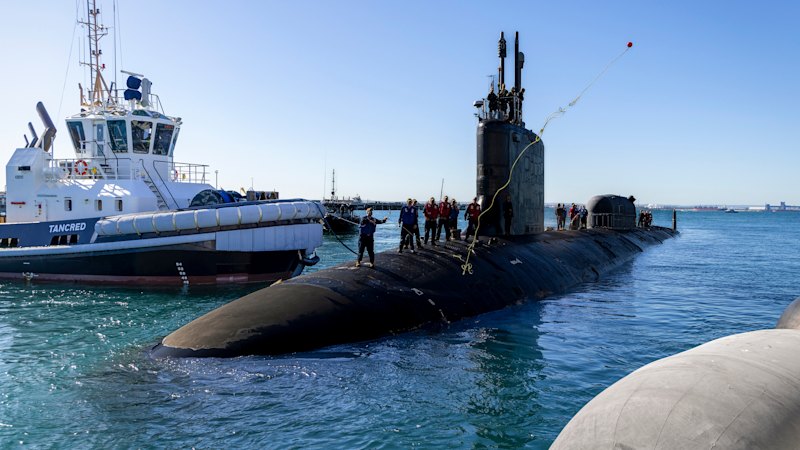
A US Virginia class nuclear-powered submarine berths in Western Australia in 2024.RANHowever, it is not clear whether the American submarines would be “stationed” in Australia, given they are technically rotating through Australia for at least five years, potentially much longer.
Deputy Prime Minister Richard Marles said that the federal government was fully committed to the Treaty of Rarotonga.
“That is a treaty that we abide by, and America understands that.
“Every decision that we take in respect of the force posture of any foreign country in Australia, including America, is in accordance with strict sovereignty rules that we have in place, which provide for full knowledge and concurrence, that means that we are always aware of exactly what activities are being undertaken by foreign defence forces on Australian soil,” he said in a statement to this masthead.
Defence Industry Minister Pat Conroy said in July that Australia would not allow nuclear-armed subs to be “stationed” in Perth.
“I can guarantee you that everything that we do will be consistent with the Treaty of Rarotonga, which is a commitment for us not to have stationed nuclear-armed vessels in Australia,” he said at the time.
McCaul said Australians should welcome nuclear-armed submarines because of their deterrent effect but would not discuss the potential impact on nuclear non-proliferation.
“This gets into whether or not our subs are carrying the weapons right now,” he said. “I can’t answer that. It’s probably classified.”
McCaul made the comments to this masthead in Washington after returning from an official visit to Australia as part of a congressional delegation. While there, he met Prime Minister Anthony Albanese, Defence Minister Richard Marles, Foreign Minister Penny Wong and Conroy, among others.
AUKUS, the $368 billion-plus defence pact with the US and United Kingdom, was announced five years ago this week, and has since been re-committed to by the governments of all three countries.
It marks the first time Australia will develop a nuclear industry – first to maintain and acquire US-made nuclear-powered submarines, then to build a new class of vessel with the UK.
That requires negotiating safeguards with the International Atomic Energy Agency (IAEA) – something that was highlighted in a new report by the Centre for Strategic and International Studies (CSIS) on Monday.
Defence Minister Richard Marles and US Defence Secretary Pete Hegseth at the Pentagon earlier in September.Getty Images“Before any nuclear fuel can be transferred to Australia … Australia needs to negotiate on its own with the IAEA,” said Charles Edel, the Australia chair at CSIS. “That has not been bedded down, it is something that Australia is working on. Chinese diplomats are working hard to muddy the waters.”
McCaul also revealed the US delegation to Australia had pressed the government to hasten the termination of Chinese company Landbridge’s lease over the Port of Darwin.
“That was something that was brought up by, frankly, our side … it’s an issue,” McCaul said. “When we talk about critical minerals, I think it’s important that Australia own that port.”
The lease was granted by the Northern Territory government in 2015 and waved through by the Turnbull federal government. Before the last election, both major parties promised to end the lease, either by finding an approved private buyer or compulsory acquisition.
Both parties have pledged to take control of the Port of Darwin from Chinese firm Landbridge.Alamy Stock PhotoThe US government has always disliked the deal, with then-president Barack Obama raising concerns about it with then-prime minister Malcolm Turnbull at the time.
Much of the lithium exported from Australia for refining leaves from the Port of Darwin, and McCaul indicated this was of concern to the US, given the multibillion-dollar critical minerals deal between the two countries.
China will resist moves to terminate the lease. This year, Landbridge lodged a legal challenge with the World Bank’s International Centre for Settlement of Investor Disputes, accusing Australia of discrimination and breaching the China-Australia free trade agreement.
McCaul visited Taiwan in August and said he was increasingly worried about Chinese aggression against the island – which Beijing claims as part of China.
Prime Minister Anthony Albanese and Defence Minister Richard Marles at HMAS Stirling in 2024.Trevor Collens/PoolHe said it was “absolutely critical” that Australia joined the US in any conflict with China over Taiwan, and had no doubt Australia would do so. “I don’t think it was even questioned. It’s just obvious,” he said.
Asked about concerns that an increasing US military presence in Australia – particularly US submarines rotating through HMAS Stirling near Perth – made the country a target, McCaul said: “Australia is a target.”
Defence spending was also discussed on the visit, McCaul said, making it clear that Washington still expected Australia to lift spending to at least 3.5 per cent of gross domestic product. That is despite President Donald Trump appearing nonplussed about the issue when Prime Minister Anthony Albanese visited a year ago.
McCaul said he recommended that Australia prioritise additional expenditure on pillar two of AUKUS, which involves developing and fielding emerging technologies.
“We appreciate your increase in defence spending. We’d like to see more as a percentage of GDP … I don’t sense that we would expect Australia to be off the hook.”
Marles said following a recent meeting with US Defence Secretary Pete Hegseth in Washington that the Albanese government was spending an extra $117 billion on defence over 10 years and had “a good story to tell”.
Federal Infrastructure Minister Catherine King said the government intended to continue good faith discussions with Landbridge about the Port of Darwin, despite the legal action.
“We ... do not think it is in either party’s interest to carry the dispute out in the public domain,” she said.
Get a note directly from our foreign correspondents on what’s making headlines around the world. Sign up for our weekly What in the World newsletter.
You have reached your maximum number of saved items.
Remove items from your saved list to add more.