
US warns allies of missile delivery delays due to shortage
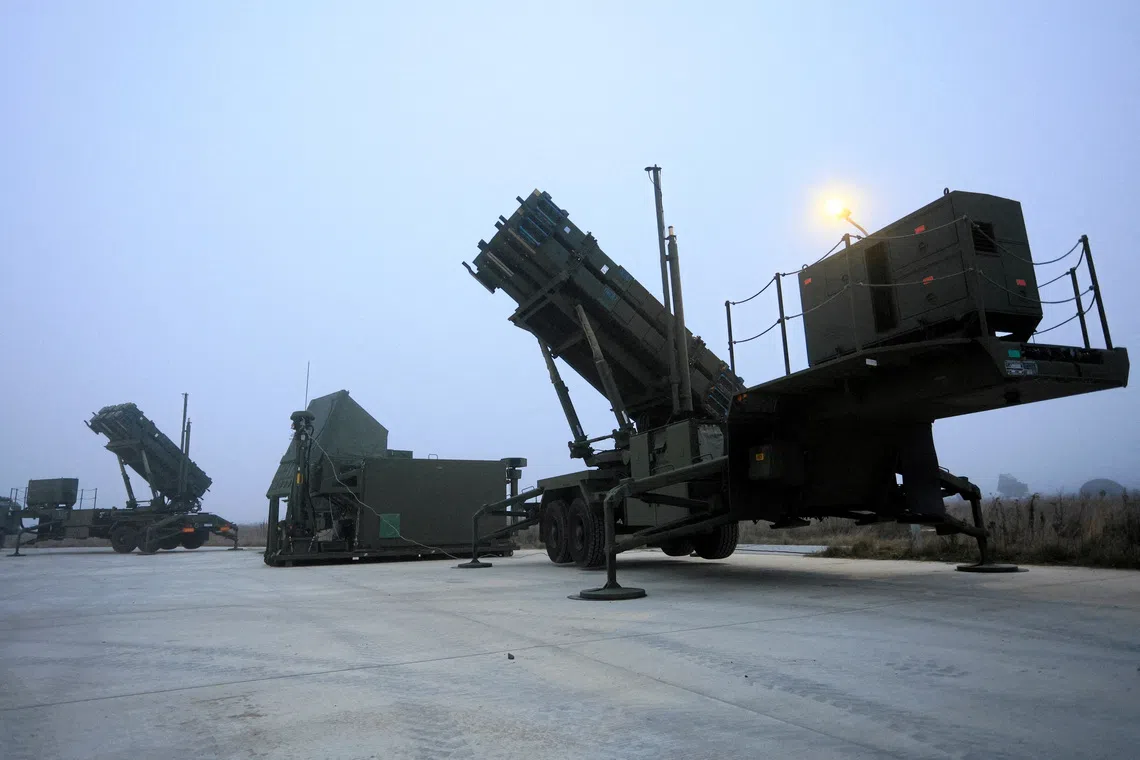
The Patriot missile systems on display at the 3rd Warsaw Air Defense Missile Brigade's base in Sochaczew, Poland, on Dec 18, 2025.
The US has warned allies to expect delays of as much as five years in key weapons deliveries as it rebuilds its own depleted munitions stocks.
Multiple European nations are expecting deliveries of key missile and air defence capabilities to be pushed back as a result of the US military exhausting its own arsenal in the Iran war, officials said.
Germany has asked the US to speed up delivery of the long-range Tomahawk cruise missile and the ground-based Typhon launcher, but depleted US stocks of the powerful weapon means its manufacturer, RTX Corp’s Raytheon, is unlikely to fulfil the order in the next five years.
Two other officials said some Eastern European nations also reliant on US weapons systems have experienced delays since soon after the US and Israel launched a war against Iran on Feb 28.
The Defense Department didn’t immediately return a call seeking comment.
The Pentagon’s decision to prioritise its own stockpiles is also straining Ukraine’s push for the US to send it more Patriot air defence interceptors ahead of what is expected to be a difficult winter for the war-torn nation. The issue of Ukraine’s badly needed air defense will be a key topic at next week’s United Nations meetings in New York.
President Donald Trump earlier this week told reporters that he’s talking to Ukraine about either sending them a “far less sophisticated version” of the Patriot system, or granting licences for Europeans to build the weapons.
The US is estimated to have used more than half of its most advanced Patriot missile variants, a third of its Tomahawk missiles and almost half of its precision strike missiles and Terminal High Altitude Area Defense, or THAAD, interceptors in Iran. The Congressional Budget Office said the US had probably used as much as two-thirds of its inventory of missile defence interceptors since June 2025.
The military fired so many munitions at Iranian targets during the first few months of the war that it “has resulted in strategic inventory shortfalls and revealed industrial base bottlenecks for munitions resupply,” Pentagon officials acknowledged to its inspector general.
Officials are now working to stockpile critical components and selected munitions, as well as streamline production lead times, the watchdog office said in a report released this week.
Defence firms are ramping up production, with Lockheed Martin Corp working to increase annual capacity from around 600 to 2,000 of the most advanced PAC-3 MSE, or Patriot Advanced Capability-3 Missile Segment Enhancement.
The stockpile shortages aren’t just impacting the US and Europe. In April the US told Japan its Tomahawk deliveries would be delayed by as much as two years. Saudi Arabia has also urged allies, including the US, to provide military support to help counter attacks from the Houthis in Yemen. Washington has not said if it will provide extra assistance.
Still, the US continues to deliver weapons bought by European allies for Ukraine through NATO and European Union initiatives, the people said.
Europe’s main concern is that the US continues to provide Ukraine with battlefield support.
European leaders plan to lobby Trump on providing Ukraine with more Patriots next week as world leaders attend United Nations meetings. EU officials also hope to push the US to grant European nations licences to build their own Patriots that could eventually be provided to Kyiv. BLOOMBERG

