
Vegans eat the most ultra-processed food, a post claims. The truth is stranger
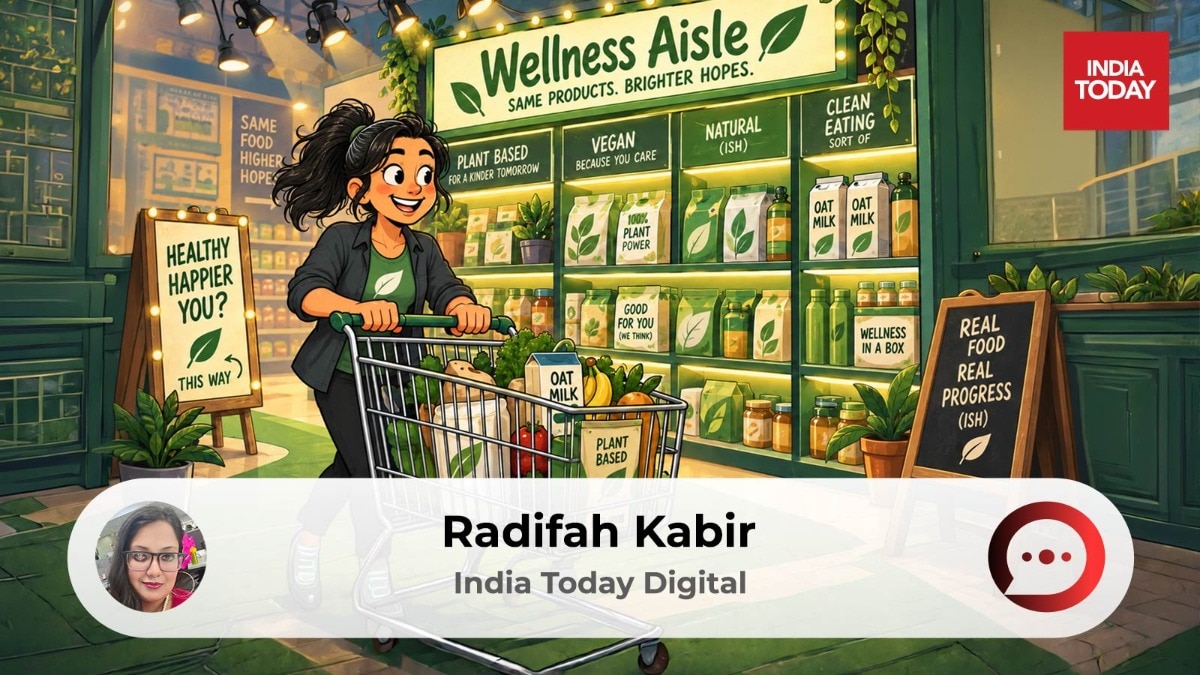
There is a particular corner of the supermarket that has learned to glow. The packaging is muted green and honest brown, the typography is gentle, and there are leaves everywhere on the label. A burger that bleeds beetroot. A cheese slice that has never met a cow. A carton of oat milk with a field printed on the side. You reach for it with a small, warm feeling of having done something decent, for the animals, for the planet, and for yourself.
Having stood on the other side of that shelf, in the rooms where such products are formulated, I want to say something that will please neither side of the argument now raging online.
I should say upfront that the research on this specific question is still thin, a handful of studies, some with very small vegan sample sizes, so nothing here should be read as the final word. But even that limited evidence tells a more interesting story than the version doing the rounds.WHAT DID A STUDY ACTUALLY FIND ABOUT VEGAN DIET?
A claim by Dr Cyriac Abby Philips, popularly known as the Liver Doc, has been travelling fast: that a vegan diet is the most ultra-processed diet of all. It is the kind of sentence built for the internet, and like most such sentences, it is a slightly broken version of something real.
The real evidence is a study of 1,99,502 people from the UK Biobank, published in eClinicalMedicine on November 14, 2024 by researchers at Imperial College London with the University of Sao Paulo and the International Agency for Research on Cancer. It measured how much of each group’s diet, by weight, came from ultra-processed foods, using the NOVA system, which sorts food not by nutrients but by how industrially it has been made.
Here’s the twist nobody expected. Meat-eaters actually ate the most processed food, not vegans. Out of every 100 bites, meat-eaters had about 24 bites of processed food. Vegetarians had about 24.2. Vegans had the least, around 23.
So why does everyone think vegans eat more junk? Because of one clever trick scientists used, and once you understand the trick, everything makes sense.
Imagine a race between two runners. One runner is young and fit. The other is older and tired. If the young one wins, is it really a fair race? Not quite, because the age difference did half the work. Scientists faced the same problem here. The vegans and vegetarians in this study happened to be younger, more educated, and mostly women. These things alone change what people eat; nothing to do with meat or no meat. Vegetarians ate 1.3 percentage points more ultra-processed food than red-meat eaters, while the vegan figure rested on just 159 people and was not statistically significant. (Photo: Vashu Sharma/India Today)
So scientists tried something clever: they mathematically "removed" the advantage of being young, educated, and female, to make it a fair race, diet versus diet, nothing else.
And that is where the numbers flipped. Once the race was made fair, vegetarians looked like they ate 1.3 per cent more processed food than meat-eaters. This result was solid.
But vegans? Their number, 1.2 per cent more, looks scary on paper but actually means nothing. Raw numbers made vegans look cleaner simply because they were younger and more educated, not because veganism itself was healthier. Once scientists removed that unfair advantage, the number rose to 1.2 per cent.
But here's the catch. Only 159 vegans were studied, out of nearly 2 lakh people. That's like judging an entire class exam based on just 2 students' answers. Even scientists admitted this number could easily have been zero.
These roughly 2 lakh people were all participants from the UK Biobank, a long-running health database of British adults recruited between 2006 and 2010, who reported their eating habits through food diaries. Out of that entire pool, only 159 identified as vegans, making them a tiny fraction of the total group.
So here's the real story in one line: meat-eaters eat the most junk food in real life. Vegans and vegetarians only "looked" worse because scientists adjusted the race to be fair, not because they secretly eat badly.
Going vegan doesn't clean up your plate automatically. You are just swapping one type of packaged food for another.WHY IS PLANT-BASED MEAT SO HEAVILY ENGINEERED?
This is the part I know from the inside, and it is genuinely remarkable engineering, whatever you think of the result.
To make a plant taste and tear like flesh, you must first take it apart. Soy or pea is stripped down to a protein isolate, which means the protein is extracted and almost everything else, including the fibre, the starch, the polyphenols, and the food matrix itself, is left behind. That isolate is then fed into a twin-screw extruder at high moisture and temperatures of roughly 120 to 160 degrees Celsius, where heat, pressure and shear unfold the proteins and force them to realign into fibres running in one direction. This is called high-moisture extrusion, and it is how a powder is persuaded to behave like muscle.
Then comes my favourite piece of quiet cleverness, the ingredient that holds nearly every plant-based burger together. Methylcellulose, listed as E461, is a modified cellulose with a property that sounds like a mistake. It dissolves in cold water and sets when heated, the exact opposite of gelatin. That is why the patty firms up on the pan instead of collapsing, holds its juices, and gives you a bite that feels like meat. Soy and pea are stripped to protein isolates, then forced through a twin-screw extruder at up to 160 degrees Celsius until the proteins realign into fibres that tear like muscle. (Photo: Vashu Sharma/India Today)
None of this is sinister. It is skilled work. But let us be clear about what has happened: a whole food was disassembled into fractions and rebuilt into a new one, with binders and flavour systems added to make the illusion hold. That is the textbook definition of ultra-processing, and it is why these products land in the same NOVA category as a packet of crisps.
The nutrition follows the engineering. An audit by Australia's George Institute for Global Health found that while plant-based meats were generally lower in saturated fat and sodium and higher in fibre than the meat they replaced, only 12.1 per cent of 132 products were fortified with iron, zinc and vitamin B12.
And fortification alone does not settle it. Swedish researchers found the iron in many meat substitutes is locked up by phytates and poorly absorbed, concluding these products do not contribute to absorbed iron in the blood in any meaningful way. The number on the label and the iron in your blood are not the same thing.IS OAT MILK HEALTHIER THAN COW'S MILK?
Consider the most beloved product in the whole aisle.
Oats are full of starch, and starch in water turns to glue. So to make a drinkable oat milk, manufacturers add enzymes that break that starch down into simple sugars, chiefly maltose. Nothing is added. Enzymes break oat starch into simple sugars to keep the drink pourable, which is why unsweetened oat milk can still taste sweet. It carries about 0.8g protein per 100g, against milk's 3.55g. (Photo: Vashu Sharma/India Today)
The sweetness is manufactured from within, which is why an unsweetened oat milk can still be quietly sugary and rank high on the glycaemic index. Oils, gums and emulsifiers complete the picture.
And the protein? Plain oat drinks carry about 0.8 grams of protein per 100 grams. Cow's milk carries about 3.55. Oat milk is lower in saturated fat, kinder to the planet, and when fortified can hold its own on calcium. It is simply not a protein food, and a great many people drinking it believe that it is.DOES A VEGAN LABEL MAKE US EAT WORSE?
Here we arrive at the heart of it, which is not chemistry but psychology.
Researchers call it the health halo, and it is well documented. A 2025 systematic review found sustainability labels, including vegan and plant-based ones, frequently raise how healthy we judge a product to be. One American study of 582 people found the halo around plant-based claims was strong enough to override the objective health rating printed on the same pack. Studies show plant-based claims raise how healthy, tasty and pure a product seems, sometimes overriding the official health rating printed on the very same pack. (Photo: Vashu Sharma/India Today)
Experiments in the United States and Germany found that adding the words vegan or plant-based made people rate a product as healthier, tastier and purer, and made them likelier to buy it, even when the product had not changed at all.
That is the mechanism. A word meant to describe an ethical choice has been quietly repurposed as a nutritional claim, and it is doing work no one ever asked it to do. Vegan tells you what is absent. It tells you nothing whatsoever about what is present.ARE PLANT-BASED ULTRA-PROCESSED FOODS BAD FOR HEART?
The most important study in this whole debate is not what the post boldly claims. It is the second UK Biobank analysis, of 1,26,842 adults followed for about nine years, published in The Lancet Regional Health Europe on June 10, 2024.
It did something elegantly simple. It split plant foods in two, by how processed they were. Among 1.26 lakh adults, ultra-processed plant foods were linked to higher cardiovascular risk, while whole plant foods were linked to lower risk. The processing was the point. (Photo: Vashu Sharma/India Today)
Every 10 percentage point rise in calories from plant foods that were not ultra-processed was associated with a 7 per cent lower risk of cardiovascular disease and a 13 per cent lower risk of dying from it. The same rise in ultra-processed plant foods was associated with a 5 per cent higher risk of cardiovascular disease and a 12 per cent higher risk of death. And when all plant foods were lumped together, undivided, the association vanished entirely.
These are observational findings, associations rather than proof of cause, and I will not inflate them. But the shape of the answer is hard to miss. The plant was never the point. The processing was.IS EVERY PROCESSED PLANT FOOD UNHEALTHY?
No, and any honest argument has to say so.
There is a serious scientific objection to NOVA, made most forcefully by Mark Messina, an author specialising in plant-based diets, and his colleagues, who argue it is too blunt an instrument, sweeping fortified soy milk into the same bin as cola. Adam Drewnowski, an internationally recognised leader in nutritional sciences, has made the same case. They have a point, particularly for fortified products that genuinely help people meet nutritional needs.
And processed plant meats can do real good. In the SWAP-MEAT trial at Stanford, 36 adults who swapped red meat for plant-based alternatives saw their LDL cholesterol fall from 120.7 to 109.9 mg/dL, along with lower TMAO and slightly lower weight. TMAO, or Trimethylamine N-oxide, is an organic compound produced by gut bacteria when digesting nutrients like choline, lecithin, and L-carnitine, which are commonly found in red meat, eggs, and dairy.
The study was small and funded in part by a gift from Beyond Meat, and I flag that plainly, but it tells us something true: a processed plant burger can still beat a steak on specific measures.
So this is not an argument against veganism, which we admire, nor against processing, which has saved more lives than almost anything in my field. It is an argument against a word doing the work that a nutrition label should be doing.WHAT SHOULD INDIA DO ABOUT ITS OWN PLANT PROTEINS?
And here is where I find the whole conversation slightly absurd, standing as we do in this particular country.
India has been eating brilliantly from plants for several thousand years. Dal. Rajma. Chana. The humble khichdi. These are not analogues of anything. They are whole foods, minimally processed, cheap, complete when paired with grain, and they sit squarely in the category that the Lancet study associates with a lower risk of heart disease. We did not need a laboratory to invent plant protein for us. We only needed to keep eating it. Dal, rajma, chana and khichdi are whole, minimally processed plant proteins. A chickpea has never needed a factory to become virtuous. (Photo: Vashu Sharma/India Today)
Yet, our ultra-processed sector has been growing at more than 13 per cent a year, by the WHO’s own reckoning with ICRIER (Indian Council for Research on International Economic Relations), and the imported vegan aisle now arrives with its green leaves and its gentle typography to persuade a nation that owns the world’s finest plant-protein tradition, that virtue comes shrink-wrapped.
Our regulator has done sensible work here, defining vegan food under dedicated regulations in 2022 and creating a logo to certify it. But that logo answers an ethical question, not a nutritional one, and we should be honest with shoppers about the difference.
So eat plants, by all means. Eat them for the animals, for the planet, for your heart. Just remember that a chickpea does not need a factory to become virtuous, and that the most plant-based thing in any Indian kitchen was always the pot of dal on the back of the stove.
Radifah Kabir is a food and biotechnologist.- EndsPublished By: Radifah KabirPublished On: Sep 14, 2026 15:38 IST


