‘Vibe coding is not going away’: AWS’ Darko Mesaroš on AI and the future of coding - The Indian Express
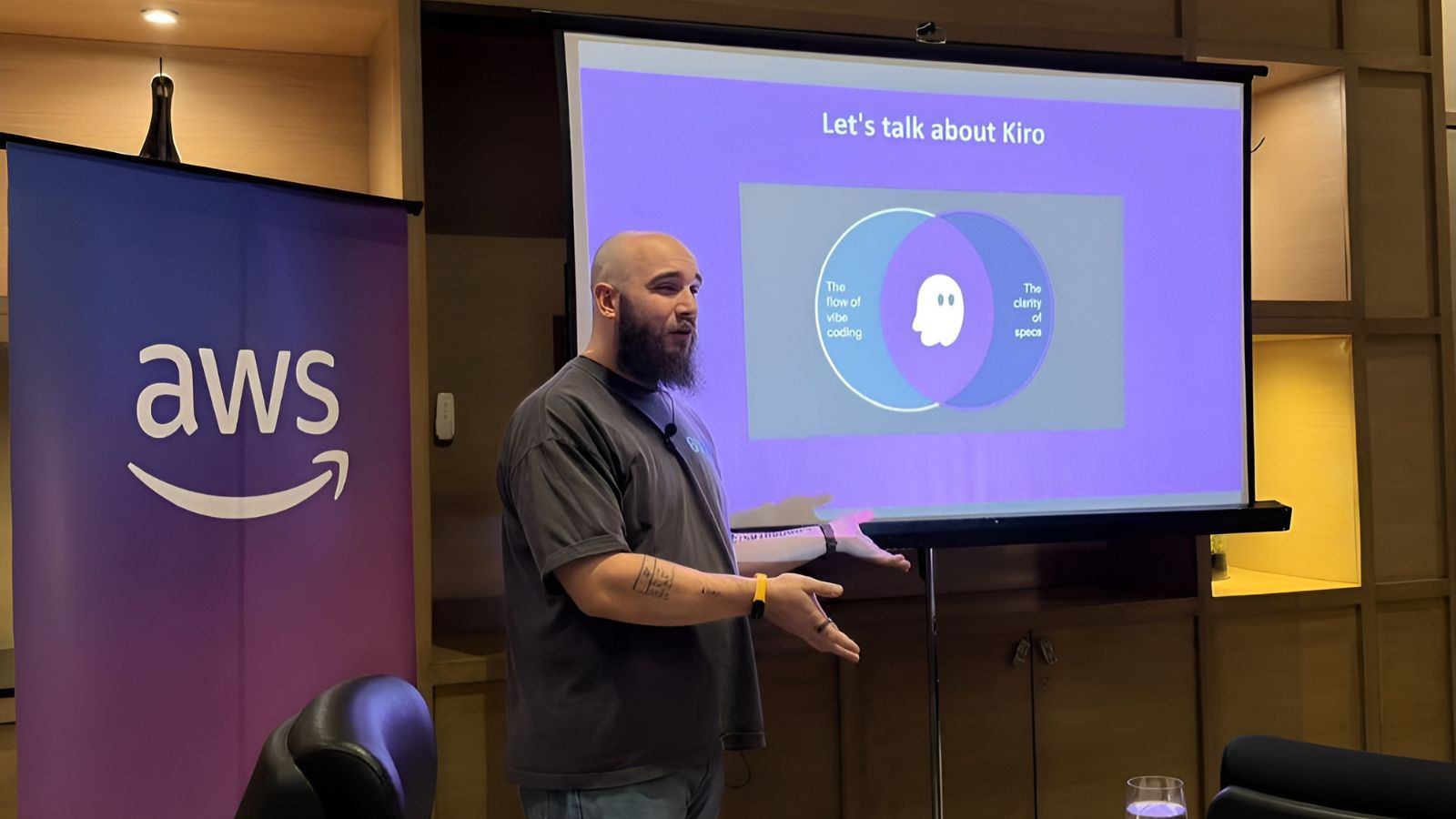
“Vibe coding is not going away,” said Darko Mesaroš, Distinguished Developer Advocate at AWS. But for developers who know what they are building, Mesaroš feels there is a more disciplined approach: spec-driven development.
With artificial intelligence (AI) rapidly changing how software is built, Mesaroš believes the role of a developer is expanding rather than shrinking. During his recent visit to India, Mesaroš sat down with Indianexpress.com to discuss how AI is reshaping coding. In the interaction, Mesaroš shed light on the growing use of spec-driven development alongside ‘vibe coding’, the limitations developers continue to face with AI agents, and what AWS is doing to bolster India’s developer ecosystem.
Mesaroš has spent about 11 years at AWS after serving over two decades in tech, systems administration, and software development, lending his voice a heft of authority in the domain. He said that AI has changed how code gets written, but not the essence of software engineering.
“Software engineering, as a practice, is so much more than coding,” he said. “Writing code was just one part of it — a big part, because it took the most effort — but it’s only part of the picture.” He added that developers now have AI coding tools, such as AWS’s Kiro, to help write code, but the discipline itself still depends on “understanding your customer base, systems design, scaling, operations.”
Mesaroš, in fact, predicts that for the next few years developers will need to broaden their skill sets. “I see that software developers are going to expand their skill sets slightly more than just being strictly coders,” he said, describing the shift as one toward people “who are actually building software and understanding a lot more than just how to write a good function in Rust.”
Kiro, an AI-powered coding tool from AWS, is an integrated development environment (IDE) that focuses on spec-driven development (SDD), a more structured way of building software. A large part of the conversation with Mesaroš revolved around Kiro, which focuses on defining requirements and design decisions before code is generated. He contrasted this with ‘vibe coding’, an iterative back-and-forth with an AI agent that can be useful for exploration, prototyping and experimentation.
Mesaroš offered a nuanced take, saying that SDD is not meant to replace vibe coding, which he views as a legitimate, if different, way of working. “It’s an integral part of software development because it’s not just about — you have to write this complicated thing every time you do anything. Vibe coding is there to help you explore, build prototypes, and experiment with what you want to build.”
However, he argued that the shift toward specs matters when developers want to ensure that what they are implementing is actually what they intended to build. “Instead of an unstructured back-and-forth with an AI agent, spec-driven development turns the process into ‘a contract between a developer and an agent of what needs to be produced. Mesaroš linked this directly to concerns about quality: “We’ve seen so much AI slop out there… I actually mean AI slop applications, and we all know what they look like when we see them. So spec-driven development absolutely helps prevent that.”
When asked about the current limitations of AI tools for developers, Mesaroš highlighted the lack of persistent context across sessions. He said developers previously had to repeatedly explain their preferences, tech stack and other requirements every time they started a new session. He credited Kiro Crew, AWS’s open-source AI agent orchestrator, with addressing this through a memory feature that learns from past sessions. “I have 273 lessons Kiro Crew has learned from me interacting with it,” he said, adding that the tool has picked up on his own coding habits over time. He also pointed to cost as an ongoing consideration, noting that Kiro’s “auto” model routes simpler tasks to cheaper models rather than defaulting to the largest one available.
Now that AI agents are taking more of the coding workload, Mesaroš asserted that the ultimate responsibility stays with the developer. He went on to cite Kiro Crew’s own growth as an open-source project with over 10,000 pull requests. “Every pull request, every software change… was approved by a human, so the responsibility still lies on the developer out there,” he said.
When asked what his advice will be to developers who want to stay relevant in the AI era, Mesaroš urged all to broaden and deepen their skills simultaneously — understanding system architecture and infrastructure while also using AI tools to dig deeper into how the systems they build actually work. “I think broadening and deepening your skill set at the same time should be a focus of developers,” he said, “and not just learning how to write a specific language or a library or a framework.”
During the conversation, the distinguished developer advocate also outlined AWS’s investment in India’s developer community, including a global commitment of more than $500 million toward student cloud and AI training and an AWS Builder Loft planned for India. He shared that over 10 million people in India have gone through AWS training and certification programmes, alongside a $13 billion-plus Amazon investment in AI and cloud infrastructure between 2026 and 2030 announced by CEO Andy Jassy during a recent visit.
However, on developer adoption trends specifically in India, he offered a measured response. “I wouldn’t say there’s any specific nature of developers in India compared to everything else, but I see the enthusiasm and just the care of developers who are using these tools to actually build some cool things.”
Bijin Jose serves as an Assistant Editor at Indian Express Online in New Delhi. A seasoned technology journalist with a diverse portfolio, he brings over a decade of experience in the media industry to his coverage of the evolving digital landscape and emerging technologies. Experience & Career Bijin commenced his journalistic journey in 2013 as a citizen journalist with The Times of India. His career trajectory includes significant tenures at prestigious media organizations including India Today Digital and The Economic Times. This diverse professional background, ranging from legacy print institutions to dynamic digital platforms, culminated in his current leadership role at The Indian Express, where he helps shape the publication's technology narrative. Expertise & Focus Areas Bijin has transitioned from general reporting to a specialized focus on the intersection of technology and humanity. His key areas of expertise include: Artificial Intelligence: deeply tracking developments in AI, providing nuanced perspectives on its ethical,industrial, and societal implications. Tech Commentary: moving beyond product specifications to analyze how technology reshapes daily life. Diverse Reporting Foundation: draws upon a robust background in crime reporting and cultural features to bring a human-centric approach to technical storytelling. Authoritativeness & Trust Bijin’s editorial voice is informed by a strong academic foundation, holding a Bachelor of Arts in English from Maharaja Sayajirao University, Vadodara, and a Master of Arts in English Literature. This literary background enables him to deconstruct complex technical jargon into accessible, compelling narratives. His steady progression through India’s top newsrooms underscores his reputation for editorial rigor and reliable journalism. Find all stories by Bijin Jose here ... Read More