Vijay sounds Hindi alarm: Has Tamil Nadu merely handed oldest Dravidian script to a younger hero?
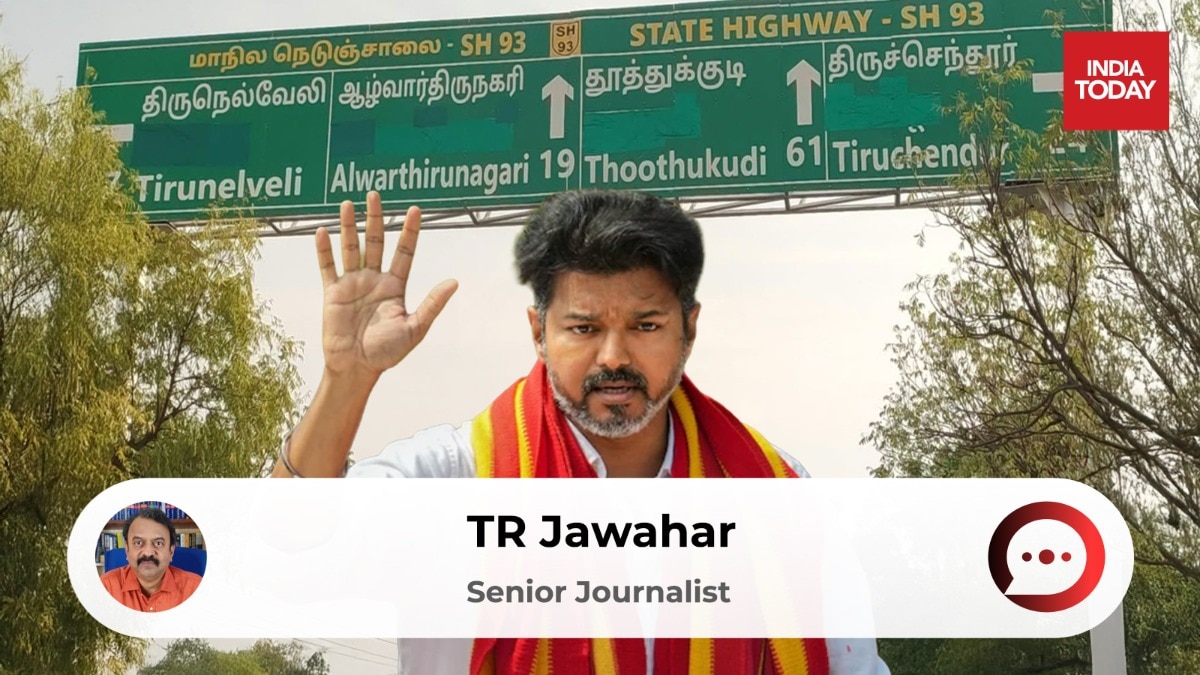
The signboard pointed towards Tirunelveli, Alwarthirunagari, Thoothukudi and Tiruchendur. Tamil Nadu's politicians looked at it and saw only Delhi.
There it stood near the Karumeni river bridge on the Sathankulam-Nazareth State Highway: one direction board, four destinations and three scripts —Tamil, Hindi and English. By the time the political traffic cleared, the Hindi lettering had been erased, two Highways engineers had been suspended, a departmental inquiry had begun and Tamil civilisation had been officially declared safe once again.
Tamil Nadu is right to resist linguistic compulsion, but wrong to convert linguistic choice into cultural treason. The sharper target is not the historic two-language policy itself. It is the political industry that deliberately refuses to distinguish between Hindi imposition, Hindi instruction, Hindi visibility and the voluntary acquisition of Hindi.
Vijay's conduct makes the episode more consequential because the self-advertised representative of a new generation has reached instinctively for the oldest script in the Dravidian cupboard.
If a government marketed as political change responds to a signboard exactly as every Dravidian government before it would have responded, where is the change — and what language is it written in?THE CONSPIRACY BENEATH THE PAINT
This was not the Union government marching southward under the cover of darkness. It was not the Railway Ministry renaming Sathankulam, nor the National Highways Authority planting Hindi milestones as cultural landmines. The offending board belonged to the Tamil Nadu State Highways Department.
Delhi was nowhere near the scene of the crime.
The board was certainly inconsistent with Tamil Nadu's established practice of using Tamil and English on State highway signs. Correcting it required little more than paint, a departmental instruction and an inquiry into how the design was approved. Instead, the government produced two suspensions and warned that officials violating the two-language policy would face uncompromising action.
Who specified the format? Did a contractor reproduce a familiar three-language template? Who inspected the work and approved payment? Were the two engineers heard before suspension? If this was a systemic lapse, locating the entire conspiracy in two field officials resembles repairing a highway by ditching the gravel.
Unable to suspend Hindi, the government suspended two engineers. In Indian administration, responsibility travels downwards faster than a file travels upwards.WHEN RESISTANCE HAD A REASON
None of this diminishes Tamil Nadu's historic case against compulsory Hindi. That resistance was neither invented for television nor sustained merely by paranoia. It arose from an unequal federation and the reasonable fear that one region's mother tongue would become another region's entrance examination.
The first great confrontation followed the introduction of compulsory Hindi in schools of the Madras Presidency under C Rajagopalachari's Congress ministry in 1937. The agitation drew Periyar, the Justice Party, Tamil scholars, women and students into a movement that outlasted arrests and the deaths of Natarajan and Thalamuthu. The policy was withdrawn in 1940, but the apprehension survived.
The later crisis reached its emotional and political peak around 1965. The Constitution had designated Hindi in Devanagari as the official language of the Union and contemplated a fifteen-year transitional role for English. Tamil Nadu feared that the expiry of that period would progressively privilege Hindi in administration, examinations and Union employment. Chinnasamy of Tiruchirappalli had set himself ablaze on 25 January 1964; further deaths and self-immolations during the 1965 agitation permanently entered Tamil political memory.
India, it bears repeating, has no constitutionally proclaimed "national language". The eventual settlement was also not delivered by one assurance or one agitation. Nehru's earlier promises, Shastri's crisis-period responses, the Official Languages Act and its 1967 amendment, and the Official Language Resolution of 1968 together preserved the continuing role of English.
Hindi was resisted not merely as another language. It was resisted as a mechanism through which one form of disadvantage might be exchanged for another. Anna converted anger into persuasion and persuasion into votes. The agitation helped end Congress rule in 1967 and shaped the federal equilibrium under which Tamil Nadu prospered.
But a defensive doctrine can succeed so completely that its custodians forget the difference between preserving the victory and perpetually recreating the war. The agitations were not theatrical when the threat was tangible. Their success cannot require Tamil Nadu to pretend eternally that every Devanagari letter carries a lathi.THREE LANGUAGES, ONE-WAY TRAFFIC
The three-language formula was not composed in the BJP office. It emerged from education-policy deliberations associated with the Kothari Commission and was incorporated into the national framework in the 1960s. Its advertised purpose was reciprocity: Hindi-speaking States would learn Hindi, English and a modern Indian language, preferably southern; non-Hindi States would learn their regional language, English and Hindi.
Its practical defect was visible from space. Southern students were expected to learn Hindi for national integration while much of Hindi-speaking India treated a southern language as an attractive extracurricular rumour. The South supplied the learning; the North supplied the formula.
NEP 2020 formally declares flexibility and says no language will be imposed. It does not expressly command every State to teach Hindi. Yet Tamil Nadu's distrust is not irrational. A formally neutral formula functions inside an unequal linguistic Union in which Hindi already possesses numerical, administrative and political advantages. Choice on paper can become pressure in implementation.
That is why Tamil Nadu may legitimately retain Tamil and English as its compulsory educational core. It is also why the Centre should not turn educational finance into a lever for policy obedience. Delhi cannot preach linguistic choice while financially punishing a State for exercising political choice.
But the converse is equally true. Chennai cannot denounce coercion from Delhi while treating optional linguistic choice by its own citizens as cultural or linguistic contamination.POLICY, POLITICS AND PROTEST
Three things have been thrown into one convenient cauldron. Policy is Tamil Nadu's decision to retain its two-language educational arrangement. Politics is the continuing contest over Hindi's role in Union administration, public employment and centrally designed education. Protest is a democratic instrument justified when compulsion becomes real.
A signboard is not a syllabus. Visibility is not instruction. Instruction is not imposition. Voluntary acquisition is not cultural surrender.
Hindi imposed is a federal wrong. Hindi offered is an educational choice. Hindi visible is merely Hindi visible. The difference between vigilance and paranoia is the ability to recognise when no one is compelling you.
If departmental rules prescribed only Tamil and English, the Sathankulam board was an administrative violation and could be corrected as one. It did not require Tamil Nadu to behave as if a column of Hindi-speaking soldiers had crossed the Karumeni river. The lettering stood below Tamil; it did not dethrone it. No motorist was ordered to read it. No student was examined on it. No Tamil word was removed to accommodate it.
Yet the political reaction inflated a minor board into a manifesto. Stalin described the two-language policy as Tamil Nadu's lifeblood and asked whether this was Vijay's promised change. It was tactically clever. The DMK led Vijay onto its ancestral battlefield and demanded proof of his Dravidian credentials.
TVK government took the test and wrote the answer in the DMK's handwriting.THE POOR CHILD RECEIVES THE SLOGAN
The fiercest defenders of restricted public choice often enjoy abundant private choice. The affluent Tamil child can learn Hindi through a CBSE school, private tuition, travel, streaming entertainment and social networks. Political, professional and business families move across India with interpreters, assistants and English as insulation. The government-school child is handed Tamil pride, uneven English and fewer options.
The issue is not whether every child should learn Hindi. Hindi is neither a magical employment guarantee nor an indispensable passport. Its value varies with occupation, geography and aspiration. The issue is whether a willing student should be prevented from learning it — or Telugu, Kannada, Malayalam, Sanskrit, French, German, Japanese or Mandarin—because a political party requires linguistic anxiety to remain electorally renewable. Such prevention too is a kind of 'imposition'.
The leader's child receives linguistic choice. The poor child receives a slogan. Tamil Nadu's elite practise multilingualism as opportunity and prescribe monolingualism as ideology.
Indeed, Tamil Nadu's accommodation of English was historically rational. English prevented Hindi speakers from enjoying an automatic national advantage and connected Tamil graduates to global education and employment. But English also became the shield against one hierarchy and the ladder of another. Families that could purchase good English prospered; many first-generation learners met it through inadequately equipped schools.
The two-language settlement protected Tamil Nadu collectively without distributing all its benefits equally. An optional-language policy could widen opportunity without weakening the compulsory primacy of Tamil. Tamil first need not mean Hindi never.
A modern Tamil Nadu need not import the three-language formula wholesale to offer a third language voluntarily. Tamil and English can remain the compulsory foundation in State schools, while additional languages are provided wherever sufficient students seek them, without becoming pass-or-fail barriers.
Neighbouring Telugu, Kannada and Malayalam deserve at least as much attention as Hindi; global and classical languages can follow local demand. Digital classrooms can supply teachers where numbers do not justify permanent appointments. Such a system would preserve the State's political settlement while returning educational choice to the family.
It would also expose a revealing truth: the real alternative is not two compulsory languages versus three compulsory languages. It is compulsion versus opportunity. A confident State can refuse Delhi's prescription without confiscating the student's syllabus.NEW BOTTLE, ANCESTRAL REFLEX
This is where Vijay matters. His attraction was never confined to cinema. He represented impatience with inherited quarrels, digitally fluent politics, administrative directness and the possibility that Tamil Nadu could escape the exhausting choice between two establishments carrying six decades of luggage.
No reasonable critic should demand that Vijay abandon the two-language policy merely to appear novel. Newness is not amnesia. A government may preserve a sound inheritance. But renewal requires the capacity to distinguish principle from ritual and a genuine threat from a politically useful prop.
Vijay could have said something both Tamil and modern: Tamil shall never be displaced; Hindi shall never be imposed; educational funds shall not be withheld; and no Tamil child shall be denied the opportunity to learn any language voluntarily.
That would have protected federal autonomy and individual liberty in one sentence.
Instead, the Vijay government erased the lettering, suspended engineers and recited orthodoxy. Vijay promised Gen Z politics and responded to a multilingual signboard with a 1965 software update. TVK arrived as an upgrade; on language, it restored the factory settings.
He has already borrowed the Dravidian pantheon, welfare vocabulary, social-justice grammar and anti-Centre posture. With the Sathankulam board, his government appears to have inherited even the punctuation. If TVK must defend every inherited reflex merely to prevent the DMK from monopolising it, has Vijay displaced the Dravidian duopoly or become its third proprietor?
This is not abuse of Vijay. It is the audit his promise invites. A politician who claims to be different cannot plead that his predecessors behaved identically. He must occasionally decline the script, not merely audition for the leading role.GOOGLE TRANSLATE MEETS AN UNTRANSLATABLE POLITICS
The irony becomes richer in the age of artificial intelligence. A phone can listen in Hindi, display Tamil, answer in English and mispronounce all three with democratic impartiality. Young Tamils consume Korean music, Japanese animation, Spanish football commentary, Hindi entertainment and American technology without filing declarations of cultural surrender.
AI has not made language learning redundant. Translation cannot reproduce intimacy, humour, trust, cultural memory or the cognitive enrichment of multilingualism. But technology has made linguistic quarantine both impossible and faintly comic. The smartphone translates twenty languages in seconds; Tamil Nadu politics translates every Hindi word into "imposition".
Tamil survived and enriched itself through encounters with Sanskrit, Prakrit, Pali, Persian, Portuguese, Dutch and English. A civilisation that absorbed empires is now being defended from a direction board. This does not project confidence in Tamil. It inadvertently advertises fragility.
Tamil does not become smaller because a Tamil learns another language. A lamp does not lose its flame by lighting another.NO IMPOSITION, NO PROHIBITION
The Hindi letters at Sathankulam have disappeared. Tamil remains where it always stood on the board—first, predominant and entirely uninjured. But the older inscription inside Tamil Nadu politics remains untouched and the Dravidian emergency siren has passed its latest sound test.
What remains untested is Vijay's promise of intellectual freshness. He could have told Delhi not to impose Hindi and told Tamil Nadu not to fear it. He could have separated a State's right to choose its curriculum from a citizen's right to expand his or her world.
He could still articulate the doctrine that this century requires: no imposition from Delhi, no prohibition from Chennai.
The board pointed towards four towns. It also pointed towards a question Vijay can no longer evade: has Tamil Nadu elected a new generation—or merely given the oldest Dravidian script a younger hero?- Ends
TR Jawahar is a senior Chennai-based journalist.