‘Village for sale’: How water crisis is affecting livelihoods, marriage prospects in Solapur’s Tulshi - The Indian Express
The poster put up in Tulshi village of Madha taluka in Solapur district is a desperate cry for help from residents who say they have waited for more than 25 years for irrigation water that flows just outside their reach.
Tulshi lies in a rain-shadow region. When the Sina-Madha lift irrigation scheme was implemented around 2000, villagers hoped it would end their water woes.
“Our village is in a rain-shadow region and we were hoping that when the scheme was implemented around 2000, we would get water. But the canal passed around 400 metres from the village boundary,” said sarpanch Sharad More.
“About 620 hectares in Tulshi is under fruit cultivation and much more land is used for other crops, yet we do not get the benefit of the irrigation network,” he said.
Tulshi has a population of around 7,000, of whom more than 2,000 have migrated to cities such as Pune and Mumbai over the years in search of work.
“With continued neglect towards Tulshi for more than two decades, we now feel like selling the village,” More said.
For the villagers, however, the ‘Village for Sale’ boards are not a literal proposition but an expression of frustration after years of waiting for irrigation infrastructure.
The failure of this year’s rains has further aggravated the situation. Pandurang Devkar, who planted around 1,000 pomegranate trees on two acres, said he had invested around Rs 4 lakh this year in preparing the farm.
“The rains have disappeared and we have no reliable irrigation supply. The crops have completely dried up,” he said.
Devkar now buys a water tanker once a week at Rs 4,000 to keep the plants alive.
“Neighbouring villages benefit from the canal network and grow sugarcane, vegetables, pomegranates and grapes, among other crops. But we rely entirely on uncertain rainfall,” he said.
“We have been demanding a canal network for more than 25 years, but political leaders have only given us assurances. There has been no groundwork so far.”
Pramod Vasekar is facing a similar situation. His guava plantation spread over five acres has dried up, with around Rs 5 lakh invested in it, he said.
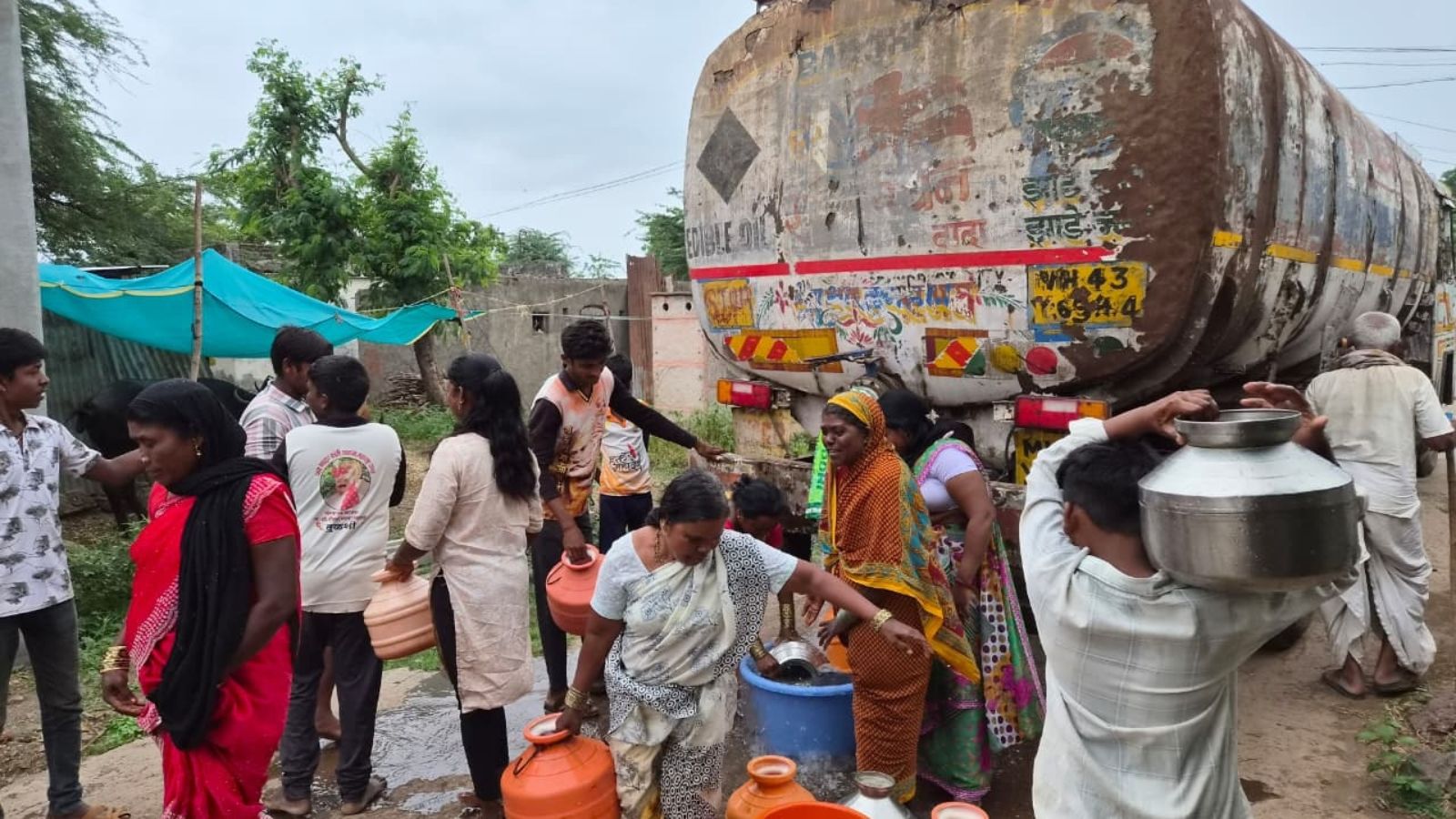
The water bodies in Tulshi now hold little or no water, while wells and lakes have run dry, Vasekar said. Four tankers supply drinking water to the village every day.
Villagers said they have depended on tankers every year and began demanding their deployment again from the last week of June. Residents also staged a protest on Ganesh Chaturthi, demanding an irrigation network.
“If a water pipeline network is constructed, at least six of the 14 water bodies can be filled, which would help greatly,” Vasekar said.
“The situation is so grim that people and even cattle are struggling for drinking water, even though it is only the end of September. We cannot imagine what will happen until the next monsoon.”
Many farmers in Tulshi had turned to dairy farming over the years, but the water crisis has now compounded shortages of fodder and drinking water for cattle.
Fed up with what villagers describe as repeated assurances and the lack of progress on the proposed canal pipeline network, residents put up the ‘Village for Sale’ boards to draw the government’s attention to their demands.
The water crisis is also affecting aspects of village life that are less visible in crop-loss figures. Villagers say families looking for prospective brides are increasingly reluctant to consider marriage proposals from young men in parched villages such as Tulshi, citing concerns over their financial prospects and access to water.
Rahul Gavhane, 30, who owns 107 acres of land, has been looking for a bride for more than five years. He said some families had rejected marriage proposals after visiting Tulshi and seeing the water situation.
“This is a hidden cost of the water crisis that is rarely acknowledged,” Gavhane said.
Gavhane, who holds a diploma, had worked with manufacturing companies in Pune before returning to the village after his father’s death. More than 30 acres of his land is under fruit cultivation, but he said the lack of water has made it difficult to sustain the orchards.
He also owns 30 cows and said arranging fodder and water for them has become a daily challenge.
“After repeated rejections, I have started losing hope of getting married,” he said.
The Indian Express contacted the Solapur district collector several times seeking a response on the villagers’ demands and the status of the proposed irrigation network. There was no response.
Shubham Kurale is a journalist based in Pune and has studied journalism at the Ranade Institute. He primarily reports on transport and is interested in covering civic issues, sports, gig workers, environmental issues, and queer issues. X:@ShubhamKurale1 ... Read More