
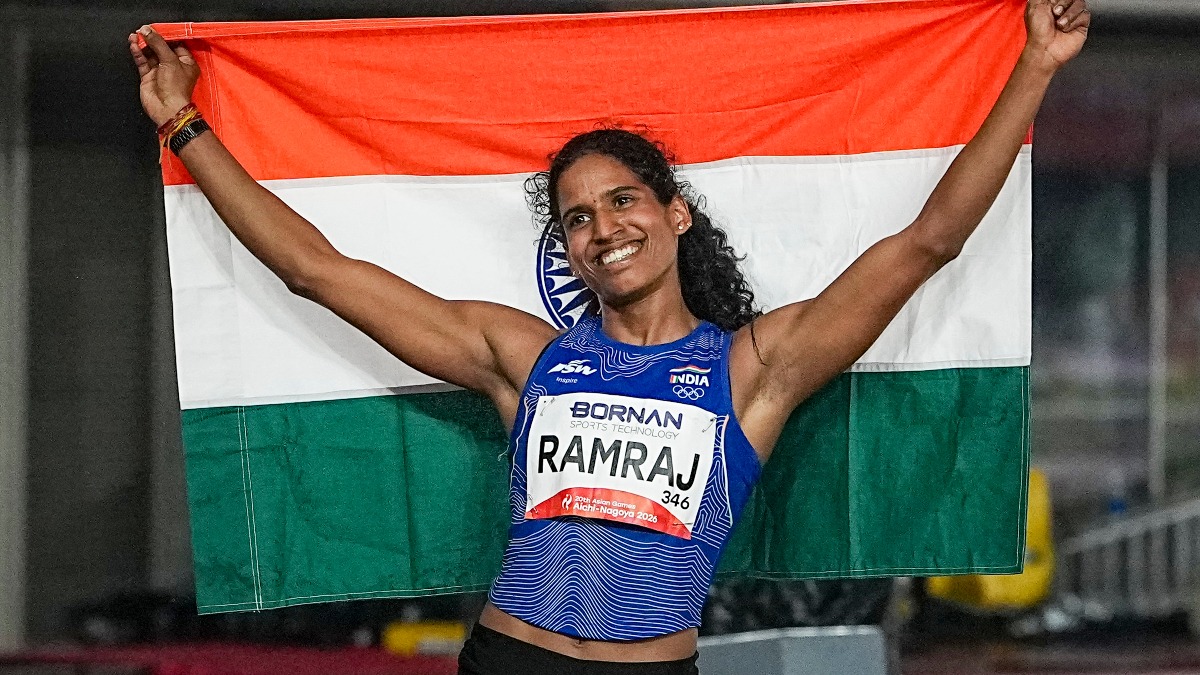
Vithya Ramraj raced the clock, not the medal, and made history at Asian Games
We get obsessed. All of us. But athletes? They take obsession to another level.
A milestone. A personal best. A medal on the biggest stage. These become the things that define you, especially when you're representing your country at an event like the Asian Games. The pressure is relentless. The world watches. The world judges. And if you don't win a medal, most people won't even remember your name.
So you chase the medal. You chase the record. You chase what the world tells you matters.
Vithya Ramraj could have done that. She could have walked into the women's 400m hurdles final on Monday, September 28, with her sights fixed on the bronze or the silver or PT Usha's 42-year-old national record of 55.42 seconds. Everyone would have understood. It would have made sense.
Instead, she did something different. She broke the problem down smaller.
She wasn't going to chase PT Usha's record. She wasn't even going to chase a medal. She was going to chase her own personal best. The one she'd set in 2022. The one that felt possible. The one that was hers to overcome.
"Medal is in our hands, but time is not," she said after crossing the line in 54.75 seconds, a bronze medal around her neck and a national record in her name. "This race will not come tomorrow or yesterday. Today is our day, so I was going for the timing, not the medal."
It was the simplest shift in perspective. And it changed everything.BREAKING HER OWN BARRIER
For three years, Ramraj had been chasing 55 seconds. Three years of training, of pushing, of believing that this barrier was the thing standing between her and her best self. Race after race, she'd come close. Race after race, she'd fall short. The number became real in a way that few things are. At 28, this was supposed to be her peak. This was when it was meant to happen.
Her coach Nehpal Singh Rathore understood what was needed. The obsession was real, but it needed direction. Before the final at the Asian Games, he didn't talk about medals or records. He gave her something concrete to chase.
"My coach said we would go 54 seconds," Ramraj recalled. "I did it, and I am so happy. The timing was so good, so I am very happy."
The strategy was elegant in its simplicity. Go fast. Maintain it through the sixth hurdle. Then from the sixth hurdle to the finish line, give everything. It was a blueprint. Not a medal strategy. Not a record strategy. A time strategy.
When she stepped onto the track for the final, the narrative of the race shifted. She didn't think about UAE's Mariam Kareem, who would eventually win gold with a Games record of 54.31 seconds. She didn't think about Kazakhstan's Adelina Zems, who would take silver with a personal best of 54.58. She didn't think about the legend in the stands.A NEW CHAPTER IN INDIAN ATHLETICS!Vithya Ramraj wins Bronze in the Women’s 400m Hurdles at #AsianGames2026, shattering legendary PT Usha's National Record in the process! A historic run that makes the nation proud.#Cheer4Bharat pic.twitter.com/IXCntDOoTH— Dr Mansukh Mandaviya (@mansukhmandviya) September 28, 2026
She thought about one number. One barrier. One time that felt possible because she'd worked towards it for three years.
She executed the plan exactly as Rathore had laid it out. For the first 300 metres, she was controlled, precise. At the sixth hurdle, she was still in the race, still chasing her target. The final 50 metres were where the real work happened. With her legs screaming and her lungs burning, she stopped thinking about technique or position or history.
When she crossed the line in 54.75 seconds, she'd broken her personal best, won a bronze medal, and shattered a 42-year-old national record in one moment.advertisementTHE WEIGHT OF LEGACYUsha was at the Games. The woman who'd set the standard in 1984 in Los Angeles, the woman who'd defined what was possible for Indian women's athletics, knew what Ramraj had just done. The record that had carried her name for four decades was gone.
It wasn't about chasing Usha's ghost. It was about chasing her own ceiling. And in doing so, Ramraj had also run into history.“I want three medals, tomorrow one is waiting for me”Vithya Ramraj reflects on winning bronze and setting a new national record in the women’s 400m hurdles pic.twitter.com/tRLw4Df0Qq— Olympic Khel (@OlympicKhel) September 28, 2026
This is what happens when you stop chasing what the world tells you to chase and start chasing what you can actually control. Obsession transforms into purpose. The medal came. The record came. But they came because she'd stopped looking for them.
Sometimes the biggest breakthroughs happen when you make your goal smaller, not larger.- Ends
Amar Sunil Panicker is a passionate sports enthusiast with a deep love for cricket, football, and MMA. A Manchester United supporter since 2004, he is also a firm critic of F1 as a sport.
