Volkswagen Mission Efficiency sets new benchmark for efficiency
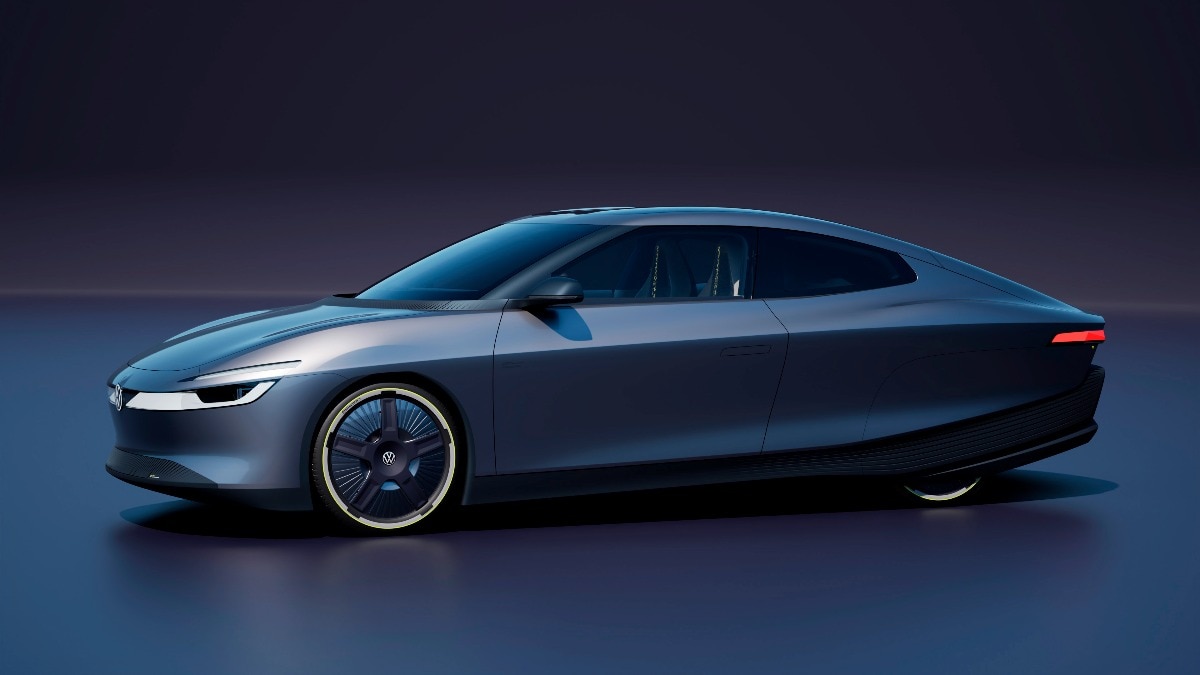
Volkswagen has unveiled the Mission Efficiency, a near-production electric car that claims to set new benchmarks for aerodynamic efficiency and energy consumption. Based on the automaker’s MEB+ platform and using production-ready technology, the prototype has achieved three world records.
The most striking figure is its drag coefficient (Cd) of 0.158, which Volkswagen says makes it the most aerodynamic road-approved car. Its streamlined body, small frontal area and extensive aerodynamic optimisation are designed to reduce energy consumption, particularly at higher speeds.
The Mission Efficiency also recorded 6.48kWh/100km during an idealised test at a constant 68kmph, with the air conditioning and other peripheral consumers switched off. More significantly, it achieved 6.89kWh/100km without charging losses and 7.51kWh/100km including charging losses over a real-world 1,278.36km journey from Wolfsburg in Germany to Vienna, Austria.
The long-distance test was completed at an average speed of 67.72kmph, with a top speed of 138kmph. Volkswagen says the car’s 54.9kWh net battery was charged only once, while it still had a claimed 164km of range remaining upon reaching Vienna.
At 4,775mm long and just 1,392mm tall, the 2+2-seater adopts a low-slung, teardrop-shaped design focused almost entirely on reducing aerodynamic drag. It features a small 2.08sqm frontal area, active cooling flaps, clad rear wheels, a fully covered underbody, frameless windows and flush door handles.
Volkswagen says the aerodynamic improvements become particularly significant above 80kmph, where the Mission Efficiency consumes more than 30 per cent less energy than the standard ID. Polo. At 140kmph, it reportedly requires roughly the same energy as the ID. Polo does at 100kmph.
The prototype also uses specially developed wheels and tyres. Volkswagen says its patented rim deflectors prevent air from entering the wheels and creating turbulence, while the flow-optimised wheel covers further reduce drag.
Working with Continental, Volkswagen has also developed a low-rolling-resistance tyre based on the EcoContact 7. With rolling resistance of 4.9kg per tonne, the tyre is claimed to be around 25 per cent below the threshold for the EU's highest tyre-efficiency rating.Production technology instead of exotic hardware
Despite its record-setting figures, Volkswagen says the Mission Efficiency is not a showcase for expensive, one-off technology. The car uses the 99kW (135bhp) electric motor and high-voltage battery from the upcoming ID. Polo, with the drivetrain designed for MEB+ models with front-wheel drive.
The prototype also uses production-derived suspension and braking hardware, although its rear axle gets a new electromechanical brake developed with AUMOVIO. Volkswagen says the system reduces friction losses and brake-fluid requirements while allowing greater flexibility in brake-force distribution and improving energy recuperation.Solar roof can add up to 30km of range
The efficiency push extends beyond the drivetrain and body. A 370W photovoltaic system is integrated into the glass roof and boot lid to power the vehicle's electrical systems. Depending on the season, location and weather, Volkswagen says the solar system can add up to 30km of real-world range per day.
Inside, the Mission Efficiency uses lightweight materials and a simplified cabin to keep weight down. Instead of a conventional infotainment display and speaker system, the prototype uses a smartphone or tablet and a portable Bluetooth speaker.
Despite its focus on efficiency, the car offers 481 litres of luggage space, along with additional storage beneath the rear seats and in the sides of the body. The rear seats are designed for passengers up to around 1.6m tall.
Volkswagen says the Mission Efficiency demonstrates how much further EV efficiency can be pushed using technology intended for large-scale production. The concept also draws inspiration from the Volkswagen XL1, the ultra-efficient plug-in hybrid launched in 2013.