Voyager 1 is now one light-day from Earth after 49 years of nonstop flying
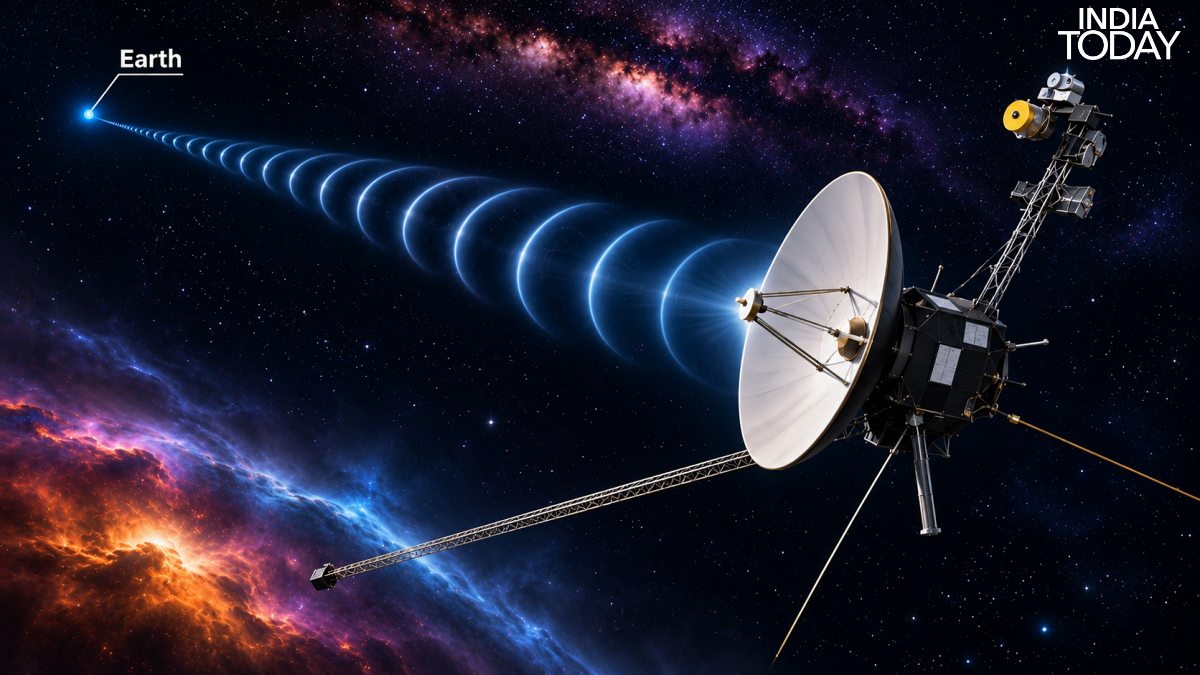
Nearly 49 years after leaving Earth, Nasa's Voyager 1 has crossed a milestone that puts the sheer scale of interstellar space into perspective. On November 18 at 3:46 PM IST, the spacecraft became the first human-made object to travel one light-day away from Earth, reaching a distance of approximately 25.9 billion kilometres.
But this is not a milestone measured in time. It is a milestone of distance.
A light-day is the distance light travels in 24 hours at approximately 3,00,000 kilometres per second. For Voyager 1, travelling at around 61,000 kilometres per hour, reaching this distance has taken nearly five decades.
The milestone also means that a radio signal sent from Earth will take approximately 24 hours to reach the spacecraft. Any response from Voyager 1 will take another 24 hours to return, making even a simple exchange with the spacecraft a two-day affair.
According to Nasa, Voyager 1 reached the one-light-day mark at 3:46 PM IST on November 18.A JOURNEY THAT BEGAN IN 1977
Voyager 1 was launched on September 5, 1977, just 16 days after its twin, Voyager 2. The two spacecraft were designed to explore the outer planets, taking advantage of a rare planetary alignment that allowed them to use gravitational assists to travel between worlds.
Voyager 1 flew past Jupiter in 1979 and Saturn in 1980, sending back remarkable observations of the planets, their moons and rings. Its encounter with Saturn's moon Titan also placed it on a trajectory that sent it out of the plane of the planets and towards interstellar space.
In August 2012, Voyager 1 crossed the heliopause, the boundary marking the outer edge of the Sun's protective bubble of particles and magnetic fields, becoming the first spacecraft to enter interstellar space.
It has continued travelling outward ever since.HOW IS 1970S TECHNOLOGY STILL WORKING?
Perhaps the most extraordinary part of Voyager 1's journey is that it is still communicating with Earth using technology designed nearly half a century ago.
The spacecraft does not rely on solar panels. Instead, it uses radioisotope thermoelectric generators (RTGs), which convert heat released by the radioactive decay of plutonium-238 into electricity.
However, this power supply is gradually weakening. As the radioactive material decays, the spacecraft produces less electricity every year.
To keep the mission alive, Nasa engineers have progressively switched off scientific instruments and non-essential systems, conserving whatever power remains for the spacecraft's most important operations.
The spacecraft also operates with computers and memory systems developed in the 1970s, long before modern smartphones and laptops existed. Engineers continue to manage the ageing systems through carefully designed commands sent across billions of kilometres.
Nasa has even developed creative engineering solutions to keep the ageing spacecraft functioning despite its deteriorating power supply and technical problems.
The agency hopes to keep the Voyager missions operating into the mid-2030s.A MILESTONE THAT PUTS THE UNIVERSE IN PERSPECTIVE
Reaching one light-day does not mean Voyager 1 is approaching another star. In fact, the nearest star system, Alpha Centauri, is more than four light-years away.
Voyager 1 is travelling towards the direction of the star Gliese 445, which it is expected to pass at a distance of about 1.7 light-years in roughly 40,000 years.
The spacecraft also carries the Golden Record, a collection of sounds, music, greetings and images representing life on Earth, intended as a message to any extraterrestrial civilisation that might encounter it.
As Voyager 1 crosses the one-light-day mark, it will not experience any physical change. But for humanity, it will represent something extraordinary: a machine built in the 1970s continuing to explore a universe whose distances are almost impossible to comprehend, and refusing to stop.
This is a developing story. It will be updated.- Ends
Sibu Tripathi heads the Science team at India Today Digital. A space geek, he writes on Science, Environment, and Health. He is a recipient of the prestigious Ramnath Goenka Excellence in Journalism award and a two-time winner of the WAN-IFRA Digital Media Awards. He has previously covered the Delhi government and written extensively on politics and city governance. Apart from travelling, he likes to cook when he has time and explore new genres of books and films.